Kitsap Humane Society at capacity, urgently seeking fosters
Published 1:30 am Thursday, August 7, 2025

The Kitsap Humane Society is once again operating at full capacity, and then some, with every dog kennel filled and overflow animals housed in meeting rooms and staff offices.
“We’re as full as we can be,” said Mike Bush, director of communications for the shelter. “There’s a dog living in my office right now.”
That dog, a sweet older lab mix named Freya, can’t be kenneled with others due to resource guarding issues. “She begs for beef jerky and will do anything for string cheese,” Bush added. “She’s the best, I love her.”
At last count, the shelter had 147 animals onsite, and that number was likely outdated within an hour. “I checked, and then I had a meeting. When I came out, we’d already had more animals come in,” he said.
On top of those housed at the shelter, another 150 animals are currently in foster homes, a vital support system that’s under major strain.
KHS has physical space for about 65 dogs and 120 cats. But with more than a dozen new animals coming in daily, either strays or surrendered pets, that space is constantly being shuffled and reconfigured.
“Our animal care team calls it Tetris,” Bush said. “They’re moving three cats over here, shifting two dogs there, it’s a crazy little jigsaw puzzle we’re running right now.”
Some spaces meant for meetings or staff use have become emergency housing for overflow. “We have dogs in offices, in meeting rooms, wherever we can safely place them,” he said.
Unlike cats, which can be grouped in colonies, or puppies from the same litter, adult dogs typically must be housed alone, especially large breeds. That makes it harder to double up and conserve space.
“We had seven big dogs come in within an hour just last week,” Bush said. “We’re dying for more foster homes that can take those dogs, even for a few days.”
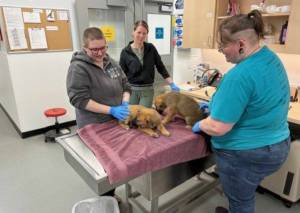
Each day before noon, staff and volunteers race to walk, feed, and clean up after every animal before the shelter opens to the public.
“It’s a giant undertaking,” Bush said. “What makes it harder is that for every animal adopted or moved to foster, we have another one coming in the same hour.”
The shelter relies heavily on volunteers, and not just for the basics. “They’re working very hard,” Bush said. “It’s a tough gig. It’s stressful, it’s hard, it’s messy, it’s smelly. But we couldn’t do it without them.”
“Every one of these dogs gets walks and playtime, but what they really need is time away from the kennel,” Bush said. “Some dogs are scared of barking. Some just don’t like the enclosed space.”
The foster process is simple: interested individuals fill out a form on the shelter’s website, complete some online training, and speak with a counselor. From there, they’re added to the list and contacted when a dog is in need.
“We’re always in need,” Bush said.
Though foster interest picked up after recent social media appeals, with 22 new fosters and 70 new volunteers signing up in one day, the shelter still can’t keep up with the volume of incoming animals.
Bush noted that animal shelters across the U.S. are seeing the same strain, particularly when it comes to large dogs.
“It’s a national problem,” he said. “We’re calling it the big dog crisis.”
KHS plans to join an upcoming summit hosted by the Association for Animal Welfare Advancement to explore broader solutions. But on the local level, the shelter is working to recruit more fosters and improve its own infrastructure.
Thanks to grants from the Millard Foundation and the American Society for the Prevention of Cruelty to Animals, 26 dog kennels will be renovated and resurfaced beginning in late September.
“It’s a terrific addition, but this is always going to be a challenge,” Bush said. “When the economy shifts, it gets worse. People start surrendering dogs because they can’t afford vet care, especially for older pets.”
While dog intake remains steady year-round, cat and kitten numbers spike sharply during the warmer months.
“This year, we’ve already had more than 500 kittens come through,” Bush said. “Right now, we only have 39 kittens onsite, but we’ve got many more out in foster.”
And while cats can often be housed together in colonies or placed in offices, they still require individualized care, especially when bottle feeding is needed.
Foster families, Bush said, are central to the humane society’s mission and its ability to function under pressure.
“It’s the backbone of what we do,” he said.
Some foster volunteers step up time and again, including one who routinely takes in up to eight kittens at a time, bottle-feeding them every two hours.
“These people are remarkable,” he said. “I couldn’t be prouder to work with them.”
Bush said he’s hopeful more people will answer the call.
“We’re going to find a way, we always do, but it’s increasingly difficult,” he said. “Every bit helps.”