
This one’s for the bucket list | Wesley Schulz
Published 1:30 am Friday, March 3, 2017



Every musician has a bucket list of composers or works that he or she hopes to perform at least once in a lifetime. Frequently these are works that are either rarely performed, difficult to play, challenging to put together logistically, or all the above.
I realize my list may be more obscure than others as I hope to conduct John Adams’ “Harmonielehre,” Edgard Varèse’s “Amériques” and Shostakovich’s “Symphony No. 7” at some point in my career.
But a common composer on these bucket lists, mine included, is Gustav Mahler: the late nineteenth, early twentieth century composer who brought Austro-German symphonic music to its zenith.
Mahler viewed the genre of the symphony as a vast musical landscape that “must be like the world. It must contain everything.”
When looking at the stage during a performance of Mahler one might think he meant it literally as well as metaphorically. In his biggest symphony there are nearly three-dozen brass players, hundreds of singers as well as the largest assortment of strings one can gather. His Eighth Symphony carries the subtitle “Symphony of a Thousand.”
Size, however, is not what makes Mahler’s music so magnificent. In fact, in regard to the large number of musicians frequently deployed in his works, what is impressive is how efficient he is in his orchestration. Some of the most beautiful moments of his music are when he utilizes a small number of musicians in chamber music settings.
When he does use everyone on stage it is usually to build to earth-shattering climaxes (listen for the literal “hammer strokes” in his Sixth Symphony). Mahler’s music is incredibly pleasing to perform as well as to hear. Every musician has a great part to perform, and the journey he creates for the audience can be exquisite.
I hope you will join us for one of two performances of Mahler’s Symphony No. 1 in D major. To help us with this performance I am proud to welcome the University of Puget Sound Symphony Orchestra who will perform side-by-side with the Bainbridge Symphony Orchestra.
To accommodate the increased size of the orchestra (more than 80 musicians on stage!) our performance on Saturday, March 4 will be held at Bainbridge High School.
You can hear the performance again on March 5 at Schneebeck Concert Hall on the campus of University of Puget Sound in Tacoma.
Mahler’s symphony is one that neither orchestra could perform on its own due to the large number of musicians required. Thus, this is a unique performance that brings two orchestras together to work in collaboration. Please join us; this is a concert for the ages!
The details
March 4 and March 5: BSO presents Mahler’s Symphony No. 1
Bainbridge Symphony Orchestra is delighted to team up with the University of Puget Sound Symphony Orchestra in this special presentation of Gustav Mahler’s magnificent Symphony No. 1 in D major.
Sponsors: Carly’s Rolling Bay Cafe and Wicklund Dental
Off-Site Performances: 3 p.m. Saturday, March 4 at Bainbridge High School and 4 p.m. Sunday, March 5 at Schneebeck Concert Hall, University of Puget Sound
Tickets (Saturday): $21 for adults, and $18 for seniors, students, military, and teachers; each youth receives free admission when accompanied by a paying adult 206-842-8569 or www.bainbridgeperformingarts.org;
Note: The Sunday concert is free for all ages.
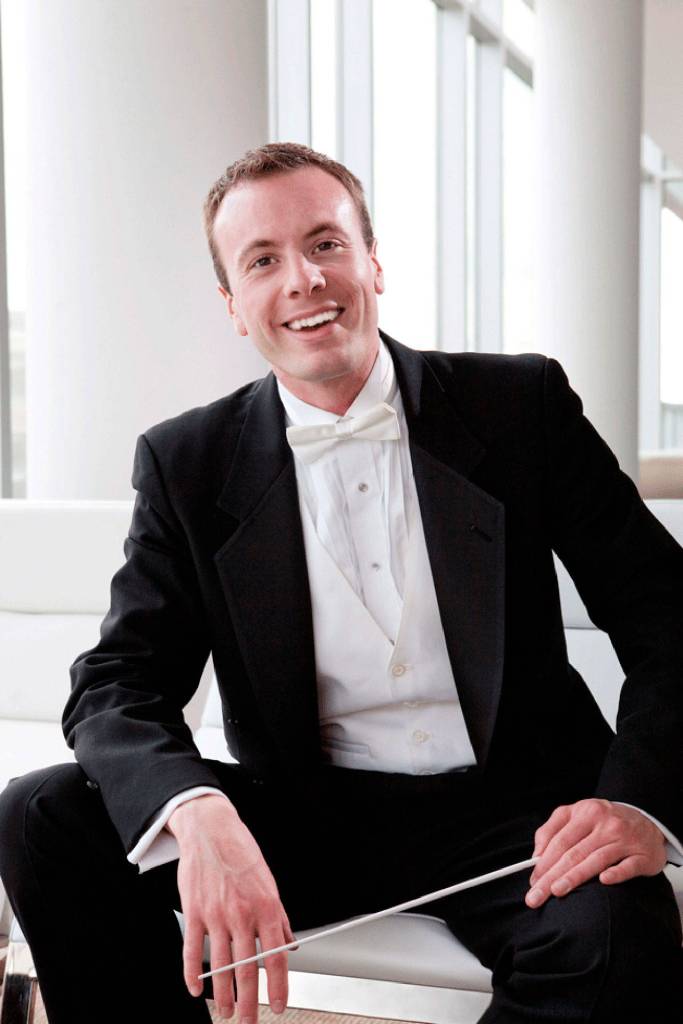
Wesley Schulz is music director and conductor of the Bainbridge Symphony Orchestra.




Best of Bainbridge
