‘Let it not happen again’: Political talk of discrimination ignites islanders
Published 11:24 am Saturday, December 19, 2015
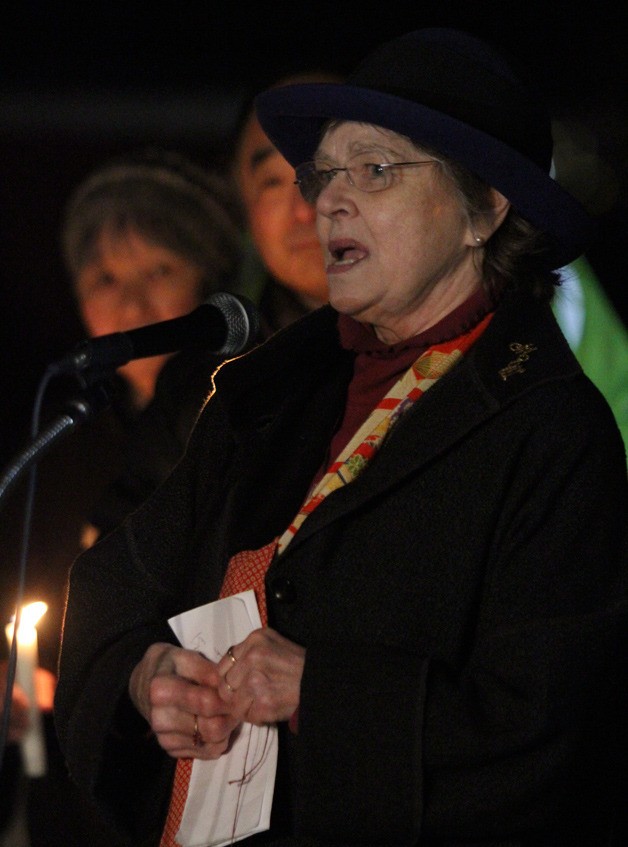
Mary Woodward looked out across the crowd that packed the Japanese American Exclusion Memorial, their many faces illuminated by the flickering flames of candles in the frigid night air, and was impressed.
Others would be, too, if only they could be there.
“I just really wish that my mother and daddy were here. They’d be over the moon to see this,” she said.
Woodward, of course, is the youngest daughter of Walt and Milly Woodward, the couple who bought the Bainbridge Island Review in 1940 and found themselves thrust into a lonely sort of fame the following year when Japan launched its surprise attack at Pearl Harbor and the United States was pulled into World War II.
The Woodwards famously stood by their island neighbors and friends — Japanese Americans, many of whom had lived here for a generation or more — as war hysteria swept the nation.
Mary Woodward recalled the newspaper’s front-page editorial the day after Pearl Harbor: “We’ve got folks living here who look like the enemy, but we know they’re not. Let’s not go off half-cocked.”
Talk of rounding up anyone of Japanese ancestry — including those born here — quickly followed Pearl Harbor, as did President Roosevelt’s signing of Executive Order 9066 in February 1942.
By the end of March, 227 island residents were assembled at the Eagledale dock amid a gauntlet of soldiers sent to the island to take them away — part of the first group of nearly 120,000 of Japanese ancestry who were eventually sent to internment camps.
Daily newspapers from Seattle to Everett and beyond supported the evacuation of Japanese Americans to the internment camps, with some adding that those taken away would never be welcomed back.
Not the Woodwards.
The couple stood firm, and continued to call attention to the ongoing injustice as the war continued from the pages of the Review. They also made correspondents out of those sent to the camps, and shared their stories with readers.
“Their issue was the Constitution,” Mary Woodward said.
But while many in the crowd at the Japanese American Exclusion Memorial were well familiar with the Woodwards’ story, Bainbridge Islanders found a new sense of urgency over the past week in recalling that troubled chapter in American history.
A candlelight vigil was hurriedly organized for Monday in response to recent comments by two candidates for president who called for people of Muslim faith to be banned from entering the country. The comments followed the recent terrorist attacks in France and San Bernardino, California.
The vigil was organized by Marsha Cutting, who recalled hearing the proposal to ban Muslims and immediately thought of Bainbridge’s own experience with discrimination.
“I was literally sick to my stomach. And when I heard a national presidential candidate repeat that sentiment, I really felt like we had to do something,” she said.
 Some people may think the idea is abstract, she said. It’s not.
“For those of us who live here, it’s real. It happened here. It was neighbors, coworkers, fellow students, friends, who, as you know, were taken away in the space of a week with only what they could carry,” she told the crowd.
“Thank you so much for showing up. Thank you for turning out to say, ‘Let it not happen again,’” she said.
Clarence Moriwaki, a board member for the Bainbridge Island Japanese American Community, said it was wrong to exclude another class of people from American soil.
“We who live on Bainbridge Island must speak up, as it was on our island that the exclusion of islanders of Japanese ancestry — two-thirds of them United States citizens — began,” he said.
“Here, from a dock on Eagle Harbor, island families were loaded onto boats for the first leg in their journey to imprisonment. This shameful event is memorialized at the Japanese American Exclusion Memorial at that same spot on Eagle Harbor,” Moriwaki said. “We have seared this occasion in our consciences, and have not forgotten this country’s misguided decision to discriminate against people who merely shared the face of one of our enemy nations during World War II.”
“We urge every citizen to remember this tragic event when our nation succumbed to fear, racial prejudice, war hysteria, and a shameful lack of political leadership, and say, ‘Nidoto Nai Yoni’ — let it not happen again,” he said.
The discrimination didn’t end with the war, recalled state Rep. Drew Hansen.
He recalled how returning Japanese American war veterans came home to find themselves excluded from the island’s veterans organization, so they created their own. He told the crowd of their visits each year to the state capital, and the thunderously warm welcome they receive each time from the legislature.
With many supporting the call to ban Muslims, he said, it’s apparent that some have forgotten our country’s history — and not just those in the Republican Party.
“It’s not some fringe opinion. It is shared, apparently, by a large number of voters in that party’s presidential primary. And it’s not just one party. You hear the Democratic mayor of Roanoke, Virginia looking back on the internment of Japanese Americans as a model of for how we should think about dealing with national security,” Hansen said.
“It does look like, at least in many places in this country, some people are starting to forget. And it’s very appropriate for us on Bainbridge Island, when people forget, to help them remember,” he said.
Organizers of the event read statements of support from U.S. Senator Patty Murray and U.S. Rep. Derek Kilmer.
Kilmer, during his first term in Congress, helped get a bill passed to rename Bainbridge’s memorial to more fittingly recall the internment of Japanese Americans.
“This memorial remembers every man, woman and child interned during World War II who had their American Dream frozen in time,” Kilmer said in his statement. “This memorial is a testament to how our community will be forever vigilant in fighting prejudice and discrimination.
“Our community has not forgotten what happened just a generation ago — when our values as Americans were compromised for a false sense of security in the face of global instability. It’s critical to keep all Americans safe and secure, but it is also important in times like these to remember our values and to continue to serve as a beacon of freedom for the world.
“We are showing that Bainbridge Island, Washington state, and the United States of America will refuse to exclude communities of people just because they practice a certain religion or come from a certain country of origin,” Kilmer added.