
Dear BSF, all I want for Christmas is 60 fetal pigs
Published 10:26 am Monday, November 9, 2015
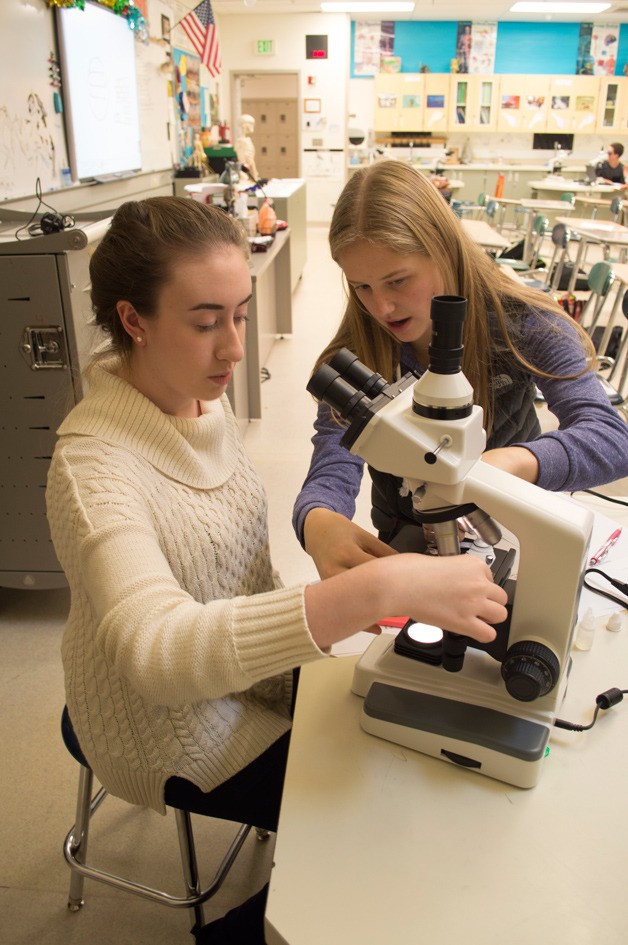
They develop vaccines; they construct synthetic skin; they perform open heart surgery — and then they head off to soccer practice.
Who is this cadre of scientists?
That would be Bainbridge High School’s Biomedical Engineering club.
Every other Thursday, they gather in Charisa Moore’s classroom to conduct experiments, collect data and design solutions to a variety of medical-related problems.
This month, Moore’s team of 90 partnered with the Center for Infectious Disease Research, formerly Seattle BioMed, in their Stage 3 trial for a malaria vaccine. Armed with brand new 1000x-power fluorescent microscopes, students counted the number of infected blood cells in mice exposed to the mosquito-borne disease — albeit, not without a few hurdles.
“We’re not sure if they’re specks or actual malaria contamination,” one junior said of the four cells her group counted.
Others, like Leah Potter and Ashley Alnwick, two of the club’s officers, struggled to see anything.
 Turns out the view can appear cloudy when lenses are loose.
But a third pair found their groove in the monotony; they were so immersed in their cells that Moore had to kick them out after the rest of the club had left.
“I’m like, ‘Really? You’re the less than 1 percent of kids that will have this job.’”
Those moments are the reason that Moore created the club in the first place.
“We sit in classrooms every day and kids don’t really have an idea of what’s career-related out there,” said Moore, who is also a biology teacher and the National Honor Society liaison. “So really it’s about exposing them to the industry in a really active way.”
Initially, she copied content from HiveBio, an open source laboratory located on the edge of the University of Washington campus of which Moore is a member. She’d watch professors, doctorate students run labs — a first go before taking them to the college setting — and think about how she might replicate them in her own classroom. She ordered cow eyes, fabricated parts using BHS’ 3D printer and invited her students to come play.
“Then it just evolved,” she said.
Kids kept coming back for her oddball experiments and demos, such as “How to build a microscope out of an iPhone.”
But lately, Moore has started to orchestrate her own projects by building relationships with local scientists. On the roster this fall: Ken Perry of Echobio, who will teach the club about implantable devices, and Dianne Hendricks, a UW bioengineering professor with whom several BME students collaborated this summer. Moore’s also hooked up with Amy Burton, a life science recruiter and fellow rower, to make connections with top specialists.
These industry partnerships are key, Moore said, as she seeks to turn the club into a full-fledged class with options for daytime internships at research centers like Fred Hutchinson Cancer Research Center or the Ben Towne Center for Childhood Cancer Research. Considering she just received approval to offer a biotech-related career and technical education credit, it would seem Moore is well on her way on the way to meeting her goal.
This year, she will lay a foundation for the course by encouraging her students to design and engineer a project centered around an unmet clinical need.
They’ll work in teams — Moore loves the diversity of her students, who enjoy separate interests in math, biology and chemistry; she stresses that, “No one person can do it all” -— to design a prototype and then test their design using fluid dynamics and open source software. They’ll present their work at an open forum next Spring.
Of course, none of this interactive learning would be possible without Bainbridge Schools Foundation and its Classroom Enrichment Grants. They’re the club’s sole source of funding, outside of the tech levy, which provided some of the lab equipment.
Last year, the nonprofit awarded $66,000 to 27 projects in seven schools, $4,000 of which went to Moore for supplies, including the aforementioned microscopes. In 2013, Moore received $6,000 from the foundation — the club’s initial seed money. And this year, she is hoping to reap just over $8,000 for new curriculum.
Seem like a lot? Fetal pigs alone rack up the bill, costing $22 a piece. And remember, Moore has 90 students, so she’s asking for funding for 60. Project Lead the Way biotech training, which would enable Moore to convert the club into a CTE-credit class, costs another $3,500. And there’s still dissecting kits, heart valve stints and mesh netting to be bought.