KRL to launch online access to Bainbridge Review’s wartime papers
Published 11:57 am Monday, February 9, 2015
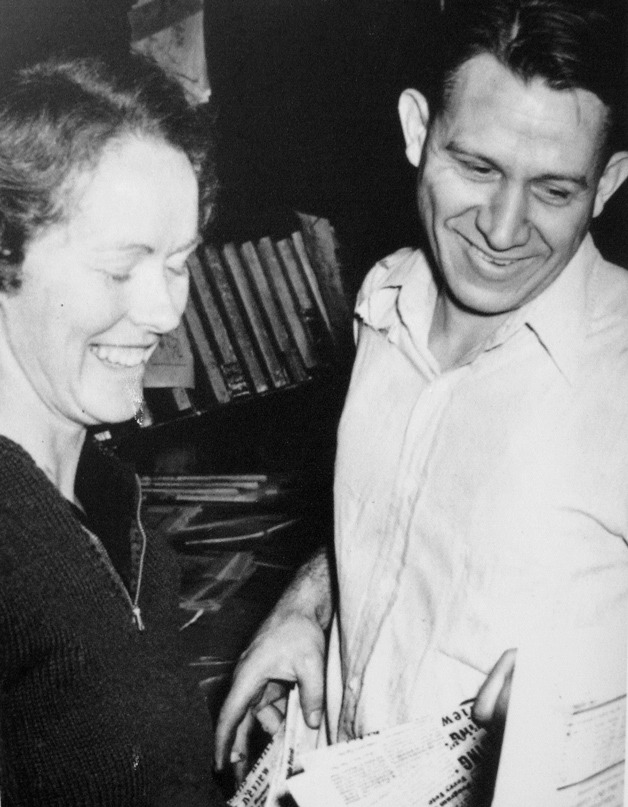
 Walt and Milly Woodward’s efforts to document life in America’s concentration camps will reach a new audience next week. It’s a dark part of history that local historians and fact checkers never want us to forget.
On Saturday, Feb. 14, the Kitsap Regional Library will launch online access to the contents of the Bainbridge Review newspaper published from 1941 through 1946. It will be the first time that these historic editions will be readily available to students, historians or anyone else interested in reading them.
The project has been three years in the works.
“Up until now, this historic local reporting only existed on microfilm,” said Rebecca Judd, manager of the Kitsap Regional Library’s Bainbridge location. “We had an opportunity to do a small-scale digitization project that has local, regional, and national significance.”
The editions were digitized from microfilm records, and the new version will allow readers to see each page of the paper during those years. A keyword search will be available on text of all stories, photo captions and advertising that were published.
The historical significance of the Review’s reporting lies in the articles published following the attack on Pearl Harbor. More than 200 Bainbridge islanders were the first of more than 100,000 Japanese-Americans sent to internment camps. Some of the families had been on the island since the 1880s.
Walt and Milly Woodward, owners of the newspaper, vigorously opposed the internment and published news from the island internees while they were in the camps.
According to KRL Library Director Jill Jean, an estimated 1,500 hours of work was spent on the project by more than 50 volunteers.
Library staff also contributed to helping with the project.
“KRL is happy to donate staff resources to coordinate this project,” Jean said. “This supports our mission. In this case, we want to be part of making an important part of our own history accessible to students and historians around the world.”
A new $15,000 microfilm scanner was purchased for the project with funds raised by the Kitsap Regional Foundation. The scanner will be available for the public to use as a microfilm reader/printer.
Over the last six months, volunteers took individual issues of the paper and compared the microfilm to the text files to correct errors from the scanning. In the process, Judd learned interesting tidbits from her volunteers who proofed the pages.
“We have shared funny stories, for instance, there is a bear that appears in no less than 20 articles over a span of three years — and poignant ones as well,” she said.
As the volunteer hours reflect, the project took quite some time. Unfortunately, documents had to be scanned twice, according to Judd, but a fellow staffer was able to help out during a critical time.
While the work might have been tedious, volunteer Charles Browne said he enjoyed spending time watching the project come to life and learned a bit, too.
“My knowledge and understanding of what was happening on Bainbridge Island definitely expanded,” he said. “It struck me how often, in early 1941 issues, Japanese-Americans were mentioned in so many aspects of the community — educational, cultural, social, agricultural, etc.
And then, following the exclusion, they disappeared almost completely from the pages of the Review except for the news reported of camp life … some editorials, some letters to editor, and in the lists of islanders serving in the armed forces.”
While the collection is quite extensive, it is far from complete.
A fire at the Bainbridge Review in 1962 apparently resulted in the loss of 11 editions of the newspaper during those years. The most significant missing papers are a special edition printed upon the news of the Pearl Harbor attack and the regular edition from Dec. 12, 1941.
Library staff are holding out hope that someone might locate an original copy of one of these editions of the Bainbridge Review. If copies can be found, they will be added to the online resource as soon as they can be scanned and indexed.
“We still have hope that someone might have these issues in a scrapbook or in an attic,” Judd added. “I am hopeful that someone might have the Pearl Harbor special edition in a scrapbook or memory box from the war.”
Access to these historic newspapers will be through www.krl.org/kitsap-history, and all documents can be printed individually. A complete list of the missing editions can be found on the site as well.
More to come
The release of this collection coincides with a number of programs on Bainbridge Island relating to these historic years.
Dear Editor: A Playreading of Letters to the Bainbridge Review – Saturday and Sunday, Feb. 21 and 22, 7:30 p.m. Bainbridge Public Library. Island Theatre actors present a dramatic reading of selected letters to the Bainbridge Review (and its predecessors) from 1877 to the recent past to illustrate the role of a local paper in community life.
The Japanese American Exclusion: An Evening of Films and Discussion – Friday, Feb. 27, 6:30 p.m. at Bainbridge Public Library. The Bainbridge Island Japanese American Community (BIJAC) presents three short films relating to the Japanese American Exclusion experience on Bainbridge Island, followed by discussions facilitated by BIJAC members.
Our Japanese to Enemy Aliens: Incarceration and the Role of the Local Press – Tuesday, March 10, 7 p.m. Bainbridge Public Library. Glenda Pearson, head of Microform and Newspaper Collections for UW libraries, presents a slideshow talk on how Seattle-area newspapers covered the bombing of Pearl Harbor and the exclusion.
“Snow Falling on Cedars”: Performances March 13 through March 29 by Bainbridge Performing Arts. Adapted from David Guterson’s novel by Kevin McKeon and Book-It Repertory Theatre. Against the backdrop of an America torn by World War II, cultures and communities clash when a Japanese American islander is accused of murder.