FEB. 10 SPECIAL ELECTION: Park bond opponents hammer away on tax issue
Published 1:59 pm Saturday, February 7, 2015
Taxes and parks.
Opponents of the upcoming $5.9 million bond measure to buy nearly 23 acres of land along Madison Avenue to create a central park for Bainbridge Island say they have enough of both already.
Those fighting the park land purchase are mostly leaning on the issue of taxes, however, as they try to convince voters to reject the Feb. 10 ballot proposal.
Critics of the proposal have complained that the purchase will result in an increase in the tax bills of Bainbridge property owners while also removing nearly two dozen acres of land from the tax rolls.
“I’m a taxpayer, I’m a senior and really love living here, but I’m seeing taxes all over the place,” Jean Capps, chairwoman of the Committee Against the Measure, told the Review.
Capps said the Sakai property that’s eyed for purchase is overpriced, and noted the assessed value was well below the $5.9 million that the park district would spend to acquire the land.
If people want the land as a park, they should help the Bainbridge Island Land Trust raise money for the purchase, she said.
“That doesn’t burden us as taxpayers for something that I feel is nonessential. We need to take care of our roads and our schools,” she said.
The island also has plenty of parks, and creating a new one on the Sakai property would mean the removal of nearly 23 acres from the tax rolls, Capps added.
Other critics of the park proposal have also raised the issue of the impact of removing the land from the property tax rolls, and Capps estimates the property would bring in $400,000 in taxes every year if the land were developed.
Supporters of the parks bond dispute those claims, however.
A review of tax statements for the two Sakai parcels also shows that the land currently provides only a minuscule amount of taxes for local governments.
In 2015, the total property taxes for both of the Sakai properties is $20,079. Most of those taxes — approximately $6,255 — will go to Bainbridge schools.
The next biggest chunk goes to the state of Washington: $4,128.
The rest of the $20,079 of the tax collections from the Sakai land go to Kitsap County ($2,279), the city of Bainbridge Island ($2,526), Bainbridge Island Fire Department ($2,396), Bainbridge parks ($1,443), and the Kitsap Regional Library ($739). The current tax bill for Sakai also includes utility district taxes that total $157.
Jason Shutt, co-chairman of People for Parks, said the tax concerns raised by opponents of the bond measure are off-base.
Numerous studies have been conducted that show land developed with residential housing does not boost the budgets of local governments, Shutt said.
Instead, governments end up subsidizing residential development as costs and demands for services grow along with the increase in population that new housing projects bring.
“Cities end up losing money on the deal. It just costs more to maintain housing than it brings in for taxes,” Shutt said.
Proponents of the Sakai measure also readily note that the purchase price of the property is not based on the current value of the land as set by the county assessor.
Instead, the land value was determined by studying its potential for “highest and best use,” which includes the zoning and location of the property as well as its development potential for more than 100 residential homes.
The appraisal, conducted by Re-Solve, a property appraisement firm based on Bainbridge, said the Sakai property was “significantly under-assessed.”
“Judging by the amount accorded to the home on the property, the assessor appears to be treating the subject [property] as a single-family estate, with little or no value assigned to the zoning or development potential,” the report notes.
The appraisal was made in October after inspections of the property last year.
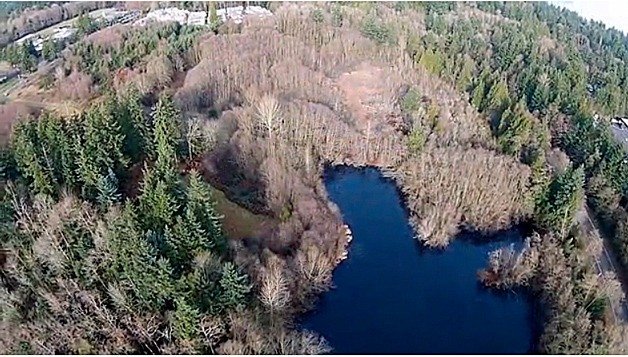
The 22.87-acre property actually consists of two parcels; a 9.51-acre piece to the north, and to the south, a 13.36-acre piece that includes a 2.2-acre lake.
The appraisal that was done on the property notes that it has “substantial development potential” with excellent access to major arterials, and its well-situated because of its location near the downtown and the ferry terminal.
The acreage is the largest remaining suburban style (mid-density) housing property on the island.
The appraisal adds, “It is an unusually large property for such a close-in location with R-8 (eight units per acre) zoning. It is unique in terms of its size and zoning within the Winslow market, and it is expected it would attract significant interest if made available for sale.”
The appraisal also noted that a home and former farm building are already located on the land, “but do not materially contribute to the value of the site.”
City officials have said the property could be developed with approximately 105 homes, which could be built in clusters on the acreage close to Madison Avenue.
Projects other than homes could be built with a conditional use permit — including churches, schools, medical clinics and senior centers — but the appraiser said any purchase price would have to be competitive with residential development.
The appraisal report also noted, however, that the Sakai family has received unsolicited interest from commercial and institutional users about the property, and that interest led the family to consult a broker and retain an adjoining lot just north of the land being sought by the park district.
The only development on the land is a single-family home on the southern parcel that was built in 1966. The park district has agreed to allow the use of the home by Paul Dean Sakai as a life estate, where Sakai would be able to continue to live until the property is transferred over to the park district upon his death.
Bruce Weiland, co-chairman of People for Parks, said that assessed values of properties often vary significantly from the actual value at the time when land is sold, especially for undeveloped properties.
The 3-acre property where Harrison Hospital built its new urgent care facility, Weiland pointed out, was purchased for four times the assessed value.
Weiland said islanders won’t see a net increase in their property tax bills, because the new levy would be offset by the expiration of the bonds for Gazzam Lake and the Grand Forest that were paid off in 2014.
A supermajority vote is needed for the parks proposal to pass. The measure must get 60 percent approval from voters, and the turnout must be 40 percent of the 2014 General Election.