Gertie Johnson Road residents evacuate due to landslide
Published 10:56 am Monday, March 14, 2011
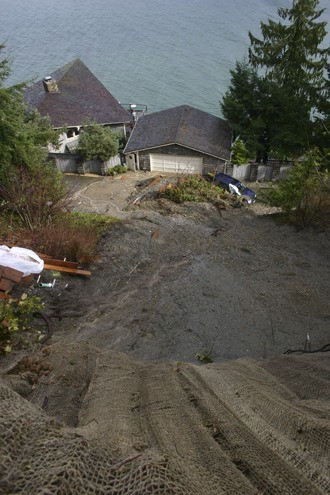
The hope is for a few days of dry weather so the city can soon remove an estimated 280 cubic yards of hillside off Gertie Johnson Road.
That should allow the five families living on the water side of the 12-foot-wide road to eventually return to their homes.
And maybe the city can then fix the road, which in parts is slumping eastward along a deep, 150-foot-long crack that has worsened since two mudslides fell on it inside of a four-hour window on Monday morning.
Still, after more than three years of travail and constant worry about the unsafe road and a tenuous hillside looming over their homes, residents of Gertie Johnson Road are having a little trouble seeing the light at the end of the tunnel.
The two slides, caused primarily by heavy rainfall last Sunday and Monday, led to the city evacuating residents of the five homes on the downside of the road for purposes of safety and city access.
Interim City Manager Brenda Bauer said Thursday that the city will have to wait to see if there is any precipitation for a couple of days before it can go in and remove the material.
“We’ll have to limit the weight of the equipment used to remove it because of the condition of the road,” Bauer said. “When it’s accessible, then we’ll decide about people returning to their homes and what we will do about the road.”
No one was injured, though an elderly couple needed to be transported by the city’s police boat because of difficulty traversing the mudslides. The only material damage was to a car that was caught up in the first slide, which occurred around 5:45 a.m. Monday.
“We had to leave early so I went up to the parking area to get the car because it was raining heavy,” said Joel Levin. “I went in to get Mary (his wife) and when I came out, maybe two minutes later, my car was in two feet of mud. I was able to drive out of there, then went back and called 911 and our neighbors.”
The second slide, which was less spectacular than the first but heavier with large amounts of vegetation, occurred in the general area of the road failure at about 10 a.m. By that time, residents had been evacuated and the city had cordoned off the road where it turns southeast parallel to the Rolling Bay shoreline.
“While we were there this morning another part of the hillside slid,” Interim City Manager Brenda Bauer emailed to Neal McCulloch of the Seattle-based geotechnical firm Shannon & Wilson, which did a lengthy report on the hillside in 2008. “We do not feel it is safe at this time for our crews to clear the landslide materials at both sides. We have evacuated residents based on conversations with the Fire Department. The two slides block public safety access.”
Levin said he spoke to McCulloch and that the scientist didn’t think either slide “was a serious event, geologically speaking, that it was not a major disturbance.”
McCulloch said in an email that the early-morning slide consisted of “soil retention structures and landscaping that was constructed prior to October 2009,” occurring in an area where movement was observed following heavy rains in early December 2010.
“In my opinion,” he wrote, “the upper 18-24 inches of soil became saturated and unstable with the heavy rainfall, resulting in the slide,” which left the top of the cliff above the road “over-steepened.” However, he didn’t see signs of recent instability on the hill above the road “and there were no visible bulges or signs of recent instability adjacent to the recent slide area.”
Levin thinks the deteriorating road, which residents above and below it had described in an email sent to the city the day before the two slides, may have had a part to play in both mudslides.
“The road itself is a big problem,” he said. “There’s water going into the road’s underbed, which weakens the road and the toe of the hillside, too.”
Of course, there’s a lengthy history of problems on the cliff and hillside not only along Gertie Johnson Road, but also above the Rolling Bay Walk road, which ends only about 150 yards south of the Gertie Johnson Road’s dead-end.
The worst of the Rolling Bay Walk slides include:
• On Jan. 19, 1997, a huge landslide demolished a Rolling Bay Walk home at its north end, killing Dwight and Jennifer Herren and their two young sons.
• The previous April 1996, two landslides caused two dozen families to evacuate in the area and one home skidded across the Rolling Bay Walk onto the concrete seawall. No injuries were reported.
• In April 2003, a slide knocked an empty home off its foundation and almost into Rolling Bay. It was the fourth home destroyed in six years and the homes remain unoccupied.
Residents along Gertie Johnson Road have been fortunate in that there have been no injuries nor damage to their homes during several slides that have occurred since Dec. 3, 2007.
After that slide, the city decided it was time to red-tag the five homes below the road, an action that would have led to evacuation either on a temporary or permanent basis because it was deemed unsafe for them to occupy their homes. A consultant for the city said the hillside was unsafe and recommended that the residents be evacuated under the auspices of a red tag.
City employees showed up with red tags in hand three days after the slide, but were eventually talked out of it by the Levins and other neighbors.
“We asked for 24 hours so we could get a geotechnical opinion from someone else,” Levin said this week. “Shannon & Wilson came and said they didn’t think the hillside was so fragile we were in imminent danger. So we agreed to have them do a report on it for $50,000 over several months.”
The study determined that while periodic high-volume rain events may trigger landslides, measures such as drainage provisions at the top of the slope and construction of retaining/catchment walls at strategic locations would reduce the potential for landslides on the road and residences below it.
“Everyone needs to work together on this,” Levin said, “and we have been doing that. We need to do more, but we’ll be OK if we get the road fixed to ensure proper drainage down here. The city has been very cooperative and we appreciate that. But there’s more that needs to be done so we can stay in our homes.”
It was the cliff bordering Hal Moore’s house, where he has lived 11 years and he estimates as being 35 years old, that sloughed off onto the road below.

“I’m not surprised,” said Moore. “Most people on the bluff, including us, have been trying to do things to stop slides. But when it rains like that there’s not much we can do.”
Moore said it’s no secret that the houses located below are in danger whenever there’s heavy rain during the early spring months. Most of them don’t have protective walls, and are built between the water and the road.

Jessica Hoch contributed to this report.