From a noble calling to a Nobel Prize
Published 3:43 pm Sunday, April 27, 2008
At 16, Edmond Fischer told his family that he wanted a microscope for his birthday. He expected a toy; instead, one of his brothers procured a professional Leitz device from a secondhand store.
“With this microscope, now we can solve all the problems of the world,” he told a friend.
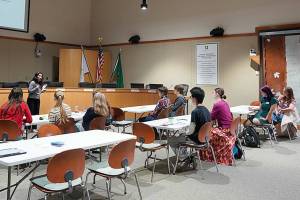
It’s fair to say that Fischer, a resident of Seattle who much later in life went on to win the Nobel Prize for Physiology/Medicine, got farther than most. He’ll discuss his discoveries and his history as a biochemist in the upcoming “Scientists in Our Midst” talk Wednesday evening at Woodward Middle School.
Fischer’s scientific spark developed early, as he devoured books by and about scientists he calls “the microbe hunters,” including Ignaz Semmelweis and, in particular, Louis Pasteur.
“In this country, you would call him my hero,” Fischer said.
Fischer and his two brothers began life in Shanghai, China, where his father was head of a large international law firm.
Believing their sons would achieve their educational and professional goals more readily in Europe, the Fischers sent their sons back to their home country of Switzerland; Fischer attended boarding school in Geneva. While traveling on break with one of his brothers, he found himself playing tourist alone for the first time in Paris.
“The first thing I did the first day, of course, I went to look at the Eiffel Tower. And then I went to the tomb of Napoleon. And then I went to the tomb of Pasteur at the Institute Pasteur. To me, the Institute Pasteur was Shangri-La,” he said.
Fueling Fischer’s already bright interest in science was his father’s death from tuberculosis. Which brings the story roughly up to the time he acquired that microscope and proclaimed his intention to save the world.
To do that, Fischer and his friend first needed space. They rented a tiny attic room for 16 Swiss francs per month, roughly $4. In addition to Fischer’s microscope, they got their hands on an autoclave and other necessary equipment, and even some bacteria samples to work on – although Fischer would prefer not to go public with how.
And although Fischer, also a talented pianist, had at one point considered music school, his collaborative extracurricular work that year led to a grand choice.
“We realized that if we wanted to do some serious research – particularly tuberculosis, polio, the other diseases that devastate our population – one of us should go into medicine and the other should go into science. And we drew straws,” he said. “I drew science.”
While his friend eventually went onto a career as a physician rather than a researcher, Fischer worked toward his Ph.D in organic chemistry, recommended to him as the best route toward bacteriology. His thesis on enzymes, those catalysts in every body that regulate cellular processes, set him up for his life’s work and the kernel of his subsequent Nobel Prize.
This he won for his discovery with University of Washington colleague Edwin Krebs of reversible protein phosphorylation. Through this process, a protein kinase, a type of enzyme, moves a phosphate group from an inactive to an active state, and back again. Fischer likens enzymes to traffic lights that tell these processes to go ahead, slow down or stop. While those processes typically obey traffic laws, they do sometimes become deregulated.
If it sounds inscrutable to a lay person, Fischer sums up the discovery’s significance.
“The importance is that (reversible protein phsophorylation) is the most general regulatory reaction that takes place in the body. Secondly,” he added, “almost 80 percent of cancers are caused by a deregulation of the kinase.”
While Fischer’s education and professional path required patience, rigor and focus – all the hallmarks of a successful researcher – he’s also a believer that unstructured time is of critical importance to creativity, another key ingredient in scientific success.
Isaac Newton, he points out, went back to his childhood hamlet of Woolsthorpe-by-Colsterworth in England for two years when Cambridge University was closed down as a precaution against the plague.
“That’s when the ideas came,” Fischer said.
He added that he himself never played piano as often or as vigorously as when he had an exam to prepare for.
These days, Fischer, now 88, doesn’t get to play piano very often because he’s rarely home. Recent and upcoming itineraries included France this past winter, where he was a witness in a court case on behalf of the Institute Pasteur; visits to Greece and to Spain, where he will sit on a panel of judges for it annual science award; and yearly visits to China.
As for Wednesday’s talk, Fischer says he doesn’t speak to kids often and in many ways finds it more difficult than speaking to scientists. But he’s happy to do it, especially with a grandchild on the island.
And who knows, perhaps some young scientist will hear what he has to say and experience a spark – it would be fitting.
“That’s one of the things about the Nobel,” Fischer said. “They recognize you for getting the ball rolling.”