
In every building, a different shade of ‘eco-green’
Published 4:00 pm Wednesday, March 21, 2007
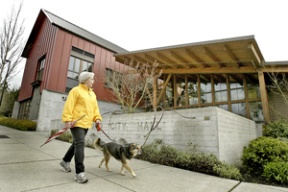
Volunteers, the city team up to draft a new code promoting ‘sustainable’ construction.
Green by Design:
This is the second in an ongoing series on “green building” initiatives on Bainbridge Island.
For more information on Sustainable Bainbridge’s effort to craft a city green building ordinance, contact Ryan Vancil at 842-7811.
The black and white of city building code may soon take on a green hue.
City officials, environmentalists and building design experts are teaming up to craft an ordinance that could make fast-sprouting condos, offices and shops along Winslow’s streets grow with the earth’s health in mind.
“Building ‘green’ means we save energy, we protect the land, people stay healthy, and we build more cost effectively and save money,” said Barry Peters, co-founder of Sustainable Bainbridge. “It’s time Bainbridge benefited from standards in green building and design.”
Sustainable Bainbridge is drafting possible rules that could mandate or encourage environmentally sound construction.
The group is modeling its proposal after green building rules adopted by other municipalities – such as Austin, Texas and Portland, Ore. – as well as national standards used to certify eco-friendly construction.
Advocates of green building techniques say homes and offices can save money over time. On average, such buildings use 30 percent less energy than conventional buildings, according to one study, and can alleviate some of urban growth’s impact on the natural environment.
While the city recently budgeted $50,000 to develop a green building ordinance, staffing constraints will likely leave much of the preliminary work to volunteers like the Sustainable Bainbridge group.
“I’m glad they’re working on this,” said Sandy Fischer, manager of the city’s downtown planning initiative. “In Winslow Tomorrow, we’ve always talked about downtown growing greener as it grows taller.”
Sustainable Bainbridge’s proposal will undergo a review process once planning staff are available.
“We can’t write city code outside City Hall,” Fischer said. “But once staff positions are filled, then we can (make) a schedule for this.”
Funding earmarked for the project will likely go toward consultant review or related staff training, Fischer said.
New city Planning Director Greg Byrne said he has not yet reviewed Sustainable Bainbridge’s proposal, but supports the concept.
“I’m a believer in sustainable practices,” he said. “I think it’s a good idea and we’ll see how it progresses the rest of the year.”
According to Peters, Sustainable Bainbridge isn’t “reinventing the wheel” as it crafts it’s proposal.
The group produced a “quick and dirty” draft last year based largely on Kitsap County’s “Built Green” program and an ordinance adopted by the city of Austin, Texas, in the early 1990s, said Ryan Vancil, an attorney serving on Sustainable Bainbridge’s green building action committee.
The county’s 10-year-old voluntary program has certified over 100 homes using a voluntary checklist limiting paved surfaces, protecting trees, filtering rooftop runoff and other features.
Austin’s program was the country’s first comprehensive approach toward encouraging green building techniques in residential, commercial and municipal construction.
Construction projects reviewed by Austin’s Green Building program receive a rating of one to four stars, depending upon the degree to which a building incorporates energy- and water-efficient designs, conserves building materials and reduces solid waste.
In return, builders receive marketing, rebates and technical assistance. More than 3,000 Austin homes have been rated under the program’s guidelines.
Vancil is also incorporating a group of green building standards known as LEED, for Leadership in Energy and Environmental Design. Crafted by the national Green Building Council, LEED standards have been used in a wide range of buildings – from University of Washington campus extensions to a business center in India.
“We’re looking at using LEED and we’re taking a more comprehensive approach,” he said, adding that adoption of such an ordinance would make the island one of the first communities in the state to do so. “Bainbridge will be on the cutting edge, like usual.”
LEED presents builders with a menu of environmentally friendly practices to choose from, including energy efficiency, water conservation and the use of recycled materials. Credits can also be awarded for using natural light and ventilation or paints, carpets and other features that reduce chemical emissions.
LEED certification was recently mandated for most new state buildings, making Washington the first state in the country to require high performance green building standards.
Vancil would like to see Bainbridge’s green building ordinance feature some of the state’s guidelines, with commercial, residential, industrial and public buildings included under the ordinance. But a key question is where and when the ordinance should mandate green building rules, and where it should coax them out of developers using incentives or suggested guidelines.
“Having (the ordinance) spread out among all different projects would be great,” Vancil said. “We want to do it right, so we’re talking a lot about this being multi-faceted, with some incentives, some requirements and some guidelines that just send a message to developers.”
Vancil said a “cross-section” of interests are represented in Sustainable Bainbridge’s green building committee. The group includes two architects, an environmental activist, a sustainable design expert and real estate agent Satu Muldrow.
“We can’t go wrong with this,” said Muldrow, who works for Windermere Real Estate. “We’re making homes more energy efficient and using less toxic materials. I think more people are becoming interested in that.”
Sales of the Vineyard Lane condominium project on State Route 305 are a testament to that, Muldrow said. As one of Vineyard Lane’s key sellers, Muldrow found a strong market for the development thanks, in part, to its green features, including energy-efficient water heaters and water-conserving toilets.
Another member of Sustainable Bainbridge’s green building committee, Jason McLennan, said earth-friendly homes and offices fit the desires of both nature lovers and the fiscally frugal.
“The long-term benefits on both sides are huge,” said McLennan, who also serves as CEO of the Green Building Council’s Northwest chapter.
“There are cost premiums (during design and construction), but each year those costs are diminished, so you have financial benefits as well as the ecological ones.”
McLennan points to a study sponsored by the Massachusetts Technology Collaborative and other groups that found LEED-certified buildings consume about 30 percent less energy than standard buildings. As an example, the study listed $60,000 in annual savings for a 100,000 square foot office building.
The Washington Board of Education estimates that the use of green building designs will cut public school energy costs by 20 percent. The board expects to see an additional 20 percent reduction in water costs and a 22 percent cut in construction waste.
The local effort to enact a green building ordinance could allow Bainbridge to “leapfrog ahead” of other cities that have limited or very narrow green building requirements, McLennan said.
“Bainbridge needs to take the lead in this area,” he said. “More and more communities are doing this kind of thing. We need to ratchet this up. It’s realistic and it works.”
********
Good example
City Hall could prove to be fertile ground for a proposed “green building” ordinance.
Built in 2001 on the site of a former gas station, the Madison Avenue lot now boasts a 24,000 square-foot example of many earth-friendly building techniques. The building features:
• 70,000 board feet of certified “responsible harvest” wood.
• Insulation made of 25 percent recycled glass
• Wallboard made of 18 percent recycled material
• Acoustical tile made of nearly 70 percent recycled fiber.
• Porous paving to increase groundwater filtration.
• Large amounts of natural lighting
• Energy efficient heating and cooling systems.
• Low-toxin paints, stains and flooring adhesives.