
Good fortune in rice cakes
Published 8:00 pm Wednesday, January 10, 2007
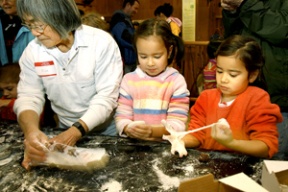
Mochi making carries on a tradition brought to Bainbridge from distant shores.
Ed and Carmen Brooks drive their wooden mallets in rhythm, pounding streamed rice into a doughy ball.
Shoichi Sugiyama’s hands dart under the mallets to pull, slap and fold the rice cake.
“Hey! Ha! Hoy-ah!” he screams, keeping the beat until Ed and Carmen had beaten the white mass to a silky consistency.
Carmen passes her mallet to the next volunteer, grins and breathes a sigh of relief.
“It was great, but I was terrified I was going to hit him,” she says of Sugiyama and his fast-moving hands.
“Nah,” says her husband with a shrug. “You just gotta focus.”
The Brooks couple of Lakewood were twp of about 1,000 people who gathered Sunday for the island’s 18th annual mochi tsuki festival. Held at the IslandWood learning center, the event was organized by the Bainbridge Island Japanese American Community.
Mochi is a sweet rice cake that has, for over a thousand years, heralded good fortune at the start of a new year.
The son of a U.S. serviceman and a Japanese woman, Ed remembers making mochi when he was a child growing up near a military base in Japan. On Sunday, he passed the mallet on to his father.
“It’s neat,” said Carmen as Ed gave some pointers to his dad. “He and his mom used to do it. Now he gets to show his dad.”
Passing on tradition among family is the whole point of the festival, said Mike Okano of Hansville.
“It’s how our ancestors were brought up in Japan,” he said. “It’s a gathering, both spiritual and cultural, for the Japanese community.”
“Mochi tsuki” means “to make mochi.” The food is a traditional offering during numerous Japanese religious holidays, harvest celebrations and to honor the birth of a family’s first son.
On New Year’s Day, mochi is typically pounded and molded into simple disc shapes. Sometimes, the mochi is placed on white paper – a symbol of purity – and topped by bitter fruits, which signify longevity.
Mochi is made by first washing and soaking white rice overnight. In the morning, it’s steamed in wooden boxes over an open fire until sticky and porridge-like.
While hot, the streamed rice is poured into an usu, or stone mortar.
“Then we pound it ‘til it’s smooshes to one homogenous blob and then we pound it some more until it’s silky smooth,” said Keith Uyekawa of Bainbridge Island.
A brave attendant dips his or her hands into the mortar to turn the mochi between strikes. The turner and pounders must achieve a consistent rhythm to avoid injury.
“The mallets are a little unwieldily, so if it hits, it’s gonna hurt,” Uyekawa added.
The finished product tastes pretty good, said Patrick Fletcher, 8, of Gig Harbor, as he munched mochi tinted with green tea. But the thrill is in the making of it.
“It was sort of scary,” he said. “I was afraid those guys were gonna get crushed.”
Once pounded, the mochi is rolled and pinched off into egg-sized pieces. Potato flour is patted on the surface to prevent sticking while bean paste is sometimes added to the center.
Crowds followed the steaming rice dough from the pounding tent to IslandWood’s dining hall, where mochi makers formed an assembly line to craft the confection.
As a taiko drumming group beat a thunderous beat nearby, author Helene Gabel Ryan sat quietly by a fireplace.
She signed copies of her book, “Hakujin,” which traces the fictional love story between a white girl and a Japanese boy during World War II in the Northwest.
Ryan, 88, smiled as she watched the mix of ages and cultures enjoy the festival.
“It’s so nice to see these feelings among families,” she said. “When I grew up in Seattle, people were so prejudiced. I remember quite well the mochi-making, but there was no coming together or getting acquainted with the Japanese people. It’s amazing how different people are now.”