Study: ferry funding in state of flux
Published 3:00 pm Saturday, January 6, 2007
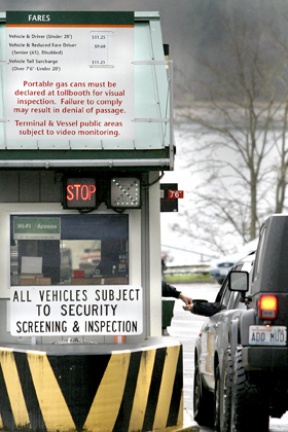
Surcharges for ‘peak hour’ rides could be the next revenue move.
Ferry fares will continue to rise, as will concerns about the future of Washington State Ferries’ capital projects and its overall solvency, a new report says.
“The capital needs of the ferry system are large, perhaps of a size which is yet totally to be determined,” said state Secretary of Transportation Doug MacDonald, in response to the report, presented Wednesday in Olympia to the Joint Transportation Committee. “And we don’t know how to pay for it.”
A possible reservation system for riders, and higher fares for those who take the boat during peak commuter times, are among the suggested solutions to WSF’s financial woes.
Charging higher peak fares would spread ridership more evenly throughout the day while increasing revenue.
Conducted by consultants and legislative staff at the urging of the Legislature, the 67-page report also recommends reevaluating ridership projections, capital projects and service expectations.
Long-term uncertainty is due to the inability of the ferry system’s current financial structure to generate enough revenue.
In 2005, WSF’s 28-boat fleet served 23.9 million riders, 45 percent of whom were vehicle passengers; the other 55 percent were walk-ons.
Fares have steadily increased since the 1999 repeal of the Motor Vehicle Excise Tax, a major revenue source of WSF, particularlyfor capital projects like ferry construction and terminal upgrades.
The fare hikes have caused ridership to decline system-wide by 10 percent.
Passenger fares generate 76 percent of the system’s operating revenue, and with many aging or obsolete facilities, WSF has scheduled $410 million worth of as-yet unfunded capital projects.
How the shortfall might impact the future of the $161 million Bainbridge terminal and the stalled ferry maintenance yard renovation remains to be seen.
The only certainty is that the current system needs fixing.
“It’s very serious,” MacDonald said, of the situation. “It actually threatens the future of ferry service and the reliance that ferry service communities place on the system.”
David Groves, a member of the Bainbridge Island Ferry Advisory Committee, said he was mostly concerned with WSF’s reaction to the report. Raising fares again, he said, isn’t the answer.
“We’ve suffered a 62 percent increase since 2001,” Groves said, citing the report. “The ferry system hasn’t yet significantly acknowledged the amount of strain that puts on ferry communities and the businesses within those communities.”
Groves said that rather than a “knee-jerk reaction” of raising fares, WSF should heed the report’s advice and reevaluate its entire budget model and projection system.
Part of the problem with ridership projections, the report said, is that WSF doesn’t account for the ways in which operational changes might impact riders’ habits. Nor does it distinguish between the different characteristics of each route.
The central sound routes, including Seattle-Bainbridge, account for 55 percent of WSF’s ridership, and are mostly used by local commuters. Ferries in the San Juan Islands, on the other hand, see a great deal of tourist use and only account for 7 percent of total ridership.
The report also points to discrepancies between projection models used by WSF. One projects a 24 percent ridership increase by 2023, while the other projects a 56 percent increase over the same period.
MacDonald acknowledged that things like peak-period pricing, or some kind of reservation system, could “drastically alter” the ferry forecasting model.
Connected to ridership projections is how WSF’s service expectations – which include things like passenger wait times – influence facilities planning.
The current standards were established in 1994 by the Washington State Transportation Commission.
As one example, the report said vehicle holding areas are larger than is usually required under normal conditions. Throughout planning for the Bainbridge terminal, WSF officials have held firm to constructing a 575-car holding area capable of accommodating nearly three boat loads worth of cars at one time.
The report also criticizes WSF’s operating financial plan, saying that “between labor and fuel costs, WSF management has little opportunity to effectively control operating costs.”
Fuel and labor account for more than 80 percent of WSF’s expenses, with costs increasing by an average of nine percent annually since the mid 1990s.
MacDonald addressed additional costs resulting from things like Homeland Security requirements.
In the coming years, federal regulations will require every ferry employee to wear a high-tech badge, for which a recognition device also must be installed at every restricted door on each vessel.
But among the most immediate concerns for ferry riders are potential changes in fare structures. The report cites several times the need to increase ridership while dispersing it throughout the day, since the cost of operating a vessel is the same no matter how many passengers are aboard.
“WSF has ample capacity to accommodate increased ridership during non-peak periods,” the report says, noting that ferry systems elsewhere have struck promotional partnerships with hotels and local businesses to encourage off-peak ridership.
A reservation system that would reduce the need for massive vehicle holding areas at terminals was also suggested.
Overall, MacDonald was pleased with the report, though he said it mostly reiterated in greater detail WSF’s presentation to the Legislature last January.
“We’re in a situation where we have many customers and legislators unhappy with the fact that we’re already talking about a 2.5 percent fare increase,” MacDonald said.
“The report is telling us ‘fasten your seatbelts because it may be worse than that’ and suggesting in fact that higher fares are going to be necessary to sustain even the operating cost relationship that’s now existing.
“In that respect, the issues that the report has teed up for us hardly give us easy solutions.”
*************
Terminal time
The City Council and the Planning Commission will meet with WSF planners to discuss terminal plans, including the environmental review process for the project, at 5 p.m., Jan. 10 at City Hall.