
Mysteries of the manor
Published 8:00 pm Wednesday, October 11, 2006
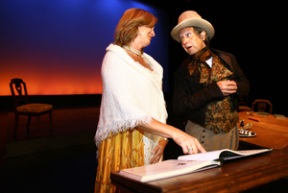
Tom Stoppard’s ‘Arcadia’ opens at the Playhouse for BPA’s golden 50th season.
Nobleman, poet, adventurer, soldier, rake – Lord Byron cast an impossibly long shadow over the early Romantic age.
So long, that two centuries later he can be the pivotal character in a colorful theatrical examination of the period without ever appearing onstage.
“His poetry is so romantic and powerful,†said Kate Carruthers, of the notoriously dashing Byron, canonical writer who both penned and embodied “Don Juan†before his death in the Greek War of Independence in 1824.
“I can see why women fell all over themselves for him,†she said.
The Byronic legend is central to Tom Stoppard’s “Arcadia,†which opens Oct. 13 on the BPA Playhouse stage.
Carruthers, coming off last season’s sold-out production of Steve Martin’s “Picasso at the Lapin Agile,†directs another writerly work rich in language, ideas and allusion.
The play skips back and forth in time between 1809 and 1989, in the fictional manor house of Sidley Hall in the English countryside.
As the Romantic age dawns, literary critic Septimus Hodge tutors the intellectually precocious Tomasina Coverley, a 13-year-old with a gift for presaging mathematical and philosophical principles decades ahead of their time.
Hodge also dallies with Lady Chater, wife of a vacuous poet whose work the critic has ridiculed in print. Casting an arch eye over the resulting conflicts is Lady Croom, matron of the manor.
Meanwhile, an offstage visit by Lord Byron heralds a symbolic shift from the stoic Age of Reason to the passion and caprice of Romanticism, as a madcap transformation of the manor grounds illuminates the changing sensibilities of the age.
“Where there is the familiar pastoral refinement of an Englishman’s garden, here is an eruption of gloomy forest and towering crag, of ruins where there was never a house, of water dashing against rocks where there was neither spring nor stone I couldn’t throw the length of a cricket pitch,†laments Lady Croom.
And then, a pistol shot shatters the still morning, crows flee the treetops, and…?
One hundred and eighty years later, in the same hall, scholars Hannah Jarvis and BerÂnard Nightingale colÂlide and collude over the Coverley family letters to decipher what transpired.
Hannah plumbs the legend of a hermit who once roamed the grounds, while the boorish NightinÂgale hopes to prove that the obscure poet Chater, eager to defend his wife’s virtue on the field of honor, fell at the wrong end of Byron’s pistol.
Shared props and parallel dialogue slowly reveal the intertwined fates of young Tomasina and the mysterious hermit, until at play’s conclusion, the ages themselves converge.
The characters bandy throughout with a repartee by turns erudite, bawdy and droll.
Madly allusive – you don’t need a working knowledge of determinism, thermodynamics or chaos theory to enjoy the play, but it doesn’t hurt – the work is so rich in extratextual references that the program comes with a glossary to help the audience keep up.
“There’s no way that anybody watching this play will get it all at once,†Carruthers said. “But that doesn’t mean they’re stupid.
“Stoppard said, ‘life’s like that – do you get it all at once?’ I think he’s resisting the idea that everything needs to be simplified. Life is rich and complex and fascinating. It shouldn’t have to be simple.â€
“Arcadia†debuted on the London stage in 1993 and was immediately hailed for its depth of ideas, earning the 1993 Olivier Award for Best Play, and the 1995 New York Drama Critics Award.
Carruthers saw the play at Seattle’s ACT Theatre a decade ago, and was at once entranced and confounded.
“I was frustrated at first,†she said. “I found myself saying, ‘hold it, can you say that again?’â€
But the successful run of “Picasso†last year convinced her that Bainbridge audiences respond well to sophisticated, contemporary productions with grown-up ideas.
Actors from Bainbridge Island and Seattle make up the 13-person cast.
Ricky Coates and Andrea ChrisÂtÂoÂpherson take on the roles of Septimus and Tomasina, while Brynne Edwards and Tim Davidson spar as Hannah and Bernard.
Fred Saas, flamboyantly clueless as Schmendiman in last season’s “Picasso,†turns up as Ezra Chater, while BPA veteran Tim Tully puts his Dickensian touch on eccentric landscaper Noakes.
If anything, the play has been criticized as too cerebral, an exercise more intellectual than emotional. But as the mysteries reveal themselves, Carruthers is confident the audience will find plenty for the heart as well as the head.
“This doesn’t deal with important social issues, and I suppose it’s not relevant to what’s happening today,†she said. “But it celebrates human potential and beauty in the world.
“And that’s a nice thing, rather than thinking about whether someone’s going to blow up the ferry.â€