
Putting a charge in transportation
Published 9:00 am Wednesday, September 27, 2006
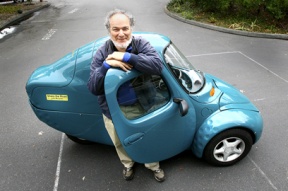
Electric cars get a foothold in the automobile market.
When choosing a parking spot, Chris Stanley often wedges his little one-seater next to the sleekest and most luxurious in the lot.
“It’s an eye catcher,†the island resident said. “I like to walk away and then watch how many stop and look at it. They won’t even look at the Audi or the Lexus but they’ll take pictures of mine.â€
Once the photos are snapped and the head scratching begins, Stanley sometimes moseys back to rattle off a few facts about his electric-powered Sparrow Personal Transit Module.
According to Stanley, 25 cents worth of juice pulled from a wall socket gives his three-wheeled ride a range of about 20 miles.
Built by California-based Corbin Motors four years ago, the zero-emissions prototype can hit 55 miles per hour and requires much less maintenance than a typical gas-powered car.
“It never needs a tune up,†Stanley said. “You just have to maintain the breaks and the tires and get a new battery every few years. Really, all you have to do is plug it in.â€
When it’s near the end of its charge – which rarely happens while running errands on the island or during his commute to Seattle – Stanley simply wheels the Sparrow to the nearest electrical outlet.
“What that means is I don’t have to make it to a service station,†he said. “All I have to do is make it to a friend’s house.â€
Interest in electric cars is growing on Bainbridge. Stanley regularly waves at four other Sparrow owners who either live on or commute to the island.
Stanley’s friend, islander Kim Bottles, recently owned an electric car, but sold it after receiving an offer he couldn’t refuse.
“They offered me too much money,†said Bottles, who was tracked down a few months ago by an enthusiast who was willing to pay “substantially more†than the nearly $10,000 purchase price Bottles paid for the car.
“I’m still very intrigued by electric cars,†he said. “I’m interested in energy independence and it was something that was unique and unusual. I really like things outside the realm of the normal.â€
Bottles purchased his 1995 Solectria Force, which resembles a Geo Metro, through Ebay, which is fast-becoming the preferred method of tracking down hard-to-find electric cars.
“I bought it eight months ago sight-unseen,†he said. “I had it shipped from Missouri because I always wanted to see what these things are about.â€
But a glance at the offerings today illustrates how a combination of high demand and growing scarcity are driving up prices. Bottles said he recently saw a Toyota Rav4 electric vehicle, which is no longer produced, sell for nearly $70,000 on the online auction site eBay.
Pam Burton, who purchased a Solectria last spring, expects the big auto makers will offer electric models as demand grows.
“You think about how the auto makers are whining about going bankrupt,†she said. “Well, why not (offer) what people are willing to drive? Consumers have to demand these cars. Look at the (gas-electric) hybrids. Four years ago, they were saying they were too ugly and that nobody would drive them.
“Now there are waiting lists of people trying to buy them.â€
Electric cars appeared ready to break into the mainstream during the late 1990s when General Motors began manufacturing the EV1, the company’s first battery electric vehicle.
The vehicle was produced, in part, to satisfy California’s zero-emissions vehicle mandate, which specified that by 1998, 10 percent of all new cars sold were to have no emissions.
Despite spending over $1 billion – mostly through government subsidies – developing and marketing the EV1, GM cancelled and recalled nearly 2,000 EV1s.
The company cited a lack of demand for the cars, but Stanley and other electric car enthusiasts suspect another reason.
“The only way to reach California’s ‘zero emissions’ (standard) is through electric cars,†he said. “But auto makers persuaded California to change the law. So (GM) never sold them. They pulled them and shredded them.
“Some of us feel that was harmful, a crime against humanity.â€
Electric tastes
But numerous electric cars are produced for the mass markets in Norway, France, Denmark, Switzerland and the United Kingdom.
Auto makers such as Peugeot and Citroen have long produced electric cars, while an Indian auto maker recently released a petite commuter called the REVA.
The Ford Motor Company had also produced an electric model to meet California’s former emissions rules. But, rather than scrap their fleet of “Th!nk†vehicles, Ford shipped many of them overseas.
“Instead of getting rid of them, Ford banished the Th!nk to Norway, where they flourish,†said electric car driver Jeremy Smithson.
Despite some setbacks, Bottles sees a new spark on the horizon.
Smaller electric car manufacturers haven’t stopped producing quality cars, he said, citing the work of the Spokane-based makers of the sporty Tango and improved versions of the Sparrow, which is now produced by Ohio-based Myers Motors.
Bottles has his eye on the Tesla Roadster. Resembling a Dodge Viper, the Tesla can leap from 0 to 60 mph in 4 seconds, gets 250 miles per charge, runs on the equivalent of about 1 cent per mile and costs upwards of $100,000.
“It’s sexy as heck,†he said. “Now if they can get it down to a rational price I’d be interested.â€
For those who like the idea of producing no vehicle emissions, but still have to eat and pay bills, Stanley and his neighbors may have a solution.
He and 10 of his fellow Bainbridge Cohousing residents formed a limited liability corporation around a 1982 Mercury Lynx electric car.
The group has an online sign-up sheet and take turns using the $7,000 car to run errands, pickup groceries, go to church and take children to baseball games.
“One of the worst things you can do is use an internal combustion engine for short trips in the two mile range,†he said. “It’s bad for the engine and the amount of pollution is just really bad news. But short trips are ideal for electric.â€
With a faded lemon yellow paint job and a body that resembles an old Ford Escort hatchback, the Lynx doesn’t turn heads like Stanley’s other electric model. But at 50 cents for a 17-mile charge, Stanley said he doesn’t mind.
“It’s not a perfect vehicle – it’s a utility car,†he said. “It gets the job done.â€
*************
Goodbye, gas guzzler
If you’re thinking about a more earth-friendly method of getting from Point A to Point B, car salesman Greg Rock has suggestion.
“Use your feet,†said the sustainability manager of the Kirkland-based Green Car Company, which specializes in the sale of used hybrid and ‘no-gas’ vehicles. “The most sustainable mode of transportation is your feet. Then it’s your bicycle, then it’s public transportation.â€
The next up from there can be found on Rock’s lot. His company offers a smorgasbord of alternative energy vehicles, from odd-shaped electric cars to conventional-looking sedans converted to biodiesel, a plant-derived fuel.
When selecting a car with the earth’s health in mind, Rock suggests buyers consider first the kind of vehicle that meets their needs 80 percent of the time.
For most, that means 30- to 50-mile trips per day, typically with the driver riding alone.
“You don’t want the (vehicle) that meets your needs 1 percent of the time,†he said. “Most people don’t need an SUV everyday to take seven people up into the snow-filled mountains.â€
A biodiesel Volkswagen Golf is Rock’s prime choice for the everyday driver who wants to balance low-cost travel, reliability with concern for clean air.
Biodiesel can be manufactured in low quantities at home using old cooking grease or vegetable-based oils, or purchased through cooperatives. Increasingly, biodiesel is featured at auto service stations, such as Quality Auto Service near the Bainbridge ferry terminal. Most diesel-powered cars can easily convert to biodiesel, which produces about 78 percent less pollutants than diesel, including many trucks, Mercedes Benz sedans and numerous Volkswagen models.
For those with a sense of adventure, Rock also suggests drivers try out an no-emmission electric car. Many models on the market have limited ranges and speeds, but can fill the needs of most everyday drivers. While used electric cars are purchased at a premium, some drivers see a payoff over time, with many models boasting a .02 cents-per-mile rate using a wall outlet charge.
Some of the island’s electric car owners praise the utility of their cars but warn that such vehicles have little support if something goes wrong.
“I recommend you don’t buy an electric just because you think it’s a great idea,†said electric car owner Chris Stanley. “It is a great idea, but the truth of the matter is that, by having an electric car, you’re the odd man out, like Peugeot drivers.â€
For more information on alternative energy vehicles:
The Green Car Company, www.greencarco.com
The Seattle Electric Vehicle Association, www.seattleeva.org
The Northwest Biodiesel Network, www.nwbiodiesel.org
– Tristan Baurick