No end to the headaches on Grow Avenue
Published 7:00 am Wednesday, August 30, 2006
Neighbors are frustrated by city attempts to manage traffic, parking.
The foot bone may indeed be connected to the leg bone, but both bones – linked as they are – have different needs.
Likewise, for residents at both ends of Grow Avenue, the problems are distinctly different.
At the north end of the street, parking problems persist, especially during the school year when high schoolers park end-to-end along the shoulder.
Meanwhile, though they’ve found relief in temporary “No Parking†signs, those on lower Grow say they continue to deal with speeding traffic and unsafe pedestrian passage.
Foot bone, leg bone or anywhere in between, prolonged but fruitless streetÂscape planning on Grow has made one thing clear to all: finding a solution is a pain in the rear.
“The city keeps missing it,†said Barry Griffin, a 16-year resident of lower Grow.
“One reason why people are so frustrated is because we see money that’s supposed to be spent to improve our street, but it’s really being used for the benefit of everyone on the island except us.â€
After looking at yet another city revision to the street that didn’t come close to the residents’ own vision, some neighbors at a Monday meeting want to scrap plans altogether until a consensus can be reached – even if that means walking away from a $500,000 grant.
The city had planned to use that money for non-motorized improvements along the east side of the street, but the design doesn’t address traffic calming or a long-term parking fix, two of many problems that neighbors say are the crux of the issue.
Now the city will re-evaluate the situation altogether and may implement “stopgap†solutions to alleviate the worst problems while they redesign the street in segments that would be completed in phases.
Stopgap solutions would include more parking restrictions and possibly lowering the street’s speed limit to 15 or 20 miles per hour.
Though allowing planners to address each segment separately would likely appease more neighbors, it also could mean abandoning the grant money, which must be used by next year and only pays for certain non-motorized improvements.
Still, many, including Councilwoman Debbie Vancil, agreed that getting the design right is the most important part of the process.
“What I’m hearing the community say is ‘give us what we want, give us what the community wants,’†Vancil said. “It doesn’t make sense to spend money on things they don’t want.â€
Though the meeting was supposed to be a presentation of the city’s preferred changes, it turned into a lengthy roundtable discussion between residents, city planners and several public officials, including members of the City Council and the mayor.
Many Grow residents were angry and felt the city largely ignored the neighborhood’s own preferred design, which was crafted through a lengthy process and presented to the city for consideration two years ago.
The discussion highlighted a disconnect between the city council and planners, whose path is dictated by what council directs them to do.
For example, city engineer Bob Earl has continually emphasized that the reason the street design doesn’t adÂdress traffic calming is because the council – and the grant that would pay for the project – only authorized non-motorized improvements.
Grow residents have long lobbied for solutions to parking and speeding problems on the street.
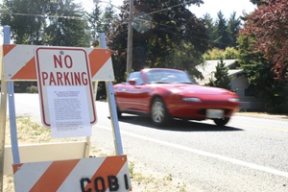
The city recently placed temporary “no parking†signs along the east side of Grow from Winslow Way to Wyatt Way.
Griffin said the new signs have been a major help on lower Grow, which used to be clogged by commuters who would park for free on the shoulder and ride their bikes to the ferry.
Public works Director Randy Witt said the city has the authority to enact permanent parking restrictions for distances of less than 100 feet, and can implement temporary restrictions for unspecified periods of time to address “spot issues.â€
Witt said the city council on Sept. 13 will consider a resolution to add temporary parking restrictions on upper Grow.
Dee DuMont, who lives on upper Grow Avenue and runs a home-based business there, urged the city to put up no parking signs before school starts on Sept. 6.
As the city mulls its options, Mayor Darlene Kordonowy suggested planners debrief the city council to ensure everyone is on the same page.
“I’m concerned about having another meeting without having a plan about how to go forward, especially regarding the grant money,†she said. “Otherwise people will begin to say ‘how many meetings do I have to go to?’â€