Prickly going on North Madison
Published 12:00 pm Saturday, August 19, 2006
Neighbors, the city begin planning for bicycle and pedestrian facilities.
Along the shoulder of North Madison Avenue, blackberry brambles shoot in all directions.
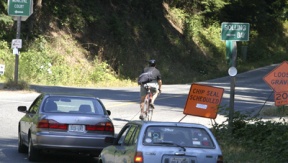
The roadway creates its own prickly situation, curling west before it intersects with 305 and posing a hazard for those who must navigate the sharp contour.
It is a blind and wince-inducing turn that raises the hackles of chugging bicyclists and trembling pedestrians alike, as motorists scream by in both directions.
Recently, as Bruce Bachen sped down the hill at 35 miles per hour on his bicycle, he encountered a jogger who refused to yield the right of way. The standoff, which occurred in a matter of seconds, forced Bachen into the roadway.
“If there had been a car there I’d have gotten creamed,†the North Madison resident said. “We need a marked bike lane on both sides.â€
The curve from North Madison toward the highway – a convoluted, Y-shaped intersection with Manitou Beach Road – is only a portion of a non-motorized nightmare that includes narrow lanes and microscopic shoulders stretching up the hill to Day Road.
Even as the city works on non-motorized projects, long stretches of roadway like North Madison essentially exclude bicyclists and pedestrians.
Just as frustrating to others is the prospect of dealing with city engineers who in the past have – like a hairpin turn – offered only a peek at what’s around the bend for island roads.
Now the city is approaching the community and the coming North Madison non-motorized improvements with an empty notebook.
“For the first time we’re walking into a public meeting with a blank sheet of paper,†said City Engineer Bob Earl, before a meeting Thursday at City Hall. “We really haven’t done any design work yet. This will be a learning experience all around.â€
Shoulder width, shared-use paths, bike lanes and user education – all aimed at safer passage for bicyclists and pedestrians – were among the items discussed as planners, architects and about 20 members of the community. It marked the first step toward improving the nearly two mile stretch of North Madison between 305 and Day Road East.
Earl said the $780,000 project could go to bid in January with construction beginning as early as next spring.
It will only address non-motorized improvements, which means the road itself, including the treacherous turn, won’t be reconfigured. Still, Earl said other solutions, such as crosswalks or bike signals, could solve problems.
In addition to initiating design work on North Madison, the meeting was a tangible marker of the city’s effort to shift toward more community-inclusive design work.
In the past, the city model has typically involved significant design prior to meeting with the community. The result has been a series of public controversies over the way island roads take shape.
City officials began Thursday’s meeting with a brief presentation on design constraints and material costs, with an overview of features that could be built into the streetscape. The larger group then split into three smaller teams to discuss possible design options before reporting back to the city and the other teams.
Bachen, who lives on North Madison and rides his bicycle along the street there six days a week, emphasized bike safety. He suggested that the path on the east side of the road be elevated to separate bicycles – whose riders must struggle up the hill on that side – from the cars that now share the same space.
More than 100 bicyclists whistle down the narrow chute of North Madison each day according to the city’s presentation, and several at the meeting sympathized with Bachen’s plight.
Others emphasized pedestrian safety, including Dianne Thompson, who said the city should consider better signage and user education in addition to creating safer thoroughfares for bikers, walkers and joggers.
Many times, she said, cyclists and pedestrians find themselves at odds when paths aren’t clearly designated.
“The city did an outstanding job of educating people about how to use the roundabout (at the intersection of Madison and High School roads),†she said. “It should be safe for anyone walking anywhere on the island.â€
Many stressed maintaining the character of the tree-lined street by avoiding the “suburban†look of streets like High School Road.
“We need a low-key enjoyable path where you might be able to stop and pick a few blackberries without having to worry about being sideswiped by someone on a cellphone,†said one man.
Most at the meeting want the project to be finished in its entirety instead of completing it in phases.
Earl said doing so may require a request for additional funding from the City Council, which he said is fairly typical for projects like this.
Receiving grant money for the project is also possible, though the contribution would not likely exceed $100,000, which means the bulk of the funding would come from the city.
The design team now will come up with alternatives to be presented to the public in late September.
Earl is optimistic that the new design approach will limit quarreling that has bogged down previous efforts.
“To be frank, I don’t think there was management or executive support for this type of process in the past,†Earl said, adding that this will likely become the model upon which most future projects are based.
Earl said some efforts, particularly those with only a handful of possible solutions, require less input than others, but concedes the need for public involvement.
“That’s one of the reasons why I came here,†he said. “I like to see people get involved. We do need more community input and we do need to gauge the needs of the community more closely than we have.
“This department is going to be phasing into a collaborative relationship with the community from here on out.â€