It’s all about the beans
Published 5:00 am Saturday, July 23, 2005
Coffee trade brings higher standard of living to Ometepe farmers.
ISLA DE OMETEPE, NICARAGUA – The harvest is months away, but Finca Magdalena coffee cooperative president Santo Lopez has already spotted a ruby glow under a few dark leaves.
“We’re in luck,†he says as his fingers expertly trace the branches of a 5-foot-tall coffee plant, plucking soft red berries among many that remain green.
Lopez pops the reddest one into his mouth and chews the sweet outer pulp.
“These little things mean a lot to us and the people of Ometepe,†he says before two pale green beans emerge from his lips. He holds one up triumphantly and smiles.
“These beans,†Lopez says, “have meant a good living for our workers, clean water for the island, many schools and many friendships.â€
Despite its small size and shriveled appearance, the humble coffee bean long ago sprouted into one of the world’s biggest exports – second only to oil.
Farms in Kenya, Peru, Indonesia and Nicaragua contributed to more than $70 billion in global coffee sales last year. But farmers saw little trickle-down – perhaps a dollar a day – as Americans, Brits, Swedes and Italians sloshed millions of gallons of pricey lattes and cappuccinos.
But Lopez says his plantation on the slopes of Volcan Maderes is one shining exception to the global rule – and it all started with a few pounds of green beans stuffed into the suitcases of visiting Bainbridge Islanders.
“They had good intentions, but their first export was only 14 pounds,†says the co-op’s founding president Bernabé Lopez, of his first meeting with members of the Bainbridge-Ometepe Sister Islands Association. “They packed it in their luggage before they went home. I’m glad they came back again.â€
They returned in 1992 with $35,000, enough to buy the cooperative’s entire harvest.
“But one problem was that we didn’t have that money,†admits BOSIA founder Kim Esterberg. “So I asked people on Bainbridge to invest $100 with the promise of one pound of coffee in interest. At $8 a pound, that’s 8 percent interest.
“Many people kept the interest and told us to keep the $100.â€
All the profits from coffee sales were donated back to the Ometepe community, sparking more than 10 years of social projects built on the sweat of the co-op’s pickers and the pocketbooks of Bainbridge’s coffee drinkers. Profits from the initial sale were funneled into the first of many BOSIA-led clean water projects, which piped a volcanic lake’s crystal waters down to the small pueblo of San Pedro.
BOSIA brought in almost $85,000 in coffee sales last year and spent over $34,000 on scholarships, libraries, classroom repairs, medical supplies, additional clean water upgrades and other projects, according to BOSIA treasurer Lee Robinson.
While their community sees broad benefits, Finca Magdalena’s workers have found they have more money to spend on life’s necessities.
BOSIA pays $1.61 per pound for co-op coffee, which tops the international fair trade price by more than 30 cents.
“We add that little more because it’s shade-grown, organic and because it comes from a cooperative,†Esterberg says. “These aspects are very important to us and the coffee drinkers on Bainbridge Island.â€
It’s also important to Bernabé Lopez, president of the co-op.
“We see many benefits by growing this way, and many benefits we cannot see,†he says. “We know the birds love the trees that grow over our plants, but because the coffee is organic and does not use pesticides, we know there are unseen benefits, such as the life of the soil, the health of the consumer and life in general for those of us that live on Ometepe.â€
While shade-grown coffee produces about a 35 percent lower yield than beans grown in the open, the technique extends the lives of the plants by over 10 years and often supports 100 more species of birds and 24 more types of mammals, according to the National Audubon Society.
Santo Lopez said many pickers also appreciate a shaded work environment devoid of harsh chemicals.
“We also produce our own organic fertilizer from the parts of the coffee we don’t need,†he says. “And that means there’s no need to buy fertilizer chemicals and it means more money for workers.â€
Double pay
The export relationship with BOSIA, along with a burgeoning hotel business at the cooperative, has seen workers’ pay double in less than 10 years.
Pickers are paid just under $2 per day to gather about 40,000 pounds of coffee each year.
More than 120 temporary workers are hired from around the island to join about 40 permanent co-op farm workers during the November-to-January harvest.
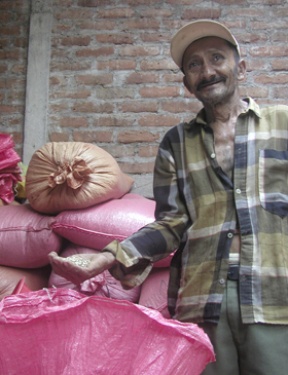
Pickers dump beans by the basketful into ancient de-pulping machines – some of which are over 115 years old. The machines break open the red pod and drop the seeds into a water trough to ferment for about 12 hours. The beans are then rinsed and hand-sorted by quick-eyed and nimble-fingered women.
“They’re just faster,†says Santo Lopez. “We had a contest, men against the women. They won, so we stay out of their way.â€
After sorting, the beans are spread with rakes over tennis court-sized patios to dry for two weeks.
The beans are sorted again into three quality grades. The lowest-quality grade – typically containing misshapen and small beans – stays at the cooperative.
“I think the lowest grade has a better taste and aroma,†Santo Lopez says. “Europeans and Americans want the big beans, but we in Nicaragua have a special kind of gentle taste for the coffee.â€
The beans are shipped in 100-pound bags to Bainbridge Island, which typically buys one-third of the harvest, and two destinations in Canada.
Once on Bainbridge, the beans are dropped off at Pegasus Coffee Roastery, where they are cooked to the black sheen familiar to most coffee drinkers.
BOSIA volunteers bag the coffee for sale at local markets or over the Internet.
After a decade of selling BOSIA’s co-op-grown coffee, Town & Country Market still takes only $1 from each pound it sells.
“Town & Country is now a chain of stores selling our coffee, but they still only want $1,†says Esterberg.
“That tells you something about the strong relationship that’s formed between Ometepe and Bainbridge Island.â€
The tight bonds between Northern Hemisphere coffee drinkers and Southern Hemisphere coffee pickers have weathered recent economic storms that crippled many Central American growers.
In the 1990s, Brazilian and Vietnamese plantations flooded the market with lower-quality robusta beans, sparking a dramatic drop in coffee prices.
Many Nicaraguan and Costa Rican growers, who produce the lower-yield arabica bean preferred by specialty roasters, were forced out of business as the price per pound dropped to 50 cents.
That was around the time BOSIA raised its per-pound pay from $1.26 to $1.61.
“That really helped us,†says Santo Lopez. “They gave us that extra money to help stop what was happening (to coffee farms) all over Nicaragua.â€
Fair trade marketing expert Nick Hoskyns said other coffee cooperatives with similar relationships to North American buyers also thrived despite the crisis.
“The cooperative movement in Nicaragua demonstrates a different way of doing things that has become one of the most dynamic sectors of the nation’s economy,†he says. “Nicaraguan coffee cooperatives have overcome the coffee crisis and continue to ship to the most demanding markets in the world.â€
Nicaraguan cooperatives now produce 15 percent of the nation’s coffee exports and almost 40 percent of the organic coffee shipped abroad, according to Hoskyns.
Bernabé Lopez knows his cooperative’s success has had to do with more than just the fine taste of the beans he grows.
“Thanks to (BOSIA) and all the coffee drinkers on Bainbridge our lives have improved and the cooperative’s assets have been able to increase to $2 million,†he says.
“But all this would have been impossible without the friendships we have forged.
“Because, as you well know, money is not everything in life.â€
Wednesday: the future of Finca Magdalena.