All (little) hands on deck!
Published 12:00 pm Wednesday, April 20, 2005
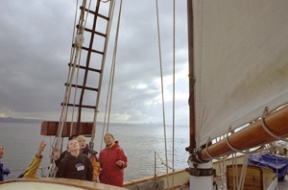
Island fifth-graders explore the wonders of Puget Sound aboard the Adventuress.
Learning about plankton was never so much work, or so much fun.
“Heave!†yelled Dani Davis from the bow of the Adventuress.
“Ho!†Mary Hadley’s fifth-grade class yelled back.
With little fists gripping wide ropes, the 20 kids from Sakai Intermediate School launched the sail of a double-masted wood ship as it eased out into the winds of Eagle Harbor Monday.
“We can’t go anywhere without all your help,†Davis told the kids. “We can’t push a button to make this go.
“All we have is teamwork and our own muscle.â€
The polished deck of the old schooner has weathered arctic explorations, fires, at least one sinking, and a trip around Cape Horn on its 1913 maiden voyage.
Now it serves as Sound Experience’s floating classroom, teaching kids from Olympia to Bellingham about the largely unseen life teeming in Puget Sound’s briny waters.
“This is all about getting kids out on the water,†said Morley Horder, owner of Eagle Harbor Books and co-founder of the schooner-bound nonprofit. “If they learn to love Puget Sound, they’ll take care of it.â€
Taking the wheel of the 137-foot vessel as it moved south past Bill Point, Horder was glad to see that the organization he founded 16 years ago is still going strong.
“It’s all about having a good crew,†he said. “Professionalism and enthusiasm – those are the most important things. I’ve turned this over to a great group of people.
“Just look at them go.â€
Horder tipped his head toward a gaggle of kids crowded around a screen magifying a fresh catch of plankton.
“Some of these plankton like to eat all the dead stuff in the water,†said deck hand educator Shannon Hagen, as a monstrous zooplankton zoomed across the screen. “What do we call dead stuff? It starts with a ‘D’.â€
The hint was met with a blurted chorus: “Detritus! Detritus!â€
“You guys are brilliant!†Hagen answered.
A head full of new words is one of the best things about the three-hour trip, said fifth-grader John Scott.
“Fo’c’sle,†“gaff-rigged,†“aft†and “starboard†were a few of the words Scott hoped he’d remember for his next trip at sea.
While some of the sailing terms might slip away, the classroom marine biology lessons taught by Hadley found new meaning for the student.
“It’s more interesting to do stuff on the boat,†Scott said. “It’s a lot different than being in class, because I’m also learning to sail.â€
The students took part in various interactive lessons aimed at showing the interconnectedness of the sound’s sealife – from microscopic to gigantic.
During one exercise, kids stacked hands in a pile, the first representing plankton, with salmon, crabs, sea-cucumbers, seals, humans and other creatures sandwiched underneath a whale at the top.
“Now, plankton! Pull your hand out!†Hagen said, as the pile of hands crumbled. “Boom! We’re all outta here!â€
Fifth-grader Emma Keese was quick to catch the lesson.
“If the plankton die out, the entire food chain collapses,†she said.
Hadley stood back smiling, as she watched eyes brighten all around the vessel.
“I can say this stuff a hundred million times,†she said, “but here, in this dramatic environment, they’re living it. They listen to it and it stays with them.â€
Some of the parents who came along for the ride were surprised to see their kids so fixated on what amounted to science lessons.
“This is wonderful,†said Mike McCloud, shortly after watching his son’s jaw drop when he learned that the lowly barnacle is, in fact, a relentless predator.
“As parents, we try to drag the kids away from video games,†McCloud said. “These days, kids need a lot more to be engaged. They spend so much time with TV, with its flash and dazzle. It’s hard to compete with that.
“But listen to them,†he said pointing to his son’s typically rambunctious group as they quietly touched a giant starfish in a tank. “They’re quiet. They’re listening. And this is the goof-off group.â€
Hadley’s class was lucky enough to benefit from a scholarship provided by Sound Experience.
A similar short tour would cost a group $850 or much more for overnight trips. Dependent on grants, user fees and fundraising events, Sound Experience is trying to keep costs low to get more kids on board. The nonprofit organization spends about $60,000 annually to maintain the ship and thousands to keep up with skyrocketing fuel prices.
Geoff Ball, an island resident and director of Sound Experience, hopes to establish a regular relationship with Bainbridge schools, broadening an already close relationship with Bellingham and Seattle educators.
“We’d like to make this a part of a regular curriculum district-wide on Bainbridge,†Ball said. “We want this to be affordable and for more people to be a part of this, because if we’re not educating people about Puget Sound, we’re not meeting our mission.â€
While Bainbridge schools no longer earmark funds for field trips, Hadley said Monday’s adventure will likely last her kids a long time.
“They’ll remember this the rest of their lives,†she said, as her kids lined up to disembark. “I bet that if you ask them at graduation what their best memory of their school career was, they would talk about this.â€