The non-objective Constructivist
Published 11:00 am Wednesday, February 16, 2005
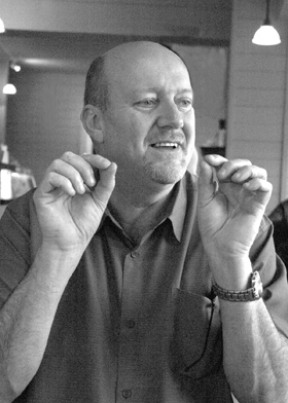
If you call Paul Ziakin an abstract artist, you’re wrong.
Twenty years ago, Paul Ziakin was a trained and dedicated artist.
Now, after a hiatus to raise a family, Ziakin returns to the work he loves with new oil stick drawings on view at the Tree House Café through March 8.
“It wasn’t like I just fell back into (making art),†he said. “The desire was there, the passion was there, but it was like a person who’s in a terrible car accident and he’s paralyzed. They’re just determined to walk again. They used to walk, they love to walk. But it’s painful.â€
For Ziakin, the pain was self-doubt. But with the encouragement of his wife, Colleen, he began. On the wall he pinned these words: I give you permission to just draw and make garbage for the next six months.
“It was a humble beginning,†he said.
Ziakin’s introduction to art came early, with awards in grade school.
His post-secondary art education began in the early 1970s when, after a Vietnam-era stint in the Navy, he used his veteran’s benefit to study college-level art at the Northwest School of Fine Art in Portland, Ore.
Although he was in his early 20s, Ziakin found it difficult to relate to his younger classmates.
“I was in it to learn, I wanted to paint,†he said. “This was the only opportunity I had. I didn’t have a studio, I didn’t have the lighting – all the stuff you need. So this was my time. For the younger students, it was party time.â€
But among the faculty were several inspired teachers, Ziakin says. He found his attraction to Impressionism challenged by Paul Missel, a realist painter in the manner of the Dutch masters, and he learned patience and discipline from another instructor, Eunice Parsons.
“They were worldly wise and knew what was going on,†he said. “They were passionate about their art.â€
After art college Ziakin traveled, staying for 18 months on the Greek island of Paros, drawing, sketching and “generally having a pretty good time.â€
At last, ejected by the authorities for overstaying his visa, Ziakin went to Holland, where he viewed first-hand Renaissance paintings that inspired Missel, and toured England and Egypt. Encountering poverty opened his eyes to the relative prosperity of the United States.
“In Alexandria there were people living on the roofs of these ornate Victorian buildings built by the French. On every building there was a farm with goats and chickens,†he said. “The trip changed how I thought about the world. A lot.â€
Returning Stateside, Ziakin, a self-described “confirmed bachelor†at 31, married Colleen Jacobsen and the couple had three children.
“I guess I was ready to hunker down and have a family,†he said. “I spent 20 years raising that family and providing them with security, and I did a good job. But I had to put aside my art.â€
The couple lived in New York City, while Ziakin, worked as an antiques restorer and a cabinetmaker. After eight years, the family moved home to Portland and Ziakin started his own construction company. They relocated to Port Angeles and eventually Bainbridge.
Through it all, Ziakin didn’t forget about art.
“I was always talking about it,†he said. “I was always looking at books. I had sketch books and I had my journal.â€
Ziakin also had a generous-spirited capacity to enjoy art through his kids’ creativity.
As the children grew older and more independent, however, Ziakin turned more to rediscovering his own work – but as a returning professional, not a hobbyist retiree. About eight years ago, he set himself up in his garage with a roll of butcher paper, paint, pens and a set of oil sticks.
“I just drew and drew,†he said. “I wasn’t worried about development or anything. I didn’t feel an obligation or any disappointment. It was completely free.â€
After three years, Ziakin “took off the gloves†and began to push himself to make finished works.
Today, Ziakin uses oil stick on paper to make works ranging from about 8 by 10 inches to 24 by 36 inches. They are abstractions oriented to a horizon line – although many of the small-scale works are vertical, rather than the horizontal orientation of most landscape-based art.
He begins with a premise that might be a phrase or an idea, like the one driving the current show: “views from my heaven.†He then develops visual concepts that embody the notion or address the intellectual or spiritual question.
Although a cursory viewing of his work might suggest Abstract Expressionist influence, Ziakin has adopted his daughter’s description of his art as “non-objective Constructivism.â€
“Abstraction assumes that you’re deconstructing something, abstracting from something that exists,†he said. “What I have done is more of a building-up, more of a construction. It’s non-representational work built on a variety of things.â€
An ambitious artist, Ziakin wants to be taken seriously, although he acknowledges he has a long road ahead.
He has received encouragement, though; Ziakin enjoyed a recent studio visit from the director of Seattle’s Foster White Gallery.
“She was very encouraging,†he said.
While being taken seriously can mean anything from wanting the respect of one’s artist friends to a career on an international stage, it implies a commitment to locating one’s work in the broader context of art history.
So Ziakin reads about his subject, following historical and theoretical developments and keeping up with contemporary art.
“I’m committing my self more and more to my art. It’s something I’ve wanted to do my entire life,†he said. “I’m an emerging artist. Even at 55, I’m an emerging artist.â€