A new useful yardstick for planning
Published 7:00 pm Wednesday, February 16, 2005
The question is not whether more new residents are going to descend on our little island, but rather, what to do with them when they get here.
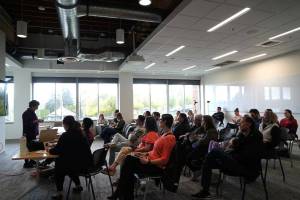
So there is a definite usefulness to visits from folks like Patrick Condon, a noted landscape architect who appeared at City Hall last week as part of the Envision Tomorrow speaker series. Condon has created a bit of a stir with his assertion (as reported in these pages Saturday), that we could add significantly more people to our downtown mix without damaging Winslow’s character.
Condon’s presentation will be replayed on Bainbridge Island Broadcasting in the coming weeks, and we hope folks watch it; he is an engaging and informative speaker. As a primer, we thought it worth sharing his “seven principles for sustainable community design,†a useful yardstick against which to measure our values and actions as we plan our future.
1) Conserve land and energy by building compact neighborhoods that allow people to walk five minutes to commercial services – and in so doing, weaning ourselves away from the auto-centric standard of the “five-minute drive†to buy a quart of milk.
2) Provide a mix of dwelling types, sizes and densities in the same neighborhood, to prevent economic enclaves.
3) Show a “friendly face†to the street – build homes with porches in front to promote social interaction
4) As a corollary, put parking and “car storage†behind buildings, in lanes and alleyways, out of sight. Avoid the development of “snout houses†with three-car garages fronting the neighborhood.
5) Provide an interconnected street network to disperse traffic congestion, and provide public transit with connections to the surrounding region. Keep streets narrow, with a maximum curb-to-curb distance of 24 feet. Any wider, and vehicle speeds tend to increase, putting children and other non-vehicular street users at risk.
6) Develop streets with a “rural profile,†tree-lined avenues perhaps with crushed-gravel parking strips and grassy shoulders to separate pedestrians and cars. Less curbing means lower infrastructure cost, and lower future maintenance costs for the public.
7) Preserve the natural environment and promote natural drainage systems, in which stormwater is held on the surface and permitted to seep naturally into the ground. Again, less pipe means lower insfrastructure costs now and in the future.
It seems to us that these principles are very much in alignment with what we islanders profess as a community; indeed, anyone who actually watches Condon’s presentation should be struck by how intimately his views meld growth with environmental stewardship.
How well we stack up is another matter, but that just underscores the usefulness of the Winslow Tomorrow plannning effort. Remember: Under the state Growth Management Act, Bainbridge Island must plan to accommodate 6,550 new residents by 2025. Under our own Comprehensive Plan – the planning framework that we as a community agreed upon – half of those (some 3,325 new faces) are earmarked for Winslow. Rather than posing some sort of threat, Condon’s views provide tools by which to accommodate them.
If we succumb to a visceral rejection of the concept of “more people†and don’t plan, we surrender ourselves to fate.