An exotic arrangement
Published 5:00 pm Wednesday, January 19, 2005
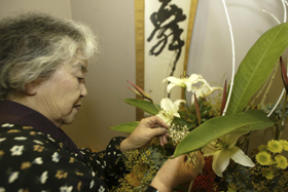
First standing white-painted, curved boughs of bamboo in the center of a 3-foot red vase, Aiko Ii deftly adds flowers one stem at a time.
A joyful mass of flowers slowly forms.
Ikebana, the art of Japanese flower arrangement, has been part of Ii’s life since she was 12. She has taught the art in greater Seattle for over 40 years and nurtured some 30 teachers from her many students.
“My teacher told me to kusawake (“part the grassesâ€),†an image of pioneering, she said.
She learned directly from the founder of the Sogetsu school of ikebana. Throughout life, flowers have always been by Ii, for births, sickness and deaths.
Even when her husband, who passed away recently, was ill, she kept her teaching commitments.
Her teacher taught her, “When you are going through hard times, work with flowers and you will be able to concentrate there. If your heart is troubled, flowers will heal it; if bad things come, escape in flowers, if you have no place to live, live in flowers.â€
Ii was sent to Seattle in 1962 from Tokyo by her teacher, Sofu Teshi-gahara to bring Sogetsu ikebana to the Seattle area.
Sogetsu ikebana, established by Teshigahara in 1927, differs from the more traditional forms of the Ikenobo and Ohara schools of ikebana in its freer style.
Flower arrangements were traditionally associated with tea ceremony and placed in a tokonoma, a special alcove in a Japanese parlor often displaying a scroll of calligraphy or painting with a flower arrangement.
Ii says Teshigahara’s modern approach enlarged ikebana’s range beyond flowers for the tokonoma; some Sogetsu arrangements could be called avant-garde.
Teshigahara saw that buildings and architecture were changing. He established Sogetsu ikebana with the philosophy that it can be done any time, any place – not just in Japan – with any materials, by anyone.
Flowers, in essence, have to get out of the tokonoma.
Even with more freedom, the Sogetsu school has roots in traditional ikebana, beginning with the three main stems with specific length and angles, then considerations of line, mass and color.
“After studying the fundamentals,†Ii said, “arrange flowers from your own imagination, (create) flowers that match the place.â€
Although 76 years old, Ii still keeps a busy schedule, spreading the seeds of ikebana and cheer. An assistant helps interpret and carry heavy buckets, but she drives herself to teach or arrange flowers in Seattle, Mercer Island, Bellevue, Tacoma and Bainbridge Island five days a week.
A winter session on Bainbridge, offered through the park district, begins this Saturday.
Ii has been coming to the island to teach for over 20 years. She has performed demonstrations at Bloedel Reserve, in churches and in homes.
She arrived in Seattle with her husband and three children when she was 36, having earned the Riji degree, the highest ikebana teaching degree. In Tokyo, Ii taught ikebana because it allowed her to also care for her children, but as also something she enjoyed.
In Seattle, with the attitude that “you can’t sit and wait for students to come,†she went to find pupils. She attended community college to improve her English in order to learn how to drive.
Islander Sheryl Todd recently took Ii’s class and said she was impressed by her dedication and attention to each student, each of whom were at a different level.
After Todd watched Ii’s demonstration and tried the arrangement, the teacher would come look at her work.
“She can move something a tad of a degree and trim off a leaf or two, and it turns from a jumble to a lovely arrangement,†Todd said. “It’s all having an eye.â€
Ii would like students to enjoy flowers most of all. Through flowers, she said, “the heart can be cleansed and bring about friendships,†Ii said. “Flowers tell a story. Arrange the flowers while talking with them.â€
* * * * *
Parting grasses
Aiko Ii teaches Sogetsu ikebana classes for all levels from 10 a.m. to noon at Bainbridge senior center on Brien Drive. Winter session classes are Jan. 22, 29, Feb. 5, 19 and March 5. Spring session classes are March 9, April 2, April 16, May 7 and 21. The recommended five-class session is $90, payable to the teacher at the first class, although single classes are also possible for $18 each. An optional textbook is $10. Sign up with the Bainbridge Island Park and Recreation District at 842-2306.