A dance floor awhirl in kilts
Published 5:00 pm Wednesday, January 19, 2005
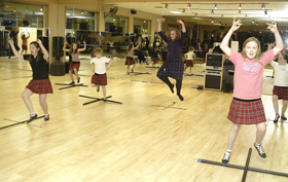
Youngsters learn the art of Highland Dance at a local studio.
In tartan plaid skirts and black shoes, the girls leap about the room like deer.
Knees high and toes pointed, upper bodies straight, arms raised high, faces determined – Scottish dancing has come to Bainbridge Island.
“In ballet, you must be really dainty, but in Highland Dance it’s more about strength,†said 12-year-old dance student Mary Forbes. “It’s fun to do a cultural dance in which every dance has a purpose.â€
Those leaps like the deer? They are part of the “Highland Fling.â€
Legend has it that the dance is derived from a tale of an elderly shepherd, who was teaching his grandson to play the bagpipes, when a stag leaped by and distracted them.
The old man asked his grandson to duplicate the animal’s graceful leap, and he did so with such beauty, that a new Scottish dance was born. In another interpretation from Scottish lore, the dance is thought to simulate an exultant warrior dancing on his shield.
“Of all the dances a child might do, this is all steeped in legend,†said Dianne Speers, Mary’s mother, who spent a year searching for a Highland dance teacher to come to Bainbridge Island. Her daughter started dancing two years ago in Canada, but when the family moved to the island, her lessons stopped.
One day, while shopping at Seattle Kilts, Speers mentioned her quest to find a teacher to the store’s owner, Megan Hawkins, who has been dancing since she was a wee lass.
Hawkins said she’d be happy to come to Bainbridge if Speers could find six students and a sprung floor.
So Speers got to work, finding that Island Fitness was willing to make a dance studio available on Friday afternoons. It was no trouble finding eager students and parents, several of whom also hail from Canada, where Scottish dancing is very popular, and dancing competitions abound.
“It gives girls another choice, another option that isn’t belly dance or salsa,†Speers said. “Ballet is not for everyone. You don’t have to be a petite delicate creature. You need to be strong, and it’s great exercise. Highland dancing can be a recreational activity, while ballet often is not.â€
Now, to the tunes full of wailing bagpipes and steady drumming, seven Bainbridge Island girls ranging from 7 to 12 are learning the steps to the Sword Dance and Shean Truibhais (Gaelic for torn trousers), as well as the lore behind them.
“I was so excited to hear about it coming here,†said Alyson Stephenson of Bainbridge Island, whose daughter Bryndley is a beginner in the class. “My grandfather came from Scotland to Canada, and in addition to being fun, it is a heritage dance.â€
Scottish dancing was done by men until about 100 years ago, said Hawkins, who initially learned to dance from her Scotland-born grandmother. “But then we made up our own dances,†she winked, speaking of the women. Today, women as well as men keep the traditional dances alive.
Hawkins said that Scottish dance is a lot like Irish dancing, except that the Scottish use more ballet-like movements, and they make ample use of their arms, while the Irish keep their arms rigid and straight by their sides. There is a reason for the Irish dance style, she said, noting that the British in the 18th Century banned public displays of Irish and Scottish ethnicity. So the Irish continued to dance behind fences and walls, keeping their heads and arms straight and moving only their feet, to keep from getting caught.
The Scottish were harder to tame: “We didn’t take lightly to putting our arms down,†Hawkins said.
The Sword Dance is considered one of the oldest, in which dancers step and twirl (or “jigâ€) over two swords laid on the ground, one over the other, in the shape of a cross. Legend has it that the dance was first performed by Malcolm Canmore, as he laid his sword over the sword of an enemy when he defeated Macbeth’s army in 1057, Speers said.
Once considered an athletic event, Highland Dancing is highly regimented, with practitioners reaching various stages of proficiency, determined by expert boards such as the Scottish Official Board of Highland Dancing. It is also competitive, with contests and exhibitions held throughout the world.
Students need not enter the competitions, although many do, Hawkins said.
“The important thing about competition is that it’s been part of the culture for hundreds of years,†Hawkins said. “The bagpiping competitions, the drumming competitions, the caber toss — they are all part of Scottish tradition.â€
Highland Dancing lessons with instructor Megan Hawkins are offered from 4:30-6 p.m. Fridays at Island Health and Fitness. A series of eight lessons is $86 for club members and $110 for non-members. The next session starts Feb. 11; call 842-5720.