
Painter has an eye for the overlooked
Published 7:00 am Saturday, August 23, 2003
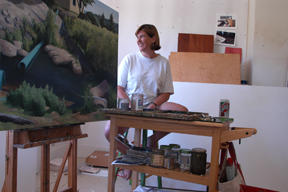
Islander Ellen Wixted transforms construction sites to landscape paintings.
The artist underlines changes to the natural setting by framing disturbed sites, her subject matter for close to a decade.
Her work features vistas of trees, mountains, and meadows, but the telling detail – a septic tank, a broken pipe, a bull-dozer in the distance – alert viewers that the snake’s loose in Eden.
“Raw land is the term realtors use to describe undeveloped land,” Wixted said. “It seems to me that land being developed becomes invisible – it’s neither wilderness nor home.
“I’m interested in making the invisible seen as I am exploring the visual consequences of spelling out our material desires so plainly on the land.”
Wixted dates the series to 1988, when she began commuting to her job as a product manager for Adobe – then Aldus – in Pioneer Square.
Twice a day on the ferry, she passed by the old creosote plant on Bill Point – now a Superfund site – without paying it much attention.
“It wasn’t picturesque,” she said. “It wasn’t pretty. It was polluted. It was invisible. I suddenly realized there is something seriously frightening about not seeing it.”
Wixted began painting and pulling prints of the site.
If her images can’t be classified as paean-to-Nature picture postcards, neither can they be reduced to moralizing.
Wixted’s work exists in a self-conscious, sophisticated relationship to the heroic tradition of 19th century American landscape painting.
In the 1800s, painters traveled west with the pioneers and explorers. They rendered the landscape in Romantic terms that promoted “manifest destiny” – the 19th-century notion that God willed pioneers of European descent to settle the breadth of the North American continent, “from sea to shining sea.”
Whether they depicted sweeping vistas of mountains, lakes, and gorges, in paintings that were sometimes a composite of several sites, or captured semi-domesticated settings like Niagara Falls and the Catskills, with man-made features neatly excised, painters like Thomas Cole (1901-1948), Frederick Church (1826-1900), Albert Bierstadt (1830-1902) and Thomas Moran (1837-1926) touted the untrammeled wilderness as a kind of national self-definition – even as they implicitly promoted its passing.
Wixted’s oil paintings embrace something of the lyricism of the early paintings, but they include, and disconcertingly aestheticize, the human footprint.
“So much of our cultural collective vision of landscape is informed by the Western tradition. I’ve chosen the strategy of working representationally and explicitly within that tradition,” said the artist, who earned a double degree in art history and philosophy from Middlebury College in Middlebury, Vt., and then did graduate work in painting at Indiana University in Bloomington.
“It’s ambitious and I like that side. I like using that language for drawing attention to the things that are ambiguous or fraught with tension.”
The tension and ambiguity reside within Wixted, as she both deplores and benefits from growth.
“There’s an element of alchemy at play,” she said. “Woods become a neighborhood. A place you’d drive past with out ever noticing it becomes an image that haunts you every time you see a pile of dirt, or some trees coming down, or a new road slicing through woods you know like the back of your hand.
“There a sort of redemption
in looking carefully and seeing clearly.”