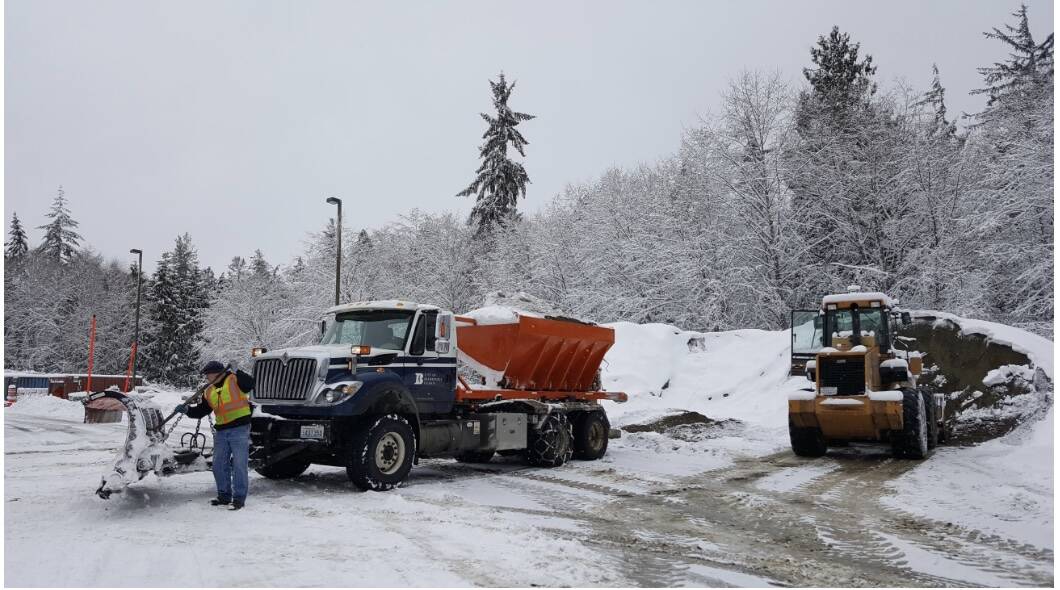
The city of Bainbridge Island typically prepares for emergency weather preparations beginning in August of each year.
In 2025, COBI has activated its emergency weather shelter between Jan. 19 and Feb. 13, with no December activations as of Dec. 22, city communications coordinator Shannon Hays wrote via email. A previous activation occurred at the Senior Community Center in early 2025, and provided coverage for 18 nights, encompassing 54 volunteer shifts, with an average of 2-3 volunteers per shift, 148 shifts covered and 740 volunteer hours. “On average, we provided shelter for 6 guests per night, with a high of 9 guests—the highest utilization we’ve seen in the past six winters,” Hays wrote.
BI also has a full-time emergency manager, Anne LeSage, whose position is funded by the city’s general fund, something Hays said is unique and allows for stable and locally focused preparedness efforts without needing to rely on federal funding streams. Some of these winter preparedness efforts include: advanced planning for snow, ice, and flooding.
Emergency management also includes public education about local hazards and neighborhood preparedness efforts. In the event of an emergency, the city also provides coordination between residents, volunteers and city services, including before, during, and after an emergency, Hays said. The city has an ongoing partnership with Bainbridge Prepares, an organization committed to providing a wide variety of emergency preparedness efforts for Bainbridge residents.
Hays said the city doesn’t upstaff for winter weather events; however, for snow and ice events, the city utilizes 12-hour operations and maintenance shifts providing 24-hour coverage. The city breaks snow plow routes into two categories: primary roads, priority 1 responses typically within 36 hours, and secondary roads, priority 2 responses typically within 36-72 hours. City operations and maintenance staff respond to local access or residential streets after priority 1 and priority 2 are covered. Highway 305 is the responsibility of the state Department of Transportation, per COBI.
The city reminds homeowners and businesses whose property abuts a sidewalk as responsible for ensuring sidewalks remain clear of snow, ice and obstructions, per city code. City property is maintained by city crews.
As part of city resiliency efforts, Hays said the city has sandbags stocked and available with up to 10 free sandbags per household. In 2026, COBI plans to improve water and sewer system upgrades, with the completion of a new seismically resilient Winslow Water Tank anticipated to come online in early 2026.
Hays said previously in 2023, the BI City Council increased the annual road preservation budget from $600,000 to $1 million annually, with the city’s long-term needs closer to $2.5 million.
Regarding power, Puget Sound Energy (PSE) provides electrical services to island residents and reported in 2024, 350 outages on the distribution and transmission system (346 distribution and 4 transmission), with transmission outages often impacting more customers, PSE spokesperson Gerald Tracey wrote via email.
A BI substation outage summary reported a total of 19 substation outages between 2018 and 2024 due to loss of transmission, including storm and non-storm outages lasting more than one minute, per PSE.
PSE reports BI residents can experience longer wait times and more frequent outages due to aging equipment, lack of redundancy, and difficulty accessing certain areas due to trees. PSE has several projects underway that aim to improve reliability and capacity.
“While federal programs are valuable, the city has long recognized the need for local self-reliance,” Hays said. “As an island community, we understand that outside assistance may be delayed in major weather or seismic events. The strongest indicator of success is how well prepared we are locally, at home, in our neighborhoods, and through city services.”