Wyckoff site healing year by year
Published 6:00 pm Saturday, February 10, 2007
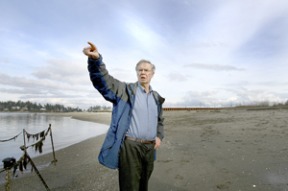
Biologists say life is returning to an area long fouled by creosote.The sand, the driftwood, the dog walkers and the children in search of jellyfish make the beach at Pritchard Park a much more inviting place than it was 15 years ago.
Still, Charles Schmid isn’t about to kick his shoes off.
“When we walked near here, after the creosote (facility) closed, they had us wear plastic booties for protection,” he said, watching people stroll along Bill Point, near Eagle Harbor’s entrance. “It’s such a great beach now. I’d like to take my shoes off…but I really don’t know…”
Schmid eyes a warning sign and ropes marking a portion of the beach where creosote, an oily, cancer-causing toxin, still seeps into the harbor.
“This roped-off section is just enough to get you worried,” he said.
Schmid and other members of the Association of Bainbridge Communities helped expose the toxic effects of the former Wyckoff wood treatment plant, which operated for nearly a century on the harbor’s southeast shore.
In the late 1980s, the facility was shut down and designated a federal Superfund site.
The EPA has spent nearly two decades cleaning the 50-acre site of creosote, a wood preservative used to treat dock pilings, utility poles and railroad ties.
The contaminated areas on the site’s western half were capped with sediment and transformed by the city into what is now Pritchard Park. The eastern portion of the former Wyckoff property continues to undergo cleaning behind chain-link fences and razor wire.
“That’s where the larger problem lies,” said Schmid.
The Environmental Protection Agency, which oversees the former Wyckoff property, stresses that the site poses no immediate health risks.
The EPA announced last week that it will spend $35 million to overhaul existing facilities used to pump and treat an estimated 1 million gallons of underground contaminants remaining at the site.
Overall, federal officials say significant progress has been made in restoring what was once one of Puget Sound’s most toxic shores.
“It’s a pretty good success story,” said Mark Myers, a National Oceanic & Atmospheric Administration biologist who has tested the fish off Bill Point since 1983. “The area’s still releasing creosote, so it’s not a perfect situation by any means – but we’re seeing a real decline in the risks from contamination.”
In 1983, almost 80 percent of the English sole Myers caught near the creosote facility exhibited cancerous liver lesions.
“When we first went out there we didn’t know quite what to expect,” he said. “We were pulling up mud that was 5 percent creosote. We didn’t bring protective gear.
“It was a pretty dangerous situation.”
Myers dropped healthy fish into tanks with samples of Eagle Harbor mud at NOAA’s Seattle lab. The results were shocking.
“They were dead within 10 minutes,” he said.
The toxicity of the area’s waters and beaches made the southeast portion of the harbor a virtual wasteland 30 years ago, said island fisheries biologist Wayne Daley.
“It was dead,” he said. “I’d row out there regularly. I just didn’t see any life there.”
But life is making a comeback, with many fish, harbor seals and shore birds returning to Pritchard Park’s rehabilitated shores.
Efforts to clean and cap contaminants have made for healthier fish populations, according to Myers, who now reports lesions in just 5 to 10 percent of samples taken last year.
“In ‘83, Eagle Harbor was the worst we’d seen anywhere in Puget Sound,” he said. “It’s come a long way.”
But much more remains, said EPA project manager Mary Jane Nearman.
“The plant’s in pretty bad shape,” she said. “It’s been working in a rough environment and needs to be replaced.”
Pumping on
The treatment plant pumps 30 to 55 gallons of groundwater per minute. Some creosote is skimmed off after it rises to the top, much like oil in salad dressing, according to Nearman.
From there, the water is sent through filters and then poured into what amounts to a giant litter box, where creosote bonds with carbon granules.
The treated water is released back into the harbor while about 300 gallons of creosote and other toxins are shipped off and incinerated each month.
Salt air and creosote have taken a toll on storage tanks and other treatment equipment.
“When Wyckoff built this stuff, they did it with carbon steel, which is vulnerable to rust,” Nearman said. “We want to replace just about everything with fiberglass and stainless steel.”
The $35 million overhaul, which could begin next year, may also include upgrades to the site’s sheet pile wall.
Set 30 to 100 feet in the earth, the rusty wall that rings the property is aimed at containing underground contaminants. Groundwater tests indicate the wall is doing its job, according to Nearman, but above-ground portions are degrading.
“We’re seeing pinhole penetrations,” she said.
As for the roped-off portions of Pritchard Park, Nearman promises an extensive $2.5 million re-cap by October.
About 1,200 feet of the beach will receive new sediment to contain seeps observed over the last two years.
The EPA plans to continue work for another five years before transferring the property to the city and clean-up responsibilities to the state Department of Ecology.
Nearman said it was unclear how long treatment would continue.
“That’s the question,” said Schmid as he strolled along a narrow strip between Wyckoff’s high walls and the shore. He stopped and took in a rare view that warning signs urge beach walkers not to risk.
“Right now the tanks and the fences are in the way and you can’t see this from the park,” he said, standing before the expanse of waves spreading toward Seattle’s skyline.
“When will we have this beautiful point to look out over?”