
When the knee goes ‘pop,’ the season’s over
Published 7:00 am Saturday, October 14, 2006
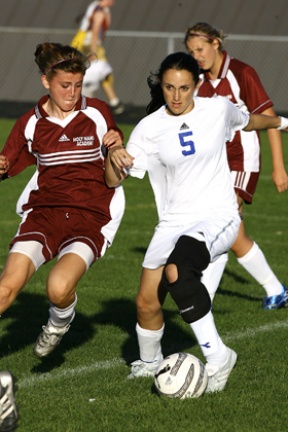
Young athletes face surgery, rehabilitation after ACL injuries
on the sports field.
When an athlete goes down with an injury, the sound they least want to hear is a “pop†in their knee.
It’s the sound that many people make while simply stretching to get the muscles limbered up in the morning.
Sometimes, it’s the sound that ends seasons and even careers.
Zena Hemmen, a co-captain for the Bainbridge girls soccer team, heard that sound last Saturday during the Spartans’ game against Lakeside.
Already playing on a bad left knee, Hemmen cut hard on her right leg, forcing part of her leg to move one way, while the rest of her body went the other way.
That’s when she heard the sound.
“I fell over and it just hurt really bad,†Hemmen said. “I heard a big ‘pop.’ My doctor said later that was the sound of my ACL snapping.â€
Coach Anh Tran and Hemmen’s father John, helped take her off the field. Her father, an ER doctor, helped get her to the hospital and for an MRI, a test that revealed the tear.
She goes in for surgery next Friday, and will miss not only the rest of the soccer season but her spring track season as well. A middle-distance runner, Hemmen was on the 4×400 relay team for Bainbridge at state last year.
“It’s rough,†she said. “The fact that I won’t do anything for a while hasn’t hit me yet. It’s different now that I’m not playing soccer every day.â€
The “pop†sound is something with which Hemmen’s teammate Hannah Oshin is all too familiar as well. The senior is coming back from her own ACL injury when she tore the ligament back as sophomore in May 2005.
She was at a tournament in Snohomish with her club team when she was fouled by a defender.
“I cut the ball back when I was crossing it and planted my foot,†Oshin said. “She turned around and slammed into my leg and bent it backwards.â€
Oshin knew she was in trouble in the split second it happened.
“My mom said I went completely pale,†she said. “I was just shivering. I’ve never felt anything like that before, so I knew I had done something really bad.â€
The anterior cruciate ligament injury – a tear in one of the four ligaments critical to the stability of the knee joint – is one of the worst an athlete can fall victim to, but for girls it’s become an epidemic in recent years.
According to a joint study done by Morgan Stanley Children’s Hospital at New York-Presbyterian and Columbia University Medical Center, adolescent girls are eight times more likely than boys to suffer an ACL injury.
“With more girls competing in soccer, basketball, gymnastics and volleyball – sports requiring maneuvers such as jumping and landing, or quick stops and turns – more cases of ACL injuries are being seen,†according to Dr. Christopher S. Ahmad, director of the Center for Pediatric and Adolescent Sports Medicine at Morgan Stanley Children’s Hospital and assistant professor of orthopedic surgery at Columbia University College of Physicians and Surgeons.
Bainbridge physical therapist Lynn Schorn has seen first hand how prevalent knee injuries are in girls.
“It’s an unfortunate incident for young kids,†Schorn said. “It takes them out of their favorite sport.â€
Schorn has been a physical therapist for 24 years, with the last 10 spent on the island at two different centers, most recently at New Motion.
She has worked on and off with Bainbridge High School to provide therapy for young athletes.
She is recovering from an ACL tear of her own, suffered a year and a half ago while she was playing soccer.
“Physicians push (athletes) to get back out there, but you risk the stability of the surgery,†Schorn said.
ACL 101
The anterior cruciate ligament is considered the most important the four major ligaments of the human knee.
It crosses in the center of the knee with the posterior cruciate ligament, providing stability to the knee and minimizing stress in the joint.
The injury occurs when an athlete makes a quick stop followed by a sudden change in direction, or when someone plants their foot and makes a cut.
It can also occur when another object, such as the body of another athlete in motion, comes in contact with the front of the knee, causing it to move in a different direction.
The knee’s other ligaments – the medial collateral ligament and the medial or lateral meniscus – can be torn as well.
This is called the “unhappy triad,†and can be potentially devastating, as evidenced by Miami Dolphins quarterback Daunte Culpepper, who hurt his ACL, MCL and PCL during a game while he was with the Minnesota Vikings last year.
The tear can be a partial or full one, with a full tear requiring surgery and a rehab time of six months to a full year to regain strength in the knee and be able to resume any physical activity.
For girls, the increased risk is due to the physical differences between men and women.
Women are more susceptible due to a wider hip placement causing a different angle in the knee, Schorn said. This causes a greater range of motion when the knee is in the valgus, or “knock-knee†position and puts more stress on the ligaments.
“The cleats that are worn for soccer, they’re designed to grab the turf, so there’s less ability for them to move easily,†she said. “The knee doesn’t get the movement with the torque that’s caused, thereby tearing the ACL.â€
Recent studies have shown how a woman’s menstrual cycle can affect how their muscles are impacted as well.
Shorn said that women have a 50/50 balance in strength in their hamstrings and quadriceps, but after their cycle occurs, the balance turns 75/25 in favor of the quad muscles, forcing them to compensate for the weaker hamstrings and putting stress on the other joints.
“It’s a huge difference,†she said.
Beyond the physical impact of the injury, there is an emotional impact for athletes as well.
“I’ve never done something major like this,†said Oshin, who went in for surgery in July 2005.
“I had known other people who had torn their ACL and come back from it, so I knew I could come back. But I was more worried I wouldn’t have the confidence to come back.â€
After surgery, Oshin undertook physical therapy for three months.
She stayed involved with the high school team as a manager, but found it wasn’t the same.
“It was really, really hard for me especially since my sister was a senior last year and I was really close with the other girls on the team,†she said. “Not getting the last chance to play with them was really hard for me.
“Sometimes the girls would complain because it was raining or it was cold and they didn’t want to play, and I had to sit there and be like, ‘I want to play, so don’t complain around me,’†she said. “It was really, really hard.â€
But Oshin pushed through with the support of her teammates – “They were so supportive of everything I did. I don’t know how I would have done it without them,†she said – and got back into soccer with club tryouts in March.
When tryouts for the high school team came around, Oshin wondered whether she would be the same player she was before her injury.
“I was just worried that I wouldn’t feel comfortable enough to tackle someone again, or if I jump up on the ball or kick the ball the wrong way that I would tear it again,†she said. “And after all this hard work, I didn’t want to go back down to the bottom again.â€
It hasn’t been in vain, as Oshin has made her positive contribution to the team, scoring two goals against West Seattle. But that’s not her measure of success.
“I’d rather play a good game than score a goal,†she said.
Oshin’s comeback will serve as an inspiration to Hemmen.
“I’m looking to Hannah for her advice,†she said. “If she can do it, I can do it.â€
And Oshin said she wants to be there for Hemmen as well.
“I don’t want to overwhelm her,†she said, “but I know she knows that if she needs someone to talk to about it that I’m the person to talk to and I’m there to help.â€
********************************************************************
Prevention by PEP
Suffering an anterior cruciate ligament tear is one of the toughest injuries athlete can come back from. But it’s not something that they often think about.
“I heard about other people tearing their ACLs and I was like, ‘that (stinks),’†Hannah Oshin said. “That’s so bad. But it didn’t even register with me that I would ever tear my ACL. It seems like you would have to do something really extreme to tear it.
“So when it happened, I was like, ‘Why? How is this possible?’â€
Due to hormonal and skeletal differences, female athletes are more susceptible to knee injuries than boys. But there are several programs out there that are trying to reverse the trend.
Laura Ramus, the head athletic trainer for the WNBA’s Detroit Shock, started a program called Girls Can Jump and sells a DVD on the website (http://girlscanjump.com/) that shows female athletes how to jump, cut, land and run to minimize the risk of knee injuries.
In a recent Detroit News article, Ramus is quoted as saying she can tell by the way an athlete lands after a jump whether she will tear her ACL. She’s helped more than 200 high school female athletes and several WNBA players come back from knee injuries.
Another prevention regimen is the PEP Program.
Designed by the Santa Monica Orthopaedic and Sports Medicine Research Foundation several years ago, the Prevent injury, Enhance Performance (PEP) program is designed to improve flexibility and strength through stretches, plyometric and agility drills.
Lynn Schorn, the physical therapist from New Motion, said the program is gaining popularity in soccer as athletes try to cut down the number of injuries.
“There’s a whole new move in soccer to take more steps instead of standing and planting,†she said. “It’s more of an emphasis on working on ball skills.
“The strategy (behind the PEP program) is to improve and maintain hip flexibility in young kids,†Schorn continued. “Their skeleton system is growing quickly so their muscles are tight. So a good stretching program is key.â€
Oshin feels the program is a good idea and could keep future soccer players off the sidelines.
“If we had done a lot of this I think it would have helped,†she said.
Information on the injury prevention regimen is at www.aclprevent.com/
– John Becerra, Jr.