
Remembering the Dix
Published 9:00 am Wednesday, November 8, 2006
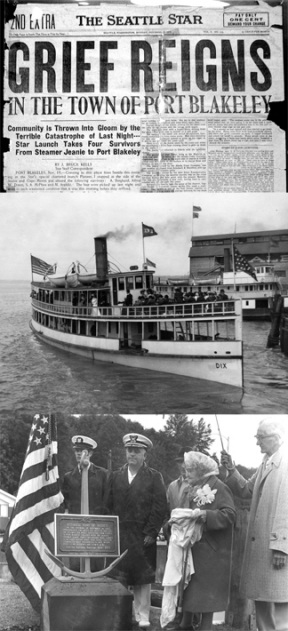
One hundred years ago this month, the island saw its worst maritime disaster.
Neither written history nor family lore can say with precision why Lillian Grainger traveled from her Spokane home to visit Port Blakley in November 1906.
Thanksgiving was 10 days hence, but perhaps a rare visit with two of her three brothers and other kin was occasion enough for the trip.
On Sunday, Nov. 18, at the end of her overland journey, Mrs. Grainger was greeted in Seattle by Charles Edward Byler and Christian Byler, manager and clerk at the Port Blakely company store.
At 7 p.m., the three siblings set out aboard the SS Dix, one of two passenger steamers that provided regular service between Seattle and the thriving mill town at the southeast corner of Bainbridge Island.
The happy reunion ended mid-route, about two miles off Alki Point, when on a calm and moonlit night the little steamer collided with the freighter SS Jeanie. In less than a minute, the Dix and more than half of its passengers and crew were gone.
The accident orphaned Charles Byler’s son, 14-year-old Charles Archibald “Archie†Byler, who had already lost his mother Ethel Mae to a medical malady two years earlier.
While in adulthood he never spoke much of his father’s death, Byler’s daughter Mary Harris says the Dix tragedy remains embedded in her own heart and the hearts of her family.
“We’re very close to the memory of what happened,†said Harris, 61, of Damascus, Ore. “That was a tragedy for our family.â€
Harris will join Bainbridge Islanders and other Puget Sound historians on Nov. 18 for the centennial observance of the final voyage of the steamer Dix. A commemorative excursion will depart Seattle’s Pier 55/56 to retrace the last moments of the Dix, in which 45 of 77 passengers and crew members were believed lost.
While not the only maritime mishap in Bainbridge history – four lives were lost in the sinking of the steamer Tolo in 1917 – the Dix tragedy endures in local lore because of its great loss of life, and the unfathomable impact on the mill community where many of the victims had lived and worked.
“Port Blakely is grief stricken,†a newspaper man somberly told readers in the next edition. “Scarcely a home in that mill town is not darkened by the disaster.â€
Wrote another: “The greatest mill in the world is silent.â€
Collision
The 102-foot, 130-ton inland steamer Dix sailed under the flag of the Alki Point Transportation Company, one of numerous marine outfits that ferried passengers and cargo around Puget Sound in the Mosquito Fleet days.
The vessel had been commissioned just two years earlier and was mastered by Capt. Percy Lermond, a seasoned salt with 13 years of uneventful service.
At 186 feet and 1,071 tons, the Jeanie was larger and older but also new to Puget Sound, having seen most of its work up north with the Alaska Coast Company. On this evening, helmed by Capt. Philip H. Mason, it was loaded with ore bound for a smelter in Tacoma.
Shortly after setting out from Seattle’s Pier 52 with nearly 80 aboard, Capt. Lermond turned over the wheel to First Officer Charles Dennison and went below to collect fares from passengers, most of whom he knew by name.
The steamer headed south and west at seven knots across glassy seas, on what was generally a 40-minute run.
Two miles off Alki, the two ships crossed paths and then into maritime history.
Approaching from the north, the Jeanie’s captain slowed to allow the westbound Dix to pass across his bow. But Dennison misjudged the maneuver and turned the wheel hard into the path of the oncoming freighter.
Frantic whistles alerted Capt. Lermond, who sprang to the deck to find the Jeanie bearing down on his steamer.
“Where in the hell are you going?†the captain was heard to call to Dennison – but the moment for deliverance had come and gone. The Jeanie struck the Dix just aft of amidships, rolling the narrow and top-heavy steamer onto its port side.
While little structural damage occurred, the sheer weight of the larger vessel forced the Dix down. Water poured in and filled the cabins and hull; the steamer righted itself for a moment, then plummeted by the stern and disappeared in 100 fathoms.
The time: 7:24 p.m., known with precision because Capt. Lermond’s watch stopped when the captain himself went into the water.
First Officer Dennison was last seen motionless at the pilothouse window; he made no apparent attempt to save himself and followed his blunder to the bottom.
Crew and passengers below decks, including the women in the ladies’ lounge, had no chance to escape and too were dragged to a sodden fate.
Those fortunate enough to be on deck were thrown into the icy waters of the sound. Some drifted away and succumbed; others clung to debris until they were fished out by the crew of the Jeanie.
A.W. Dixon, a Dix passenger who served as first officer on a steamship docked at Port Blakely, credited the Jeanie’s crew with an able rescue effort.
“The boats from the Jeanie did good work, and I don’t think they missed anyone,†Dixon told the Daily Times. “They were splendidly handled and lowered with promptness that indicated the skipper kept his boats and men in first-class shape. Every man knew his work, and they were on the water as soon as possible under the circumstances.â€
The Jeanie spent several hours searching for survivors before returning the haggard few to Seattle. Most returned to the island around 2 a.m. the next morning aboard the steamer Florence K.
Port Blakely townsfolk – who by this time knew of the sinking, but had no idea who might have been saved and who lost – lined the pier to greet them.
Aftermath
The Dix tragedy touched the company town from boardroom to bedroom.
Among those lost were Mrs. T.C. Ford, wife of the Port Blakely Mill Company superintendent; the Byler brothers, manager and clerk of the mill store; an entire family, who history records only as “James Smith and wife and boyâ€; an array of company employees and mill workers, from lumber surveyors to oilers; Peter Buzzattie, the town barber; C.J. Kenny, hospital steward at nearby Fort Ward; five Japanese mill workers and two Chinese laborers coming over to look for jobs, and a newly immigrated Filipino named Bazzintia Garcia.
While more tales of heroism and sacrifice no doubt went unrecorded, the greatest distinction went to Roland R. Price, son of the Port Blakely postmaster.
The younger price is credited with saving 13-year-old Alice Simpson – who was reading a magazine in the ladies lounge, and was helped up the wildly tilting companionway to safety – before he was himself claimed by the waters.
The day’s mode of attire also helped; Simpson’s billowy skirts gave her added buoyancy until she was plucked from the sound.
Newspapermen flocked to cover the story, and the sinking was amply documented in records that survive to this day.
The event was of sufficient magnitude that the Seattle Star published not one but two “Extra†editions the following afternoon, giving readers on both sides of the water the latest developments.
“The town is mourning. The mill is closed,†a Star reporter grimly intoned, while in the Seattle Daily Times, a reporter surrendered to a more dramatic writerly impulse:
“Somebody blundered,†the unidentified writer opined. “In those two words lie the reason for many of the greatest tragedies the world has known in modern times, when men, women and children have gone down to death in scores and hundreds as a result of carelessness or inattention to orders on the part of men who have been at the throttle or wheel of those mighty machines…
“On water, noble vessels have gone plunging to the bottom of the ocean carrying with them freight of human souls whose joys and sorrows have been snuffed out like the candle by the mistake of the human brain that can never be infallible because of its very humanity.
“And so last night, almost within hail of the city of Seattle, at an hour when the people were brightest and gayest, when the cafes were filled with the Sunday evening crowd of diners-out., whose laughter mingled with the orchestras, on the waters of the sound another tragedy of human error was enacted that sent down to death in the bitter cold waters more than half the passengers of the little steamboat Dix…â€
Both newspapers carried extensive and sometimes conflicting first-hand accounts of the sinking. The discrepancies – mainly centering around the damage sustained by the Dix, and how long the vessel managed to stay afloat – can only be ascribed to the trauma of the survivors.
Alki residents combed the beach throughout the following day, but the Dix did not surrender a single body. Some who were reported missing later turned up alive, having missed the Dix’s 7 p.m. departure for whatever reasons.
At Port Blakely, the mill shut down as the town observed two days of mourning for the souls who perished.
Witnesses on both vessels put the blame squarely on the shoulders of Charles Dennison and his ill-fated turn into the freighter’s path – a notion gladly advanced by Capt. Lermond.
“I can’t see what he was driving at,†the captain told the Daily Times. “There was plenty of room without going so close to the Jeanie. He was an experienced man and must have known he was taking grave chances.â€
A formal inquiry nevertheless faulted Lermond for failing to provide a lookout and for giving the wheel to the first mate, who it turned out was not properly licensed to pilot the vessel on inland waters.
The captain’s own license was revoked but reinstated the following year. He continued to ply the sound as ship’s master until 1933 – never again with passengers, only cargo.
The Jeanie continued to sail until Dec. 19, 1913, when it went down after running aground in fog off Calvert Island in Queen Charlotte Sound. All hands were saved.
Through the years, the tale of the Dix has been burnished like a ship’s bell.
In 1973, a commemorative marker was established at Alki Point. Among those on hand for the ceremony were 81-year-old Alice Simpson Bassett, and Marcus Otnes, 97, the last living survivors of the sinking.
On Bainbridge Island, visitors to Port Blakely Cemetery will find a great obelisk erected in memory of those lost who were members of the Knights of Pythias, one of several fraternal organizations active in the mill community at that time.
Young Archie Byler moved to Shelton to live with friends, while other family members put down new roots on the southern Oregon coast.
Mary Harris was born in Los Angeles, Calif., where her father played baseball in the Pacific Coast League in the 1920s.
One of the heirlooms left by Harris’ grandparents, Charles and Ethel, is a silver water pitcher, a wedding gift that dates to 1891. The family used the vessel in the wedding ceremony of Harris’ own daughter a century later.
That set Harris to thinking about whether Bainbridge Island would commemorate the loss of a vessel that carried her grandfather, great-uncle and great-aunt to their deaths.
It will, and she is coming north to pay her respects.
“It’s heartwarming to know that I’m here 100 years later, and that it’s meaningful to all of us,†Harris said. “There’s quite a bit of our family that are aware of this tragedy. It’s very personal.â€
************
A fateful voyage
The Bainbridge Island Historical Society and the Southwest Seattle Historical Society’s Log House Museum sponsor a 100th anniversary commemorative cruise to the site of the sinking of the steamer Dix on Nov. 18. The trip departs from Argosy Cruises at Pier 55/56 on the Seattle waterfront. The vessel loads at 11 a.m., departs at 11:30 and returns at 12:30 p.m. Tickets are $10 per person; reserve a seat by calling (206) 938-5293.