Every tree has its own tale to tell
Published 9:00 am Wednesday, July 5, 2006
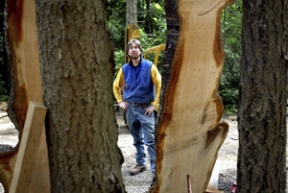
Some reveal themselves as furniture, others as mantels to craftsman David Ko.
Like the trees he mills, the life and career of David Kotz can be measured in concentric rings.
Five or eight for his daughters’ ages. Fifteen for his seasons as a mill owner and woodworker. Each year, a new layer is added.
It’s not a physical expansion – Kotz is fit – but an accumulation of experience hewing the island’s orphaned wood.
At the core lies a life-long love of trees and a desire to give a legacy to their lumber.
“I’m always looking for trees,†Kotz said. “Every tree has its own story, its own character that makes it beautiful.â€
Kotz, who started out cutting firewood as a teenager, now mills trees at his family’s 10-acre homestead on Coyote Farm Lane, for a business he aptly named Coyote Woodshop.
In addition to selling milled wood to others, Kotz builds rustic furniture for sale at Dana’s Showhouse.
The process, he admits gratefully, begins with help from his island neighbors.
Developers, homeowners and the city tip him off to trees that need to be removed and those that are dead or already fallen.
Once they’re horizontal, Kotz hauls them back to his property to begin his work.
He slices the trees into slabs of varying thickness, dries them in a kiln and then air dries them in carefully labeled stacks for a year or more.
The wood can be used to build just about anything, including tables, benches, bars, mantels and window seats.
Kotz, who has always had an “artistic bent†toward wood, said the natural character of the tree often dictates its optimal use.
Not long ago he received a cascara tree that had died shortly after achieving its distinction as an island champion.
Kotz could have turned it into a stool; indeed, cascaras have a varied history that includes use as a laxative for early Native Americans.
But this particular specimen, with its rosy color and fluid grain, seemed best suited to become a dining table, a transformation that is currently under way in Kotz’s shop.
Other trees in his inventory include an 80-year-old cherry that was removed from the old winery property, several 80-year-old oaks from an original homestead near Rolling Bay and a horse chestnut from Harbor Court.
Klaas Hesselink, co-owner of Paper Products Etc. on Winslow Way, works part-time for Kotz to satisfy his interest in woodworking.
“I’m just trying to learn,†Hesselink said after he and Kotz laboriously cut a 3-inch slab from a mammoth barrel of fir. “David has a different take on wood.â€
It has taken time for Kotz to build his business, in part due to the cost of equipment, which includes an $18,000 mill purchased in 1990.
The expense, he said, has been worth it.
Kotz occasionally ventures off-island in search of wood, but the time and expense involved in doing so often negate the benefits.
“It’s helpful when developers let me come in before the bulldozers and excavators grind everything up,†he said. “Then I can turn it into something. Sometimes it’s just a matter of luck.â€
Coyote Woodshop’s regular stock includes alder, cherry, maple, fir, cedar and madrona, though apple, elm, cascara, pine, juniper, pear, birch, dogwood, locust, walnut and redwood are also often available.
Locust, he said, is one of the more popular varieties of wood by virtue of its color and hardness, which appeal to boat builders.
He enjoys working with all kinds of wood and is up for experimentation, which is partly why he sought the horse chestnut tree, the planks of which are drying near other bygone trees that will one day be integrated into island structures.
The wood stacks are visible throughout the property, which includes Kotz’s home, as well as those of his brother, his in-laws and his mother.
He grew up on the land where he’s now raising his own family, and is happy to make his living among the trees, with one small exception:
“There’s just not enough time to build all the things you’d like to.â€