Bard blended: Sayonara, sweet prince
Published 10:00 am Wednesday, December 3, 2003
East meets West in an anime-based version of the Shakespeare classic.
“I’ve adapted ‘Romeo and Juliet’ two other times,” theater school director Steven Fogell said. “In this version I decided to go with a Japanese theme because I see the popularity of Japanese animation with young people and I needed to connect with their culture.”
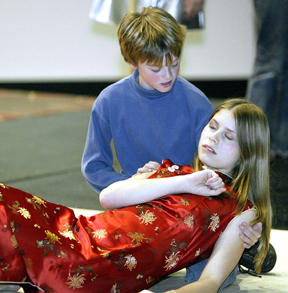
The Bainbridge Performing Arts “Romeo and Julieta” features Kabuki theater, Japanese animation, and stage combat performed by 30 seventh-through-12th grade students.
The production sets the stage with screen projections of manipulated stills from Katsuhiro Otomo’s “Metropolis” (2001).
Shakespeare’s story of young love in 16th century Italy is recast in a future Tokyo where technology is worshipped and all artforms are outlawed.
The warring families are translated into this landscape, with Romeo’s family, the ruling Montagues, pushing technology, while Juliet and her parents are an underground troupe of Kabuki performers on the run.
When Romeo sees Julieta perform, the romance that will end in tragedy is kindled.
The play features a second Kabuki segment as well.
Including the traditional Japanese dance form allowed Fogell to introduce the play-within-a-play as a vehicle to frame Shakespeare’s words.
“Those scenes are word-for-word from Shakespeare’s play,” he said. “Otherwise the language is adapted. It’s a way to introduce young audiences to Shakespearean English without overwhelming them.”
The plays-within-plays were choreographed by assistant director Rain Ross in Kabuki style.
“We went more for an approach of the style of this traditional theater form,” Ross said, “rather than full-on classes of Kabuki…it was a great opportunity to encourage young actors to go to extremes of stylistic movement and to encourage them to think about how movement can truly relate a story.”
Elaborate costuming in traditional kimonos and makeup enrich the play visually, as do projected stills that include a cherry tree super-saturated with color, that slowly dissolves until it resembles abstract art.
Despite the changes to Shakespeare’s play, the ending is preserved intact, Fogell says.
“It’s tough acting,” Fogell said, “and I was also kind of nervous about the issues of teen suicide. But I felt compelled to keep the tragedy that is at the heart of the story. And it was actually a good chance to address the issue in a level-headed way.”
* * * * *
“Romeo and Julieta,” a Bainbridge Performing Arts seventh-through-12th grade theater school production written and directed by Steven Fogell, with choreography by assistant director Rain Ross; sets and lighting by Mark Sell; and stage manager Deidre Ray, plays Dec. 4-6 at the Playhouse with shows Thursday and Friday at 7:30 p.m. and a Saturday matinee at 3 p.m.
Tickets are $9 for students/seniors and $12 for adults, available at the door or charge by phone at 842-8569. Recommended for children 7 and over.