
Animal lovers to grant Ferry Dog Mothers’ wish
Published 4:39 pm Thursday, January 28, 2010
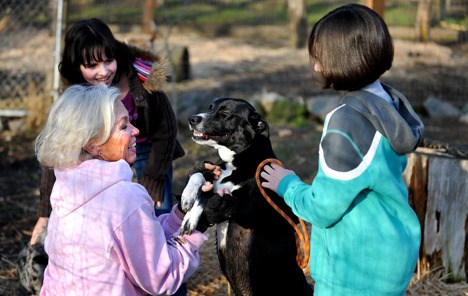
When 9-year-old Tabitha arrived at Ferry Dog Mothers rescue farm in Rolling Bay, founder Teri Cole already knew the shepherd-chow mix’s complicated medical history.
Tabitha, who had a history of strokes, drank two gallons of water a day, causing her to bloat abnormally and appear pregnant.
But Cole wasn’t prepared for news that Tabitha had a cancerous tumor in her spleen.
“I don’t think she’s in any pain, but how do we really know?” Cole said.
While removing the growth would relieve tremendous pressure from Tabitha’s organs, Ferry Dog Mothers can’t afford the $3,000 surgery.
“It’s not just the surgery,” Cole said. “She has to be in the hospital – like a person – for four days afterward.”
When 11-year-old islanders Micaela Hogger and Anisa Ashabi heard Tabitha’s story, they immediately took action.
“We heard (Tabitha) had a tumor, and we really wanted to help with that,” Hogger said. “We started emailing each other and figuring the whole thing out.”
Hogger and Ashabi, frequent visitors to the nonprofit rescue farm and avid animal lovers, have spent the last several months organizing a carnival fundraiser to benefit Tabitha and Ferry Dog Mothers.
Hogger has 18 animals – including a horse, four chickens and two guinea pigs – while Ashabi has rescued an adult dog of her own.
“We decided that we wanted people to get to know this rescue, so they wouldn’t buy from breeders and pet stores and contribute to the number of unwanted animals that are put down every year,” Ashabi said. “We wanted people to learn to rescue animals instead of buying them – by knowing this organization – and to bring attention to it.”
The event, which takes place from 12-2 p.m. Saturday at the Sea Breeze building on Bjune Drive, will include a cake walk, a duck pool, and – of course – Cole’s dogs.
Hogger and Ashabi recruited volunteers, contacted local vendors for the cake walk, and have already begun fundraising by selling eggs produced by the Hoggers’ chickens.
The girls have posted fliers throughout the community to publicize the event, and appeared on Sakai’s student broadcast, encouraging their peers to participate.
“We want people to know that even at a shelter – even if they’re mutts – they’re not going to just be ugly little dogs,” Hogger said. “They could be just as cute as any dog at a pet store.”
Dogs in danger
Ferry Dog Mothers, which also takes in sheep, goats, geese and chickens, found homes for more than 100 dogs last year, and – in conjunction with several rescues – saved more than 50 dogs from euthanasia in Moses Lake in the last two weeks.
“All of these dogs were going to have the needle in the neck – I hate to put it like that – just for lack of room,” Cole said.
Ferry Dog Mothers’ statewide network, which includes both rescues and local animal shelters like PAWS, often saves dogs that are scheduled to be euthanized within 48 hours.
The Kitsap Humane Society, which saw more than 3,800 animals adopted in 2008 and 3,000 in 2009, only euthanizes animals “when unable to rehabilitate due to sever medical or behavioral issues,” community outreach coordinator Kim McKoy said.
Kitsap’s euthanasia rate – 4.4 percent – is much lower than the national average, McKoy said.
The SpokAnimal C.A.R.E in Spokane euthanized 49 percent of its 8,124 cats and dogs in 2009.
Many of the dogs Ferry Dog Mothers rescues are from Eastern Washington, Cole said.
With a growing number of unwanted dogs and a decline in donations, the need for adoptions has greatly increased, Cole said.
“(Many animals) were surrendered by their owners because they were unable to afford or even feed them,” she said. “People lose their jobs and their homes. They usually have to move in with relatives and scale back to apartments that don’t allow dogs.”
The experience is extremely emotional for both the owners and rescue workers, Cole said.
“I cry for people every day,” she said. “A lot of the people can’t even finish the phone call conversation. I just tell them to email me, and tell them I’ll help them.”
Whether dogs are rescued from shelters or are brought by their owners, they receive the same standard of care.
“We get them all vetted, and we feed them,” Cole said. “Most of the time they’re not well. Some have kennel cough or they have weepy eyes, or they have ear infections, or they’re starving. That’s the way a lot of the shelters get them.”
While Cole can only house up to seven dogs at a time, animal rescues provide more one-on-one attention and outdoor time, she said.
“What people need to know is that they don’t have to take their dogs to the shelters,” Cole said. “There are a lot of nonprofit rescues and a lot of purebred rescues that will take dogs.”
All the canines at Ferry Dog Mothers have outdoor pens and can run in a large field on the back of the property.
“Shelter conditions are hard on a dog,” she said. “Shelters make them crazy, because it’s noisy, they’re in a four-by-four (cage). They don’t always get walked, but shelters do the best they can.”
Finding a forever home
Once the dogs are healthy and spayed or neutered, the final step is to find homes for them.
“I actually found out about Terri when I was trying to adopt a dog,” Ashabi said. “Ever since that I’ve been trying to help her out. I had a puppy, and she helped me find a good home for him. Now he lives at the pumpkin farm.”
Ferry Dog Mothers requires prospective owners to complete a seven-page application and submit to pre- and post-adoption home checks.
Adoptions, especially of puppies, can be more challenging than many new pet owners expect, Cole said.
“I think when people adopt a dog from a shelter or rescue, they expect them to walk into the house and be perfect dogs,” Cole said. “(The dogs) don’t know where their next meal is coming from, they don’t know if they’re going to be nice to them. They’re looking for their last owners, so you have to always give them a chance.”
The Internet has also stretched Ferry Dog Mothers’ reach outside of the state. Dogs have come from as far as Iowa to homes on the island.
“A lot of people want handicapped dogs, they want blind dogs, they want old dogs,” Cole said. The days of saying ‘let’s just put them down’ – those days over.”
For Hogger and Ashabi, animal advocacy consumes a great deal of their free time.
The girls use online resources like the Web site for People for the Ethical Treatment of Animals to identify companies that are cruel to animals, and write letters or call the companies directly.
Ashabi also plans to blog about her efforts.
The carnival is only the beginning of Hogger and Ashabi’s involvement with Ferry Dog Mothers.
“We’re hoping to help out here regularly and once a week and the weekends,” Hogger said. “We’re hoping after the carnival, we’ll start volunteering here, and we’ll get the word out.
***
Beware of the Internet
While the Internet provides greater avenues for finding homes for unwanted pets, online postings that offer dogs “free to good home” can often put pets in danger.
“Dog fighters pick them up and use them for bait,” Cole said. “We had a man posing as a minister saying he wanted to adopt pit bulls.”
Cole scours Craigslist daily, and personally contacts the pet owners, encouraging them to remove the post or find a safer way to find the dog a new owner.
“People just don’t know – they aren’t thinking beyond how much they love their pet and how they take care of them,” she said.


Best of Bainbridge