Steamer trip is a sellout — News Roundup
Published 12:00 pm Saturday, May 22, 2004
The Bainbridge Island Historical Society’s round-the-island tour aboard the steamer Virginia V won’t take place for another month yet, but the society is already planning to do another.
Tickets still are available, however, for a cruise from Bainbridge Island back to Seattle after the around-the-island tour.
The around-the-island trip, scheduled for June 27, sold out on the second day of ticket sales Tuesday, said Ralph Cheadle, co-chair of the event.
“I expected we would fill the ship up for the around-the-island cruise, but I had no idea we would do it as quickly as we did,” Cheadle said.
“At the very least, we’ll probably make this an annual event,” he said. “It’s also possible that we will put together another cruise for late August or sometime in September if the interest is there.”
The Virginia V holds 150 passengers. Tickets for the island tour were $50 each and went on sale to members at 10 a.m. Monday; the last one was sold at about 5 p.m. Tuesday, Cheadle said.
The society has posted a sign-up sheet on the door of its office at 355 Ericksen Ave., Suite 422, for those who would like the first chance to buy tickets for a new tour around the island. Possible dates have not been determined yet, Cheadle said.
After the Virginia V returns from the around-the-island cruise at 2 p.m. June 27, passengers can ride the ship on its return trip to Seattle through the Ballard Locks and to its berth at the south end of Lake Union, arriving at about 5:30 p.m.
Passengers traveling back to Seattle aboard the Virginia V will need to make their own arrangements for getting from Lake Union back to the island.
Tickets for the back-to-Seattle cruise are $25 each and will be on sale Monday at Winslow Drug and the Traveler. Waiting lists for a new around-island cruise also will be at both locations.
The steamer Virginia V is the only Mosquito Fleet vessel still afloat among the hundreds that provided connections to communities along Puget Sound during the late 1800s and early 1900s. The Mosquito Fleet ceased operations in the 1950s.
The Virginia V underwent a complete rebuild during the 1990s and began operations as a charter vessel two years ago.
Its last tour around Bainbridge Island was in 1980, when the Bainbridge Island Rotary Club chartered it to help raise money to overhaul the vessel.
Ferries to cut fuel emissions
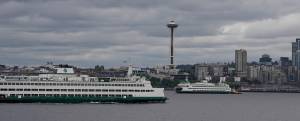
Washington State Ferries are going green, with a switch to low-sulfur diesel fuel, the agency said Friday.
WSF will also test ultra-low-sulfur diesel fuel, and test biodiesel fuel – all steps that will improve air quality by reducing the amount of harmful substances in the ferries’ diesel fuel exhaust.
The “clean-fuel initiatives” were unveiled at a press conference Friday by Gov. Gary Locke, WSF Director Mike Thorne, and John Iani, regional administrator from the Environmental Protection Agency.
“Washington citizens value our unique and special ferry system. Now we can be even more proud of our ferries because of this innovative program that will improve air quality, benefiting public health and the environment,” Locke said in a statement.
“The ferry system is far ahead of other marine fleet operators in addressing diesel emissions,” Iani said.
The ferry system has also upgraded its vessels with more-efficient engines and made operational changes that have reduced fuel consumption and emissions, WSF said.
As a result of the changes, an estimated 10,000 fewer tons of pollutants per year will be released into the air by ferry fuel emissions.
The entire fleet will switch to low-sulfur diesel this year, reducing sulfur dioxide emissions by 412 tons, or 90 percent, and particulate matter.
Lower-sulfur fuel costs less than a penny more per gallon than regular fuel, increasing the total cost by $150,000 a year for the entire fleet.
Ultra-low-sulfur fuel will be tested on the vessel M/V Elwha, which sails from Anacortes through the San Juan Islands.
The biodiesel blend “B20” – 20 percent biodiesel from vegetable oils, animal fats and recycled restaurant greases, and 80 percent low-sulfur petroleum – will be tested on the “triangle route” between Fauntleroy, Southworth and Vashon Island.
Higher costs incurred in using the biodiesel fuels will be covered by the Clean Air Agency, the EPA and Seattle City Light, the latter under its Greenhouse Gas Mitigation Program. They will not be passed on to riders in the form of higher fares, Thorne said.