So, you want to be a firefighter?
Published 8:00 am Wednesday, December 7, 2005
Volunteering is hard work for no pay – but it has its own rewards.
Imagine it’s pitch black. You’re outfitted with enough heavy gear to attempt a moon landing, and you’re about to crawl into a hole that appears to have been abandoned by a very large rat.
“Welcome to our torture chamber,†says a voice from behind. “Now pretend this house is on fire and you have to save a baby.â€
Using only your hands as guides, you slip inside, taking the first corner on a low crawl.
The tunnel turns left, drops down, twists right and begins to narrow. The breathing apparatus and face mask amplify the sound of your rapid breathing as your lungs are hit with cold gusts of canned air.
Your air tank clangs against the low ceiling as you try to puzzle your body into a tight turn that you find dead-ends when your head smacks a wall.
A personal motion detector dangling from your shoulder chirps loudly, forcing you to keep moving. Your arms tangle with tubes and straps hanging from your mask and torso as you backtrack.
Then you hit the web of electrical cords where you squirm through a gamut of contortions before finally rolling out of an opening and tearing away your steaming air mask.
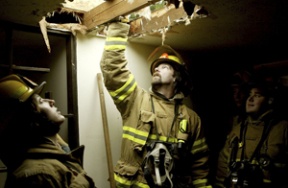
This is no surreal nightmare. It’s the final hurdle Bainbridge volunteer firefighters must overcome before storming an old house with its walls ablaze for a “live fire†training exercise.
“The maze is a confidence prop,†says Luke Carpenter, the Bainbridge Island Fire Department’s operations chief. “It gets firefighters used to having to wear the gear in a dark place where they feel trapped and uncomfortable.
“It gives them the knowledge to be able to control their feelings because, if you blow a gasket, there’s a good chance of getting dead.â€
Volunteer firefighting is no easy job. There’s no money in it – except for the paltry $8 to cover gas each time firefighters are called upon to save homes and lives.
And it certainly isn’t cushy. The island’s 60 volunteers must give up each Tuesday evening for medical assistance, equipment and strenuous fire training.
It also means they must leap from warm beds or drop dinner forks whenever their pagers alert them to emergencies ranging from heart attacks to house fires.
“There’s a lot of challenges – time commitments, dangerous situations – but the challenge is what draws a lot of them,†says Carpenter. “Some are here for the camaraderie or for service to their community. We’ve also got some thrill-seekers. As I always say, firefighting is the most fun you can have with your clothes on.â€
The island’s volunteer firefighters are a cross-section of the island’s population, says the department’s volunteer coordinator Jim Dow.
“Over there’s a lawyer, and there’s a nursing student,†he says, pointing to a crowd of volunteers suiting up for a training exercise. “This guy’s a retired scientist and over there’s a park ranger, a contractor, a ferry engineer, a stay-at-home dad.â€
Volunteer Marjorie Lemaster joined about two years ago for the “excitement of firefighting.†She intends to join the department as a career firefighter.
“It’s really something different,†she says, while adjusting her helmet after a water hose training. “Other people go to work and look at a computer screen. But I get to do something where each call has challenges and unknowns.â€
The job isn’t all wind-in-the face sprints to roaring fires. About 85 percent of the department’s calls are for medical emergencies and many fire calls end with a burned toaster.
This reality sometimes dulls the allure of the job, but most stay on the roster because the Bainbridge department puts its volunteers to real use, Dow says.
“One reason we have a successful volunteer program is because we give our people considerable front-line experience,†he says, adding that the department’s 16 career firefighters can’t cover all the primary roles in many emergencies.
“We make our volunteers feel valued because we use them,†Dow says. “At some departments they do all this training and then sit at the station or mind a water tender while the career guys do all the work. How inspiring is that?â€
Still, the department has filled less than half its volunteer recruitment goals for next year. Of the eight to 10 new volunteers they hope to draw each year, only four residents have signed on for the initial training class that begins in March.
“I don’t know why this is, but the law of averages says it’s got to go down sometime,†Dow says.
The decline in recruitment isn’t limited to Bainbridge.
According to Dow, the last two years have seen a 30 percent decline in the nation’s volunteer force. Dow believes tougher national standards and longer time commitments have made volunteering less appealing for some.
But for other longtime firefighters, years of battling fires reveal many rewards when the smoke clears.
“I’ve seen a whole lot and I’ve loved it,†says Carpenter, looking back over 30 years of firefighting. “I’ve held the hands of people when they’re bringing new life into this world, and I’ve held the hands of people as they leave this world.â€
* * * * *
This is the first of two parts. Saturday: Into the inferno.