Freed from the bonds of familiar culture
Published 6:00 pm Wednesday, October 5, 2005
The Krueger family finds new life helping Kenyans achieve
self-sufficiency.
How many people does it take to make dinner?
In the U.S. the answer is one, but that’s not necessarily better than the Kenyan answer of three or four – one to start the charcoal fire, one to cut up vegetables, and several to mind the kids and read aloud.
Jeff and Marit Krueger and their two daughters moved from Bainbridge Island to a farm on Kenya last year to help the locals throw off the passive mindset taught by the education system of British colonialism.
They found “liberation†themselves, freedom from the invisible bonds of U.S. culture.
“I’ve been so keenly aware that there’s time for self-reflection (in Kenya),†Marit said. “There’s time built into the day for self-reflection that you have to fight for in this culture. So much of what (Kenyans) do, it’s busy and working – cooking, washing – but you’re helping each other. It seems more communal, whereas in the U.S. you might do it alone.
“There it’s really busy, but it’s about living.â€
The Kruegers returned to the island recently for a one month visit this past September.
In September 2004, they left their life of 15 years on Bainbridge Island to work at Nehmiah International Miwani Center, a 130-acre farm in Miwani, a small town in central western Kenya on Lake Victoria.
The farm was established by International Fellowship, a nondenominational Christian organization established by Jeff’s father and Kenya resident John Krueger, with two Kenyans and a German.
The Kruegers and four young Kenyan families live and work on the farm, providing a family experience for 19 orphans, ages 6-16, who live with a family committed to raising them until they “graduate.†School graduates can stay on to learn skills on the farm – dairy, raising poultry, horticulture, carpentry and metal smithing – that they then can use to earn a living.
The children would otherwise be raised in orphanages, to be turned out as young teens with an education but no practical skills.
The farm children attend school and help out with household chores. Alexis Krueger, age 10, and Katarina, age 12, do, too.
The youngsters get up at 7:30 every morning to care for four goats. The girls walk to the barn and meet up with the Kenyan workers tending the cows.
The girls sell the milk – essential to the Kenyan laborer’s daily breakfast of tea with milk and sugar – to workers as they walk home. After home schooling with their mother, it’s back to milk again at 4 p.m.
At the end of each month, money is set aside for the goats’ care and then divided between the youths. Alexis says she enjoys the responsibility.
“With a cat, my sister can feed it and I can scoop the poop. With a goat, you really have responsibility,†she said. “If you don’t milk the goat (twice a day) it could get udder infection. If food is not grown, then they wouldn’t have enough to eat.â€
Compared to household chores, Katarina adds, “the house wouldn’t blow up if you didn’t vacuum the stairs.â€
Marit tutors the farm’s children on Saturday to help them catch up to their grade level. Before public education started in Kenya a few years ago, many had never attended school.
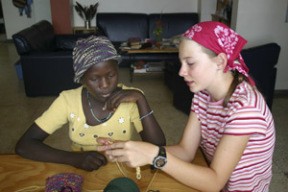
Katarina and Alexis have established a library for the farm, which has received contributions from friends and visitors from Bainbridge Island and The Last Chapter book club. It now has over 1,000 volumes. Yarn donations from the island’s Churchmouse Teas and Yarns spurred knitting classes there.
On Sunday, the residents have religious education with Sunday School.
Although the foster families are required to be Christian, the children are not. In Kenya, Marit estimates that about 65 percent of the population practices Christianity, with Islam as the second most popular religion.
Jeff also teaches once a week, but his primary role is working with the farm workers. He makes it clear that he isn’t there to teach the dairy workers how to milk or care for the animals, but rather to help undo the artifacts of the educational system based on a British rule, which lasted until independence in 1964.
Colonialism, he said, encouraged passiveness and discouraged initiative among Kenyan natives.
“Their experience is having someone tell them what to plant, when and who to get (seeds) from,†Jeff said. “They know way more about dairy than me, but they don’t know how to tie together their knowledge. I’m the facilitator for the practical application of their knowledge.â€
The legacy of colonialism shows up in a thinking that the country needs money from the West in order to improve living standards.
Jeff Krueger tells them, “You have the knowledge, you have fertile soil, you can meet the needs of the families and orphans.’ It doesn’t need to come from the West.â€
The goal is for the farm to become self-sustaining. After a year, the income from the farm’s products has gone from zero to $4,000 a month, half of what is needed to sustain the families.
Jeff hopes the farm will cover 75 percent of its expenses by August 2006.
Jeff says what he has learned is illustrated by the 20 flat tires he’s had to fix living in Kenya for a year, compared to driving in the U.S. for 23 years without once getting a flat.
“What I’ve really learned is I’m not in control,†Jeff said. “People (on Bainbridge) like it when the power goes out; we’re faced with a fairly rare opportunity. Most of the time we feel we’re in control of our destiny, and in Kenya, you’re faced every day with the reality of the power going out.â€
* * * * *
Africa online
For more information about Miwani farm, see www.miwani.org.