Plantation for progress
Published 4:00 pm Wednesday, July 20, 2005
How the means of production wound up in the workers’ hands.
ISLA DE OMETEPE, NICARAGUA – If you climb the stairs to the top of Finca Magdalena’s main building, bring a chair.
It takes a while to soak in the view.
From this vantage point, the coffee cooperative’s verdant 600 acres cascade down a mountain slope into gardens, forests and the vast blue waters of Lake Nicaragua.
To the east, broad-leaf plantain trees bristle at the rare breeze cutting the still, humid air.
To the west, Volcan Conception scratches the bellies of passing clouds, while clay roof tiles capping a handful of workshops and homes bake in the sun.
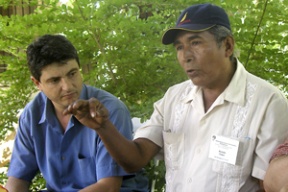
Bernabé Lopez, a lifelong coffee picker in the fields below, remembers taking in that view for the first time in 1983, but it wasn’t the panoramic scene that took his breath away.
“It was unimaginable,†he said. “I was looking at the view but couldn’t believe it. I saw land that was now all ours.â€
Built in 1888, the vast plank and beam plantation building was topped with a high deck that allowed generations of managers to keep watch over tenant farm families like Lopez’s.
Campesinos worked the coffee fields to help pay rent on small parcels that often didn’t produce enough food to support a family’s meager existence.
A wave of radical land reform changed all that, sweeping Lopez up to the plantation’s helm and casting its owner into exile.
Now looking forward to its 22nd harvest, the cooperative has felt revolutionary highs and deep debt lows.
The farmers now thrive under a stable relationship formed with the Bainbridge-Ometepe Sister Islands Association.
The partnership produces fine-crafted organic coffee for Bainbridge Island, top-rung prices for the cooperative and a host of health and education projects for the island of Ometepe.
“With the cooperative we have created a different life for ourselves and our children,†Lopez said. “The relationship with Bainbridge forms not only a large part of our history, but also many positive changes in people’s lives here. Things are good now, but I like to remind other members of the cooperative about the other stories because they are sometimes not adequately moved by what we have.â€
In the fields
Lopez often begins “the other stories†by describing the initial challenge he and other workers faced at the break of every dawn.
“You were expected to bail out of bed and line up at six in the morning,†he said. “If you weren’t there on time, you were told to leave and not come back.â€
Workers weren’t hoping to sleep in anyway, as the tight-packed bunks were rife with fleas and the dormitory’s dirt floor crawled with rats and cockroaches.
So began a long day in the coffee fields, with little respite – even during lunch break.
“For lunch we were given 35 beans, some rice and a boiled (unripe) banana,†Lopez said. “Essentially, that was the food that sustained us for work.â€
Sometimes there wasn’t enough work for the plantation’s pickers, forcing them off-island to find temporary jobs in factories more than 50 miles away.
“In my heart and mind, I was utterly unhappy, but we had no options,†he said. “We were simply a source of labor, of money.â€
Little of that money came back to the plantation’s workers. Earning five cordobas a day – which amounts to about 30 cents U.S. – eight or nine hours of work could buy a pound of cheese in the 1970s.
Much of that pay went back to the landowner in the form of rent for small, dusty plots.
“We were always scratching for survival and had to pay the rent even when the land was unproductive,†Lopez said.
The plight of Ometepe’s farm workers wasn’t unique, fomenting a surge of discontent that was harnessed by the Sandinista movement.
The Sandinistas took their name from Augusto Sandino, a nationalist who opposed the aristocratic social hierarchy in Nicaragua that maintained a broad peasant class under a small but powerful class of landed families.
Sandino waged a guerilla war against U.S. Marines sent in 1909 to depose an uncooperative president and defend American mining and lumber companies operating in Nicaragua.
Revolution
Drawing on Sandino for inspiration 30 years after his death, the Sandinistas rose up against the Somoza family, which had controlled the country after U.S. forces withdrew in the midst of the Great Depression.
By 1979, the Sandinistas had deposed the Somozas and initiated vast economic, social and political reforms direct from Fidel Castro’s playbook.
Fearing the rise of another communist enclave in its backyard, the U.S. quickly began aiding the Contras, a counter-revolutionary force composed of former members of the military.
Ometepe remained largely untouched by the conflict, but the workers of Finca Magdalena suffered nonetheless, Lopez said.
As the fight began to tip in the Sandinistas’ favor, Finca Magdalena’s owner fled to the United States.
Nicaraguan military helicoptors landed at the plantation and armed guards were stationed to prevent the workers from returning to the land.
Without an income source, many of the pickers fished the lake for food or ate wild berries.
“We were living with nothing so we just did whatever we could do,†Lopez said.
The Sandinista revolution eventually crashed against the island’s shore, and the plantation was reformed into a worker-owned cooperative along with many large farms across the nation.
Lopez became the first president of the 84-member cooperative, a position he approached with youthful optimism.
“I had a good feeling about all of us working together,†he said. “We had worked together to build our church and had always worked together as farmers. I felt we could do it again.â€
The Sandinistas brought about many changes Lopez said were unimaginable at the time.
“The revolution had good content,†he said. “It put a lot of faith in the rural people, it more justly distributed the riches of the country, it gave us an opportunity to study, to see a doctor, to get medicine, to get a loan from the bank and it gave us the land to work on. None of these existed before the revolution.â€
The Sandinista government also supplied cargo trucks and farm management advisors and purchased all the cooperative’s coffee at a reasonable price, which it then sold abroad, he said.
Changes at Finca Magdalena mirrored a new nationwide campaign to encourage food production to meet the needs of Nicaraguans and foreign markets.
Between 1979 and 1984, corn production climbed 10 percent, bean production by 45 percent and rice production by 50 percent, according to the Institute for Food and Development Policy in San Francisco.
The domestic consumption of these staples also rose 33, 40 and 30 percent.
The late Edward Bradford Burns, Latin American studies professor at UCLA, observed in 1987 that these achievements reflected new investment priorities in Nicaragua, in which the government was shifting favor from the city to the countryside. According to Burns, capital investment in agriculture leapt 149 percent between 1978 and 1980, with an additional 126 percent boost in in 1982.
But much of this investment was based more on hope than true potential returns that could be independently sustained.
“The government made mistakes,†Lopez said. “The government helped us in many ways but it didn’t show us how to help ourselves.â€
The Sandinistas were bumped from office by war-weary voters in 1990, stripping the cooperative of its guaranteed buyer, advisors and other subsidies.
“We depended on them and had been taken care of,†Lopez said. “That saying is true, that you should teach a man to fish. Don’t just give him fish.â€
Favoring the new government, the U.S. lifted its trade embargo on Nicaragua. The cooperative scrambled to find foreign markets as it registered record losses and saw a $12,500 outstanding loan’s interest swell to 36 percent under the new government.
Many cooperative members threw up their hands and decided to cut their losses. Lopez was given the unhappy task of dividing the plantation, cutting it by two-thirds.
“There were only 25 (people) left, the 25 that are still here today,†he said. “I call this group the optimists. But this was one of the most difficult tasks I’ve ever had to face. How do I lead this small group who have stayed to continue our cooperative?â€
Lopez’s response was straightforward and pragmatic. He went to “talk man-to-man†with each picker, telling them that they’d “just have to work shoulder-to-shoulder, arm-to-arm.â€
But workers pulling double duty in the fields weren’t establishing links with the choice North American and European markets.
Forturnately for the cooperative, that was around the time that Kim Esterberg and a small delegation from the burgeoning Bainbridge-Ometepe Sister Island Association hiked up to the plantation.
They brought with them enough money to purchase every bean from the 1994 harvest and pay off the cooperative’s entire debt.
Lopez smiles as he reaches this part of the story.
“Suddenly there appeared, like a light at the end of the tunnel, the sister island association,†he said. “When this relationship formed, it changed our lives.â€
The series
Review staff writer Tristan Baurick is on a three-week sojourn to Bainbridge’s sister island of Ometepe, Nicaragua. The series began last Saturday with a look at the genesis of the sister island relationship through the eyes of founder Kim Esterberg; it continues this Saturday with the Bainbridge connection to Ometepe coffee.
Also in today’s issue: how support from Bainbridge Island provides scholarships for Nicaraguan students.
On Saturday: the Bainbridge-Ometepe coffee connection is established.