BI commemorates Japanese Americans who were incarcerated during WWII
Published 1:30 am Tuesday, March 31, 2026

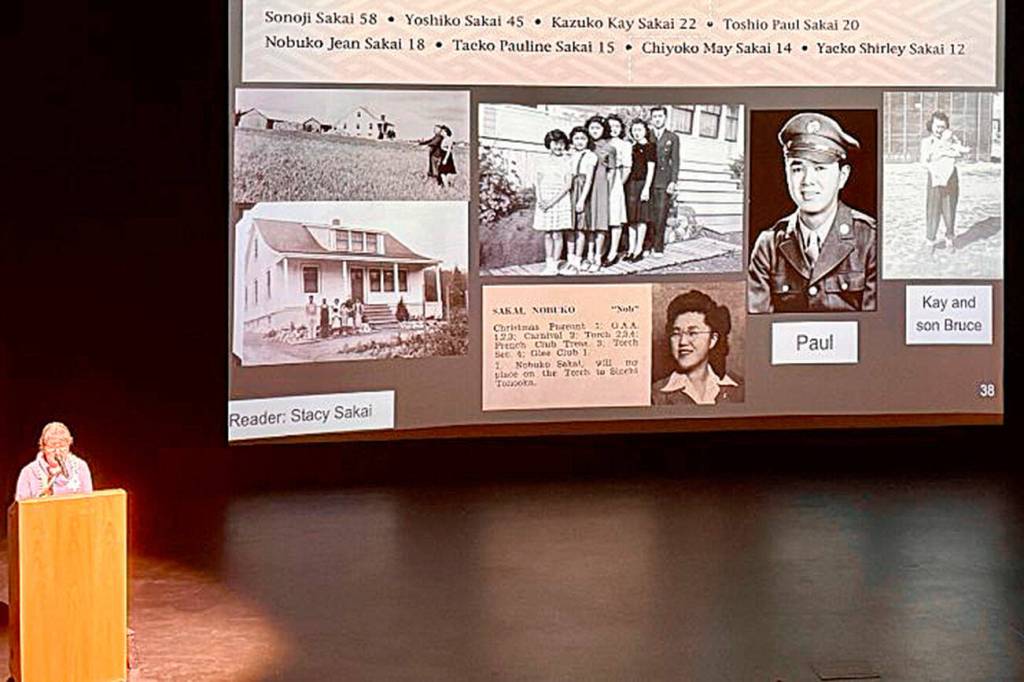


The Bainbridge Island Japanese American Exclusion Memorial Association and the Bainbridge Island Japanese American Community hosted the 84th Anniversary Commemoration Ceremony — “Remember Me” March 30 at the Bainbridge Performing Arts Center.
On March 30, 1942, 227 Bainbridge Island Japanese Americans were the first people forcibly removed from their homes by Executive Order 9066 and incarcerated in concentration camps for three-and-a-half years during World War II. 84 years later, survivors and descendants from 25 of the 51 represented on the Memorial Wall recited their family’s names aloud during a semi-private event.
“By reciting their family members’ names, they are activated. They come alive. It honors the dignity of each name and behind each name is a person. And behind each person is a life story. And behind that life story is a teaching that they leave for us,” said Rev. Duncan Ryuken Williams, a Soto Zen Buddhist who currently teaches at the University of Southern California. He also serves as the director of the USC Shinso Ito Center for Japanese Religions and Culture, alongside researching the mixed-race Japanese (hapa) experience.
Descendants of those who were once removed from their homes returned to Bainbridge Island, but this year, the Ireichō: Book of Names arrived with them. Throughout the two days of the event (March 29-30), 276 names from the Memorial Wall were stamped into the book. The stamp used is a Japanese hanko, placed underneath the name of each individual in the book.
“The stamping is a way to interact with the names, find a way to activate the names, and so I think not passive remembrance, but active remembrance is what you have all gathered here today to do. To voice the names. To recite the names. It is a powerful act of active remembrance,” shared Rev. Williams at the ceremony.
The Ireichō is a traveling national civil rights monument. On Bainbridge, the book was placed in the Museum of Art’s Sherry Grover Gallery, where families stamped the names of WWII Japanese Americans who were incarcerated. The book is also the first comprehensive national record of all 125,284 persons of Japanese ancestry incarcerated during WWII in the U.S. Army, Department of Justice, Wartime Civil Control Administration, and War Relocation Authority camps. Embedded into the very materiality of the Ireichō are special ceramic pieces made from soil from Alaska to Hawaii, Arkansas to California, and from almost every other region of the United States.
Since February 2025, the Ireichō has been traveling across the United States for additional stamping opportunities until every name in the book has received at least one mark of acknowledgement. The book was at BIMA from March 29-30 this year, available to view only by appointment.
The names in the Ireichō are not in alphabetical order, but in chronological order, beginning with names of those who were oldest when taken in 1942, to those who were born in the camps. “The purpose is to distinguish between each person; nobody has the same exact name and same date of birth,” said Rev. Williams. “But philosophically, we wanted to do it that way because we wanted to make sure that we did the opposite of what the government did back in WWII, which was to target a community, and without any due process, without treating anyone as an individual person, they labeled the whole community as a threat to national security.”
As each name was recited aloud at the ceremony, a short description of their story was also shared with those in attendance. Examples of some occupations of the individuals shared included owners of strawberry and vegetable farms, owners of Gig Harbor Market and Bainbridge Gardens, workers at the Port Blakely saw mill, butchers, filmmakers, University of Washington nursing students and more. There were 13 individuals who were students at Bainbridge High School who had missing seats that year for their high school graduation in 1942.
It was also shared that many families returned to Bainbridge Island after the war. The Sakai family ended up donating much of their land to the Bainbridge Island School District, which is where Sonoji Sakai Intermediate School is now located. The Nakata family founded Town & Country Market in 1957. Tadashi Sakuma had a seat on the Bainbridge Island Planning Committee when he returned. The Kitamoto family owned a strawberry farm, and Frank Kitamoto’s father entrusted the farm to a friend and worker, Felix Narte, when they left the island. Upon return, Frank Kitamoto sold one acre of his land to Narte for just one dollar. The Takemotos were the first family to get on the ferry off the island and were also the first family back on Bainbridge as well.
The Suyematsu family owned a berry farm on Day Road, and their farm still thrives today. The Suyematsu Farm Legacy Alliance was organized in 2023, dedicated to preserving and enhancing the living legacy and heritage of Akio Suyematsu and his family’s original farm as a community asset involving a center of active farming, interpretation, and education. On March 30 at the 84th anniversary ceremony, the Rotary Club of Bainbridge Island awarded $75,000 to SFLA to begin the restoration of picker cabins at Suyematsu Farms.
The ceremony took place at BIMA and Bainbridge Island Performing Arts Center due to construction occurring at the Visitor Center at the memorial site. The project is expected to be completed this fall, as concrete and foundation work has been finished, as well as some of the vertical beams for the building.