
SEPA appeal that halted 625 Winslow Way project dismissed
Published 1:30 am Friday, March 27, 2026
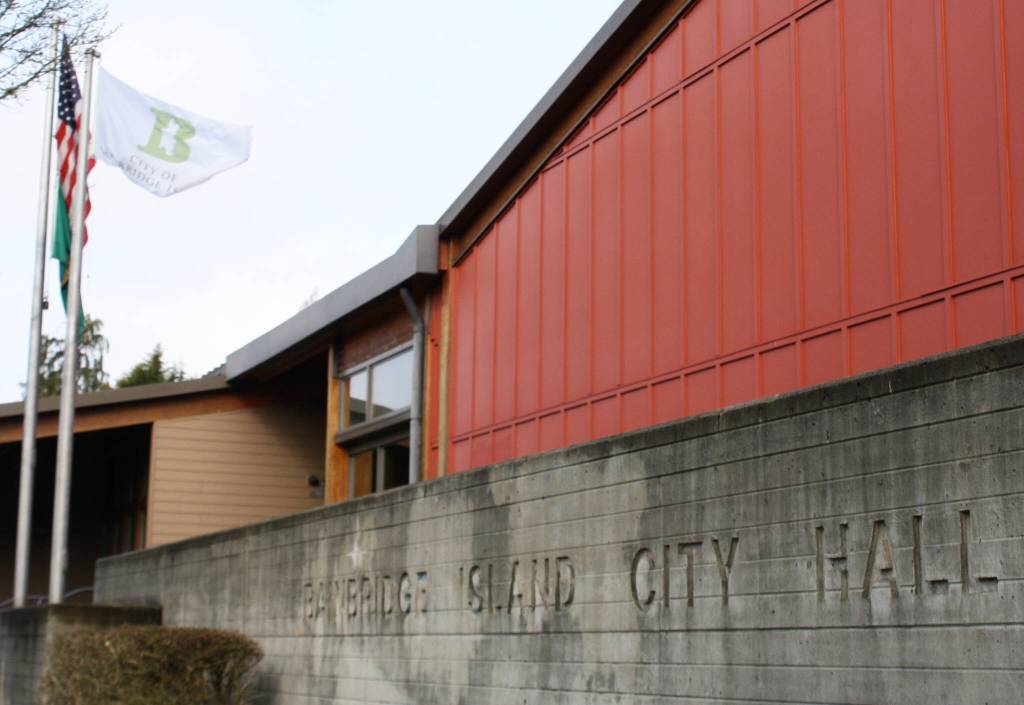
The appeal heard ‘round the island is no more, ending a six-month pause on the saga of 625 Winslow Way, a city-owned property at the center of community discussion about affordability and growth philosophy on Bainbridge Island.
BI’s hearing examiner, Phil Olbrechts, granted the city’s motion to dismiss the case March 26, following seven rounds of multi-hour oral arguments between city attorney Andrew Tsoming and local land use and environmental attorney Bryan Telegin, representing the appellant, BI resident Dawn Janow.
Olbrechts made his determination on the basis of state law RCW 43.21C.495: that appeals of ordinances or development regulations using the State Environmental Policy Act (SEPA), such as Janow’s, are prohibited when an ordinance or regulation implements the housing element of a city’s Comprehensive Plan.
“There’s no reason to twist the simple and clear meaning of ‘adoption’ within [the law] to render it inapplicable to city administrative SEPA appeals. Such a reading subverts the purpose of the statute. [The legislative bill of the law] identified that its purpose was to increase affordable housing options in response to an unprecedented housing crises,” Olbrechts wrote in the ruling. “The appellant’s interpretation of ‘adoption’ results in the exclusion of city and county SEPA appeals from the [purview] of the statute. There’s no reason to differentiate […] Both types of administrative review processes can significantly add to delays and expense in creating affordable housing.”
City staff agreed with Olbrecht’s ruling, explained city communications coordinator Shannon Hays, noting that the ordinance is consistent with the BI Comp Plan. It “supports key goals to expand affordable housing, reduce barriers to development, and encourage a more diverse housing supply,” Hays wrote in an email to the Review.
Janow and Telegin have 21 days to appeal Olbrecht’s decision to the Kitsap County Superior Court. If the case rests, the BI City Council will discuss next steps, including whether to reschedule a public hearing for the ordinance.
Most of the case proceedings up until the March 26 ruling focused on the appellant’s arguments, Hays noted.
“The city did not have the opportunity to fully present its case, as only a portion was heard before the appeal was dismissed. Based on the credible and compelling evidence presented to date, and what we were prepared to further present to the hearing examiner, we are confident the city would have prevailed regardless of the dismissal,” Hays wrote in an email.
In hearings, the main thrust of Janow’s and Telegin’s argument was that city staff had not followed the correct public process while reviewing the environmental impacts of Ordinance 2025-21, and should have included the proposed 625 Winslow Way project, which would bring up to 90 affordable housing units to downtown Winslow.
The ordinance temporarily amended development standards within a small portion of the Ferry District in Winslow, part of a bundle of code updates proposed by the city Planning Commission that aim to raise the density of the wider Winslow neighborhood to support Bainbridge Island’s growth goals, per the state Growth Management Act.
As part of the GMA, BI’s Comp Plan must show that the city is planning for population growth at all levels of income, and supporting housing development accordingly — aiming for around 1,977 units, as allocated by the county. Because most of the island’s current housing stock is in pricey single-family homes, the majority of the new units must be available to people at the lower end of the economic spectrum.
But those units won’t go just anywhere. About 90% of the island falls within a “conservation zone” that prevents higher-density developments. Winslow is the only subregion where density can be increased — and in July 2025, the City Council directed the Planning Commission to concentrate the bulk of growth in Winslow, including by raising density standards in the Ferry and High School Road sub-neighborhoods.
That’s where Ordinance 2025-21 came in.
The proposed law would allow new buildings in Winslow, east of Highway 305 and south of Winslow Way E, to cap out at 65 feet, with a floor area ratio (FAR) of about 3.0 — meaning the total square footage of the building can be up to three times the size of the lot — and reduce parking provisions. However, developers could only take advantage of the code provisions if all the units in a building were designated as affordable housing for households making about 80% of the Kitsap Area Median Income (AMI), or about $79,000 per year for a two-person household. The proposed project at 625 Winslow Way fit the ordinance criteria.
As required by SEPA, local governments must analyze how some decisions, like policies or projects, could impact the surrounding environment prior to their adoption; reviewing not just the local habitat or air quality, but elements like traffic, public services, and utilities.
When the city conducted its environmental impact assessment for Ordinance 2025-21 in fall of 2025, it was ranked a “Determination of Non-Significance” — essentially stating that there would be no major impacts on the surrounding environment if the law were adopted. This did not sit right with Janow.
“They say it’s not project-based, but I mean, those two are intertwined. There is no real question in anybody’s mind about that. So where’s the trust there?” said Janow. “We sat through multiple meetings with the city, just asking all these questions: ‘What about traffic? What about parking?’ Even if the city said, ‘Don’t worry about those things, we have a study to do it’, they didn’t produce any studies. They just said, ‘Don’t worry about it.’ I hear the pro-625 people saying environmental concerns are always what throws these projects off, but we are a community, and why not just answer the questions?”
In response to Janow’s statements, city staff noted that consulting team Heath and Associates performed a traffic study on the intersection in August 2024 for a hypothetical 100-unit building. The study, which has been available publicly online since August 2025, found that the impacts on traffic would not be significant, even during peak commuting hours, particularly because “the purpose of the building is for workers in downtown Winslow to be able to walk to their jobs.”
“It’s important to clarify that the city did not dismiss or overlook concerns related to traffic, parking, or other potential impacts. Rather, we acknowledged that those issues will be evaluated at the appropriate time — if or when a formal development proposal for the 625 project is submitted,” said Hays.
Telegin and Janow scrutinized communications between city department heads like planning director Patty Charnas, senior planner Jennifer Sutton, former city manager Blair King and others to compile evidence for the appeal. They found alleged discrepancies in the order in which documents were created and submitted, as well as correspondence between executive city staff and leadership at the Low Income Housing Institute, the nonprofit affordable housing developer that the city has partnered with for the 625 project.
Janow’s team asserted that other procedural issues arose with more digging, explained BI resident Nora Masters, a retired auditor.
“From an audit perspective, what was sent to the Department of Ecology had no checklist — zero. But the other thing is, there is a requirement that they have a public hearing, or that the public can comment, for 14 days. Only the DNS was available for the public comment period,” said Masters.
Hays responded that public hearings are not required for a DNS, and that by law and regular practice, SEPA checklists are not required to be made publicly available.
City staff maintained that the ordinance earned a DNS because the law itself would not create an adverse environmental impact, as it was not related to a specific project. Measuring the theoretical impacts of a law is a qualitative process, explained planning director Charnas during examination by Telegin, which means the cut-and-dried environmental checklist required by SEPA reviews is not the most useful tool in this context.
“We don’t contemplate projects, per se; we contemplate what the impacts of the development standard would be. I know it sounds like it’s the same thing, but in the absence of having a specific project to quantitatively analyze relative to the changes in the environment, these are more so the impacts of allowing projects to build to that standard,” said Charnas during the hearing.
Regardless, the point is moot, Olbrechts determined in his March 26 ruling.
”Counsel for both parties have focused heavily upon whether Ordinance No. 2025-21 is a non-project action. That issue is irrelevant to the applicability of [state law],” Olbrechts wrote. “There also is no legislative intent that suggests that ordinances subject to [the law] must be nonproject actions […] Practically speaking, the legislative and nonproject classes of decision making delineated by the statute effectively ensure that project-level environmental impacts of specific projects are still addressed under SEPA. Even the project-level impacts of the 625 Winslow project of this appeal will still be addressed if development permit applications are submitted for review.”



Best of Bainbridge