Free U-Pick orchard on BI creates stronger food network
Published 1:30 am Thursday, January 29, 2026

Darren Murphy wants you to eat apples, and not just one a day.
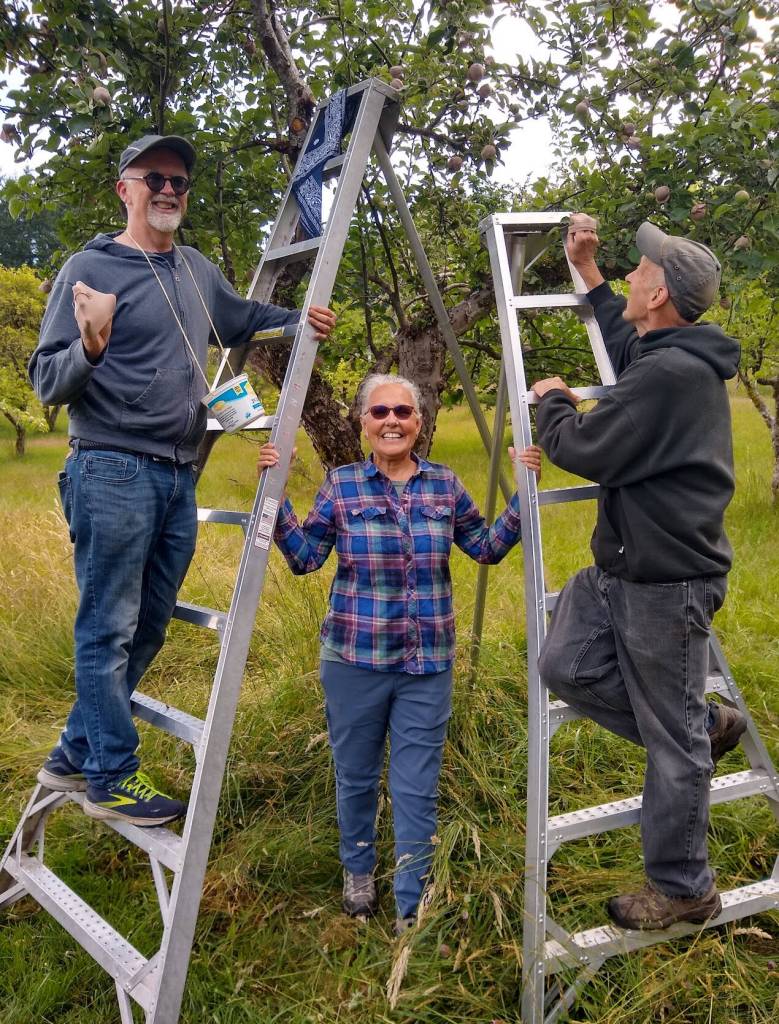
As president of the Bainbridge Island Fruit Club, Murphy is a staunch believer in the benefits of locally-grown, organic produce as a form of food resilience and community pride. That’s in part why the club has revived the historic orchard on the publicly-owned Johnson Family Farm, located off Fletcher Bay Road NE.
There are dozens of varieties of apples, pears, walnuts and plums growing on about 140 trees in the orchard, which anyone can pick and eat for free. Around 70 trees are earmarked as donations for Helpline House.
Even when it was planted in the 1950s, the farmer’s intent for the orchard has been the same: to provide fruit to the community, preserve island history, sustain the practice of fruit tree care and create a stronger connection to agriculture in the public sphere.
BIFC has recently connected with Bainbridge Prepares to serve as a “food resiliency” hub, or a place that can be considered a reserve of food in case of a disruptive natural disaster or a failure of infrastructure.
“Food resiliency goes beyond that, to the extent that if you can grow your own food and if you have your own food available, that’s something that actually adds to the overall mix of food that’s actually been prepared and stored,” said Murphy. “So it’s a combination of factors. It’s fresh produce, having the ability to grow your own food, and then also having stored food that you can then tie into in case of emergency, and you can’t go to the grocery store.”
Food resilience is also necessary when invisible infrastructure crumbles. In October, BIFC had its first-ever bulk fruit donation drive for the BI nonprofit social services and support hub Helpline House, in response to the nonprofit’s call for increased donations after the historic lapse of the Supplemental Nutrition Assistance Program. BIFC members collected 123 pounds of apples, pears, plums and walnuts for the food bank, per its Dec. 16 press release.
It was the first of many donations, Murphy said, and part of the club’s plan to elevate its presence on the island.
“We hope to increase that [donation] volume quite a lot in the future, but right now, that was our big experiment for the year,” said Murphy. “In the next year, I think we’re going to try to be more closely aligned with Bainbridge Prepares and the food resiliency program. We’re going to be expanding our effort to educate the public via grafting workshops as well as our fall fruit show. We’re trying to find venues that might be more conducive to getting a bigger audience than the Grange Hall.”
The Johnson Farm is one of the island’s oldest continuously working agricultural properties, first staked in 1888 by Andrew Johnson. Johnson’s grandsons, Harvey and Clarence Johnson, created the apple orchard on their family’s land after serving in France in World War II and helping to restore forests following the destruction of battle. The brothers planted about 70 fruit and nut trees, and in their later years, they invited the island’s 4-H clubs and BI families to fish in the ponds and use fallow fields for farming practice.
When both brothers passed in 2000, Harvey willed the property to the city to be “conserved for agriculture and public use,” per the Trust for Public Land. The city put the farm’s care in custody of island agricultural organization Friends of the Farms in 2012. Murphy founded the BIFC in 2014, and two years later, FOTF approached the club about restoring the Johnson orchard.
“[FOTF]’s concern was that they have this orchard, and they need to do something with the land. They need (to) at least have someone shepherding the land and not have it basically go fallow, sitting there,” said Murphy.
The nonprofit had heard a proposal from a brewery that was interested in using the orchard’s land as a barley field, Murphy explained, but BIFC saw potential in the old trees.
“Our proposal was to go in there and start working on the orchard, select some of the trees for significant grafting of new varieties,” Murphy said. “The majority of the trees are Red Delicious, or older varieties that might be good for cider or for making juice, but they tend not to be all that popular nowadays, or good tasting, whatever you want to call it.”
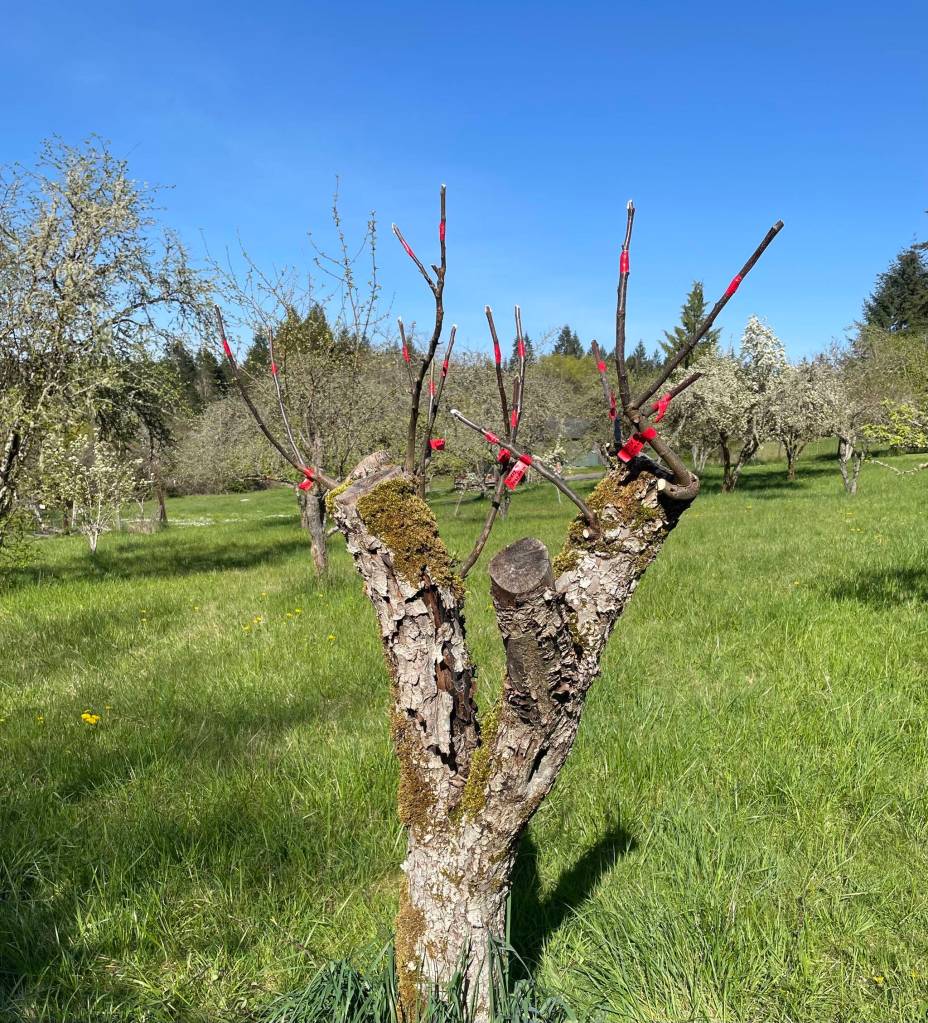
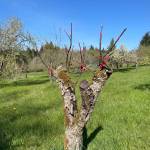
Since taking over about ten years ago, the club has grafted over a dozen new varieties of apples onto about 1/3 of the orchard, or around 70 trees, in a process that involves chopping the tree “down to a stump, basically” and attaching twigs from desired fruit varieties onto the new growth.
Those trees are maintained by BIFC members through pruning, wrapping apples in special pest-prevention socks called “footies,” and harvesting for donation to Helpline.
“Approximately 2/3 is not grafted, (and) has not been fully worked on by us. Those trees, which include some pears, some plum trees, are very available to the public. It’s basically a park owned by the city, so people can come in there and look at the trees, observe them, and pick fruit as it’s available,” said Murphy.
About 80% of the trees are apples, Murphy said, including the hardy yellow transparent apples from Russia, popular Gravensteins, rare Arnett apples, and more. There are also several Bartlett pears, a French petite plum, a Satsuma plum, an Italian plum and English walnut trees.
One of the fruit club’s goals is to have an extended harvest season, where trees produce fruit from spring all the way to fall, but success in one orchard does not necessarily translate to success in another, and finding a resilient fruit that can thrive in the Johnson orchard’s conditions is an ongoing project, Murphy explained.
“We’ve learned from this, because we noticed some of the apples in my orchard, like John Of Gold, that do great and are very clean; in the orchard at Johnson’s farm, depending on the season, can be quite scabby. Even without bugs, even if you put footies on them, they can still get scabs,” said Murphy. “Our goal is to have apples that people would want to pick and enjoy, not look at them and say, ‘Oh, this is yucky,’ and throw it to the ground.”
The BIFC hosts an annual grafting workshop at the Grange Hall on Madison Avenue, and is hoping to attract more permanent members this year, Murphy said. The club continues to work with the 4-H program and has established informational signs at the orchard to enhance visitors’ experience.
Murphy encouraged people with an interest in growing fruit to get involved, for the sake of agricultural history. Genetic diversity in the fruit pool is key to the fruit’s resilience and versatility, he explained.
“If a certain pest or virus comes through and wipes out a number of apple varieties, but maybe three of them survive — these three may not be your most favorable apples as far as taste, but could be the foundation for a new apple strain that would be disease resistant. It’s us hobbyists that actually grow these very eclectic apples,” said Murphy. “Some are fabulous, some are maybe interesting looking, some aren’t very good tasting, but when you cook them, they’re fabulous. Some are great for baking, some great for sauce, some are great for juicing, some are for cider, some are developed for long storage.”