Bainbridge teacher spends spring break volunteering overseas
Published 11:04 am Saturday, May 9, 2015
 After almost 17 hours of flying and three flight changes, spring break started for the Sovicks.
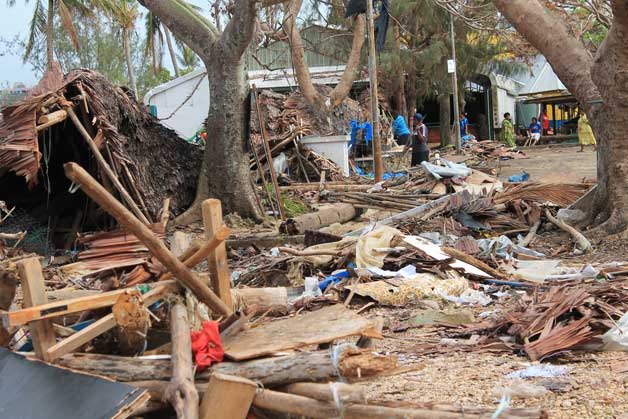
But the view from the sky was far from the pristine shorelines and crystal clear waters that might normally greet spring breakers visiting an island. Instead, as the Sovicks’ plane descended upon Vanuatu, a small island off the coast of Australia, they saw a brown land mass.
A few weeks prior, Cyclone Pam slammed into the island, knocking out power, destroying homes and taking lives.
Vanuatu is the native homeland to Mere Sovick, the wife of Jason Sovick, a Bainbridge High School teacher. The pair decided to spend their vacation helping others recover instead of relaxing on an untouched white sandy beach elsewhere.
“It was completely obvious when we were flying in. It’s really tropical and right away when we got over the island, you notice everything is all brown,” said Sovick. “It’s a long time to sit there. It was emotional.”
Now, back in the States, Sovick and his wife want to continue helping with various rebuilding efforts through their nonprofit organization, Melanesian Women Today. They need to raise $15,000.
The Sovicks had 10 days to prepare for the trip and asked the public for financial help through GoFundMe, an online fundraising site. Within days, the couple received more than $6,000 from donations to go on the trip — through the site and in-person.
Lisa Bernardin, a friend of the Sovicks, didn’t hesitate in donating money toward their trip.
“Everyone feels badly when there is a catastrophe of this nature and we all wish we could do something. Giving to the Red Cross or some large organization is always a good option, but to personally know two super-qualified people who you know will have such a tangible impact made giving that much more meaningful to me,” Bernardin said. “If I can’t be there on the ground helping out, then let me support some great people who can be.”
After hearing that 90 percent of the village blew away, the Sovicks knew they had to pack accordingly.
For safety purposes, they packed water bottles with filters. They also brought dehydrated food that had to be cooked in boiled water before consumption. Much of the farms were washed out by the cyclone, leaving many on the island hungry and forced to rely on canned goods from the market.
“To see that market just empty is really worrisome because where are people going to get their food from?” Sovick asked. “They’re used to eating from the ground. They’re pretty reliant on rice right now. Man, everybody was eating rice.”
From the minute they touched down, they looked for ways to help. They checked into a hotel and made contact with local sources they knew would need their help, including Malapoa College, where Jason worked as a Peace Corps volunteer years earlier.
When he arrived, Jason Sovick found that the school used the same textbooks he had taught from back in 1998. They had never updated the books because there was no money.
“They were resigned to the idea that they take what they can get,” he said.
“They were teaching calculus without a textbook. Oh my God, how does that work? I’m still working with them. Things work a little slow.”
While there, he showed the school’s principal how to utilize Open Educational Resources — free, customizable resources like textbooks — once electronics could be replaced. That will be some time from now, as water covers the floors of the building, including the main assembly hall, which wasn’t in too great of shape to begin with, Sovick said.
Now, he is working on getting funds from his hometown to fix the roof at the college.
By June 1, he should know if the money has been approved for Malapoa College.
“There’s no shortage of work to be done,” said Sovick.
Driving around the island, it seemed the project possibilities for fundraising were endless.
Eratap Village School, which is located about 20 minutes outside of the capital, is also in desperate need of repair. Students are currently meeting inside a church building while locals figure out how to best handle the damaged infrastructure.
“It’s not set up for school. It’s not ideal,” Sovick said of the church location. “It’s a roof over their head.”
Blue tarps cover pieces of missing roof, and water pools on the floors of rooms that have no ceilings. Much of the school that serves kindergarten through eighth grade now sits empty.
And it isn’t even one of the more damaged places, he said.
“The government is maxed out in terms of its budget,” Sovick said. “It barely has a budget to run normally; it’s really kind of scary to get through this first six months.”
With limited funding, the government of Vanuatu cannot help restore Eratap Village School. Other schools are much higher on the priority list.
The lack of support caused the Sovicks to jump into action yet again.
Melanesian Women Today, started by Mere Sovick, is working to raise $10,000 to rebuild the school.
The organization is partnering with Architects Without Borders in Seattle to help the community draw up plans for a new educational center. All that is needed now are the funds, as contractors and materials are already available. The new building will meet earthquake code requirements, Sovick said.
“If people want to donate to us, it is going to build a school,” he said.
Bernardin said she believes the Sovicks will follow through on their promises. After knowing them for seven years, she’s discovered the couple to be “devoted Christians who live out their faith very authentically and practically.”
That’s why it was easy for her to donate to their mission, she said.
“The Sovicks are a wonderful family with strong values and faith that has feet,” she said. “I love that they were positioned so perfectly to be able to make an impact in this part of the world, and I’m so glad I was able to be a small part of it.”
While Vanuatu still needs much repair and aid, there’s hope on the horizon. Tourism is starting up again as many hotels are open and running.
With that news, Sovick hopes travelers won’t be afraid to visit the damaged island.
In fact, Sovick encourages others to vacation on the island. He believes it is the best way to restore the local economy as many depend of the tourism industry to survive.
In the near future, he hopes to return to see the progress and rebuilding of a place he and his wife hold dear.
“It would be cool if everybody went on a vacation to Vanuatu,” he said.
The official Vanuatu travel website is also encouraging visitors, especially Australians.
“Recovery efforts are moving quickly and properties are coming back online and others will continue to over the next few months,” states the Vanuatu Tourism Office Australia website. “The island of Espiritu Santo has not been affected and is operating normally.”
To date, $6.4 million has been pledged since a flash fundraiser appeal on March 24, but more is needed, according to the UN News Centre website.
Want to help?
Visit melanesianwomentoday.org to learn more about Melanesian Women Today’s fundraising projects.