Of publicly funded stadiums, he’s no fan
Published 4:00 pm Wednesday, September 27, 2006
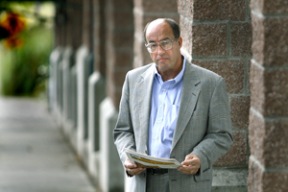
Chris Van Dyk has fought sports facility subsidies for a decade.
Chris Van Dyk never wanted to be a villain.
Before he began a decade-long crusade against publicly funded sports stadiums, he was an investment adviser in Seattle. He enjoyed a quiet ferry commute from his Bainbridge home, where he still lives, to his office in the city because it gave him time to “devour†newspapers.
Then, on a summer morning in 1995, as the ferry chugged eastward, he saw Seattle’s surliest sports hero, Randy Johnson, staring out from the page in front of him. There Johnson stood, a gangly, pock-faced southpaw with stringy locks and a scowl nearly as imposing as his multi-million dollar salary.
Van Dyk thought about the star pitcher’s massive bank account. Then he turned back to the front page, where King County Executive Gary Locke was touting a sales tax that would help pay for a new baseball stadium. The juxtaposition struck a nerve.
“I was irritated,†he said. “Here’s (Locke) saying we need a sales tax increase to pay for a new stadium because the baseball team is in financial trouble. And I’m thinking, ‘how stupid am I?’ People with money pull strings to get what they want. It’s not rocket science.â€
Nonetheless, the articles were sufficient fuel for the fiery Van Dyk, who paid $100 for the chance to speak with Locke at a political fund-raiser the following week.
“I was actually rude,†he said, flashing a toothy smile as he recounted the evening’s encounter. “I was practically tapping on their chests. I said, ‘if this gets on the ballot, I’ll use all the skills I’ve ever acquired to kill it because this is wrong.’â€
It did, and Van Dyk kept his word. Along with friend Mark Baerwaldt and current Seattle City Council President Nick Licata, Van Dyk that year founded the Citizens for More Important Things, a group that unsuccessfully fought the construction of both Safeco and Qwest fields.
Sports, he contends, were not the crux of the issue. Public funding was.
Still, CMIT’s efforts to stop the stadiums failed. Van Dyk eventually returned to the investing world, but through his efforts assumed the dual persona of sports villain and public crusader.
Which title is more apt, he admits, depends on who you’re talking to. And, though he continually tries to deflect attention from himself, the Bainbridge man is once again at the center of what could be a decisive battle.
The Seattle City Council last week voted unanimously to include on the November ballot an initiative organized by Van Dyk that would require the city to receive “fair value†for any publicly-subsidized arena.
The initiative defines fair value as at least the return on a 30-year U.S. Treasury bond, about 5 percent a year Van Dyk said.
If passed by voters, I-91 could thwart the Sonics and Storm, who say they are losing money by playing games at Key Arena and are seeking taxpayer help to build a new arena.
Van Dyk and the CMIT collected nearly 24,000 signatures in support of I-91, which is largely funded by Service Employees International Union Local 775, a union of 28,000 low-wage healthcare workers that is paying Van Dyk to run the campaign.
He has drawn plenty of criticism through the years from those who question his intentions, but says he is what he is and his group’s name says it all; there are more important things than sports, and public spending should reflect that. His goal now is to get that message out.
“I may be a crank and a flake, but I know how to do campaigns,†he said.
Vox populi
Van Dyk got his start as a kid writing speeches for his father, who once ran for the Washington state Legislature.
During the 1970s at New College in Sarasota, Fla., Van Dyk joined several committees and continued to sharpen his political toolkit. He learned as much as he could and developed thick skin to match his Coke-bottle glasses.
After school he moved to Seattle. He had several jobs, but mainly led campaigns until 1986, when he tired of politics and decided to change careers. Though he’s spent a great deal of time as a dissenter, Van Dyk said it isn’t his favorite role.
“It’s easier to be against something than it is to be for something,†he said. “It’s easier to destroy something than it is to build. That’s why I don’t like being against things if I can avoid it.â€
Unless, of course, that building includes public contributions to sports facilities.
Even as the Mariners lobbied for their new stadium, the Seahawks had begun cursing the Kingdome, a facility shared by both teams.
When Seahawks owner Paul Allen wanted public money to build a new football stadium, Van Dyk again dug in, and again came up short.
But in many ways, he said, both campaigns were successful.
“We were characterized as having lost both times,†he said. “But in the case of Safeco Field, we didn’t lose the election, we lost in the legislature.â€
Without CMIT, Van Dyk believes taxpayers would have been stuck with cost overruns at Safeco Field. He also said the group brought to light many issues with Qwest Field that might have gone unnoticed.
The CMIT went dormant until 2005, when the Sonics began seeking funds to either renovate Key Arena or build a new facility.
Talks between the city and the Sonics’ ownership group, led by Starbucks Chairman Howard Schultz, eventually stalled, leading to the sale of the team in July.
Because the new owners have ties to Oklahoma City, where a new arena was recently built to lure a pro sports franchise, there has been speculation that the team could leave town if an arena deal isn’t reached in the Puget Sound area.
The Sonics lease with the city expires in 2010.
Van Dyk, who has dealt personally with both ownership groups, said he believes the Sonics will remain in Seattle. And he’d be fine with that, as long as the public doesn’t have to foot the bill.
“The Sonics have a positive community impact,†he said. “But they’re not necessary or constitutionally mandated for the preservation of the health and welfare of the city of Seattle. We’d be fine without them.â€
Others disagree, saying that sports teams generate millions of dollars in revenue for surrounding businesses. In addition to that, they say, the cultural value of the Seattle sports teams are immeasurable.
As for the debate over a proposed NASCAR track near Bremerton, Van Dyk said he’s stayed mostly on the sidelines, though he lauded the efforts of groups opposed to that project.
“No matter what the issue, there’s a chance you’re not going to be right,†he said, before a burst of laughter rippled through his next sentence. “I suppose for some people that probability is greater than it is for others.â€
As is the probability of being a controversial figure like Van Dyk, who more than anything is tired of the sense of entitlement that he says is displayed by so many people in professional sports.
He would like to see the formation of some kind of national entity that would regulate sports owners across the country who, in his view, ask too much of the cities in which their teams play.
“They believe they have some God-given right, that they’re owed some sort of fealty,†he said. “Well, I would use a different f-word.â€
Despite his bluntness and sometimes flippant use of profanity, Van Dyk has managed to remain afloat in his current venture as owner of Bainbridge Media Group, a public relations firm that, not surprisingly, often works for politicians.
“I admire politicians,†he said. “Whether you agree or disagree with them, it takes no small amount of goodwill to sit in a room and be called every name in the book.
“But at the end of the day, you’re going to take a vote and one side will keep on screaming.â€