Learning comes into new focus
Published 9:00 am Saturday, August 27, 2005
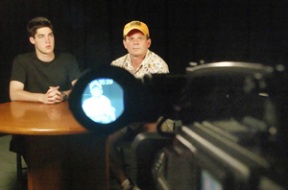
Through the camera’s eye, Scott Schmidt and Peter Rallis sit at a talk show-type round table against a black backdrop, but an annoying reflection of a studio light mars the image.
John Kersten and Eric Debarros try holding a black screen at different angles in front of studio lights to find the offending light and block it, but it remains elusive.
After a few minutes, Schmidt, the students’ Bainbridge Island Television instructor, takes the screen and shows them how moving it around just a foot from the camera lens will quickly find and eliminate the “camera flare.â€
It’s day two of the advanced field production class at BITV.
“(This class) goes more in depth on the technical side of production,†Schmidt said. “How to create the right feel to draw in the audience, using technique to help enhance the story.â€
BITV channel 12, the local public access cable station, is taking a big step forward this year, reaching out to the community to make movie making and storytelling more accessible to individuals and nonprofit organizations.
That access begins with classes in video shooting and editing basics and extends to advanced editing techniques and learning about lighting, audio and “grip†– the non-electrical equipment used at a shoot.
Unlike in the past, a mere $1,000 is enough to purchase equipment to shoot video and edit, said Schmidt, BITV’s executive director.
But with classes or certification under their belt, students qualify to cheaply rent BITV’s camera equipment in exchange for providing finished programs to air.
Islander Alex Van Gelder, a 10th-grader, signed up for the current class having learned camera basics from BITV a few years ago.
Last year he did a year-long independent project in filmmaking at school. Using borrowed equipment, he shot five hours of video and edited it down to a 10-minute film short, “The Sphinx,†now playing on BITV.
The film is based on an excerpt from a book by Terry Pratchett, whose other works he plans to adapt for the screen.
BITV classes were limited by staff size last year to just a few, with only one or two students in each one. This year, Schmidt and production coordinator Jeff Antilla teach two full classes a month with up to six or eight students.
Day one of the field production class, students learned audio techniques which use a number of mics to pick up different sounds and mix them, bringing up or filtering out sounds.
A “shotgun†– a mike suspened from a boom pole – will pick up dialogue as well as ambient noise like a car passing or bird chirping, which a mic on a lapel would not.
Today, the students are learning about lighting.
“Lighting is the most challenging,†BHS junior Eric Debarros said.
“You don’t know where a shadow will come in,†added junior Peter Rallis, who hopes to help his father’s friend make a promotional DVD.
Schmidt comments approvingly of Debarros and Kersten who noticed that the light was appearing more brightly on Rallis than Schimdt, so set up a scrim – a white screen that filters light without casting a shadow – to lessen the light’s intensity on Rallis.
The on-camera image is checked on a highly color-accurate, 8-inch monitor – its size belying its $1,500 price tag – that was adjusted by the young filmmakers at each shoot’s start.
The classes are kept deliberately hands-on and small with a maximum of six in this one so computers don’t have to be shared.
“They’re based on workshops I’ve taken, very similar to a preliminary film school class,†Schmidt said. “They’re far more involved than a theoretical class.â€
On final day, students will go “into the field†to practice setting up shots at the library, the Pavilion and other downtown locations while also dealing with issues such as finding electrical outlets and not impeding the normal flow of pedestrians.
Schmidt’s emphasis on practical learning comes from his own experiences learning on the job from professionals. He started a video company within the department of a larger company. With the success of the organization, he was able to hire good crews and learn from them. He was director and producer for 40-50 programs a year, including commercials and PBS programs.
Now 20 years and more than 500 productions later, Schmidt is passing on what he’s learned to all who are interested.
The Bainbridge Island Senior Community Center is taking up BITV’s offer to nonprofits to put two of its members through classes, which will allow them to rent BITV’s cameras and film BISCC events and educational programs, such as expert speakers on timely and relevant topics.
“We’re looking at it as a way for people to see the variety of things we do at the senior center,†BISCC Executive Director Jane Allan said. “It’s outreach to the community to see what we do.â€
Going forward, Schmidt says the station will continue its emphasis on youth outreach. Partnering with the Bainbridge Island School District, three or four BITV classes will be accredited with Bainbridge High School and should attract 50-70 students.
“Kids pick up video like it was second nature,†Schmidt said. “It’s not intimidating, it’s a way of communication for them.â€
All of the BITV classes are open to youths and adults.
“We’re trying to be a portal,†Schmidt said. “Empowering the community to tell their own story.
“That’s the essence of community TV.â€
* * * * *
And…action!
BITV introductory classes are:
Movie Making Workshop — A 12-hour class that teaches the basics of shooting and then editing in iMovie, concluding with a finished short film to air on BITV.
Classes are eight hours on a Saturday plus one four-hour session on a weekday night preceding it. Next classes are: Sept. 24, Oct. 22, Nov. 19 and Dec. 17.
Final Cut Pro I — How to edit footage and add all the components to finish a film. Classes are on Oct. 8, Nov. 12 and Dec. 3.
Classes cost $150-300 each. For more information, call BITV at 780-2980 or visit www.bibonline.org.
Alex Van Gelder’s “The Sphinx†can be seen on BITV channel 12 at 1:15 p.m. Aug. 27, 5:05 p.m. Aug. 29 and 5:35 p.m. Aug. 30.
See the BITV listing on the Calendar page of the Wednesday edition of the Review for other times.