The wing wherewith we fly to heaven
Published 1:00 pm Wednesday, March 2, 2005
Thus didst the Bard describe ‘knowledge,’ which the humanities inquiry brings anew.
Brush up your Shakespeare, the Bard’s been sighted on Bainbridge.
Stratford-on-Avon is a Northwest island this month, thanks to the fifth annual Bainbridge Island Arts and Humanities Council’s Humanities Inquiry.
Eleven events ranging from musical comedy to erudite musings, give islanders a multidisciplinary chance to see why Shakespeare still matters today.
“I admire him tremendously,†said inquiry organizer Kathleen Thorne. “His use of language – it’s intimidating. When he says something, you look at it and you think, ‘that’s the best way that could possibly be said.’â€
Shakespeare’s accomplishments were all the more remarkable, Thorne notes, because “there was nothing in his education or family heritage that would suggest that he would rise to be what he has become,†400 years later, not just a cultural icon but a still-vital force.
Besides savoring Shakespearean language in film and performance, audiences can eat the food that Shakespeare ate, hear Renaissance tunes and discuss the issues that were uppermost in the minds of his Elizabethan contemporaries.
But anyone who goes looking for Shakespeare also finds layers of interpretation, as each generation has drawn from that rich oeuvre what was most relevant to the particular era. An interpretation of “Othello†for an Abolitionist audience circa 1860 can’t be the same play witnessed today, while the Hamlets of Lawrence Olivier and Mel Gibson are distant cousins, at best.
Shakespeare’s lines have been spoken on the bare stage, in contemporary clothing, even from actors suspended on swings. Yet it’s the author’s ability to plumb the depths of human character that still speaks to us – and if reading and understanding what Thorne terms “a majestic use of language†takes some effort, the time is well spent.
“I don’t feel like we revere the really proficient use of language in society today,†Thorne said, “the really in-depth use of language.â€
By contrast, award-winning educator Harvey Sadis uses Shakespeare to teach everything from history to math to his second-grade students. Sadis will demonstrate March 26 how the Bard can illuminate elementary school studies.
“His students are immersed in Shakespeare for the entire year,†Thorne said. “They do a full-scale play at the end of the year.â€
Thorne conceived the first humanities inquiry five years ago, a memorable, three-month-long series examining American popular culture. Since then, subjects have ranged from science and technology to the media. This year’s focus was chosen, in part, to provide more opportunities to include the arts.
“We wanted a topic where there’s more room for multi-disciplinary approaches,†Thorne said, “a little more room for music, dance, poetry and theater.â€
Theater plays a major role in “The Bard on Bainbridge†with a newcomer to the inquiry, Bainbridge Performing Arts. The mainstage production of “Kiss Me Kate†that opens this week offers a play-within-a-play, as a 1940s theater company presents “The Taming of the Shrew.â€
Two couples feud onstage and off, framing the Shakespeare comedy about the war between the sexes. The show, which many consider Cole Porter’s best, is studded with a glittering roster of tunes, including “Another Opening, Another Show,†“Wundebar†and “Too Darn Hot.â€
A serious application of Shakespeare to the headlines of today is the subject of Steven Marx’ lecture, “The Political Shakespeare,†on March 20. An English professor who specializes in Shakespeare studies at California Polytechnic State University, Marx analyzes “Henry V†and “Troilus and Cressida,†both plays that take place in times of conflict.
“These are the two plays in which Shakespeare really looks at war,†Thorne said. “He contrasts wars of choice and wars of necessity…and I think that’s really pertinent to what’s going on today.â€
In the end, it is Shakespeare’s delineation of moral choices that attracts her to his work, Thorne says.
“The plays that I really like the most are the ‘big’ ones: “Hamlet,†“Macbeth,†“Othello†and “(King) Lear,†she said. “I think why Shakespeare is still resonant is that he draws this line between good and evil. He shows us how easy it is to fall over that line, to cross that line, and how disastrous.
“In the soliloquies his characters give after they’ve done these things, they don’t excuse themselves,†she adds. “And Shakespeare doesn’t excuse them because of historical events, or because of passion. Or a bad childhood or ill advice. Ultimately, they make that decision.
“It’s scary for us to admit that all of us could cross that line. Shakespeare awakens that self-examination in all of us.â€
* * * * *
The Bard on Bainbridge
The Bainbridge Island Arts and Humanities Council’s 2005 inquiry, “The Bard on Bainbridge,†runs through April 2. For a full schedule, see www.artshum.org. Selected events include:
• Cole Porter’s “Kiss Me, Kate†appears at the Playhouse March 4-6, 10-13, 17-20.
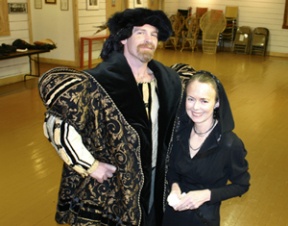
• An Elizabethan Banquet is at 5 p.m March 6 at the Filipino-American Community Hall. Guests are encouraged, but not required, to come as their favorite Shakespeare character or dress in Renaissance attire. Seattle Shakespeare Company supplies Queen Elizabeth I and her advisor, Lord Burghley, who engage the audience in a discussion of Elizabethan concerns. Bainbridge-based Early Music group, Arundel Consort, plays throughout the evening and Seattle’s Ravenrook, Ltd. caters from authentic recipes while entertaining with magic, dance and song. Dinner is $45 for BIAHC members; $50 for nonmembers. Reservations are required, deadline is March 2; call 842-7901 or email admin@artshum.org.
• Poetry Corners Exhibition: Shakespearean Sonnets. Bainbridge poets’ Shakespeare-inspired sonnets are on display in Winslow venues through March.
• “Our Shakespeare: Creating the Bard,†a Chautauqua-style lecture by Sandra Ellston, 3 p.m. March 12 at Island Center Hall. Tickets are $10 for adults; $5 for seniors and students at the door.
• Island Theatre gives a free reading of Amy Freed’s “The Beard of Avon,†7:30 p.m. March 19 at the library. Call 842-1301 for information.
• In “The Political Shakespeare,†Steven Marx discusses Shakespeare’s take on leadership, loyalty, power and war, at 4 p.m. March 20 at library.
• “Shakespeare in the Classroom,†at 2 p.m. March 26 at the Bainbridge Commons is a demonstration by Cascade Elementary School teacher Harvey Sadis of his use of Shakespeare to teach. His students perform scenes from “The Comedy of Errors.â€
• Free screenings of Shakespeare-based films selected by an online vote are at 10 a.m. March 19 and April 2 at Bainbridge Cinemas.
• BPA theatre school students present an adaptation of “Macbeth,†March 31-April 2 at the Playhouse. Call 842-8569 for times, tickets.
• “Seattle Shakespeare Company: Shakespeare’s Top 10†Professional actors perform a one-hour introduction to Shakespeare’s plays in Bainbridge schools. Dates, schools and times TBA.