WSDOT working toward final design of 305/High School Rd roundabout
Published 1:30 am Monday, April 6, 2026
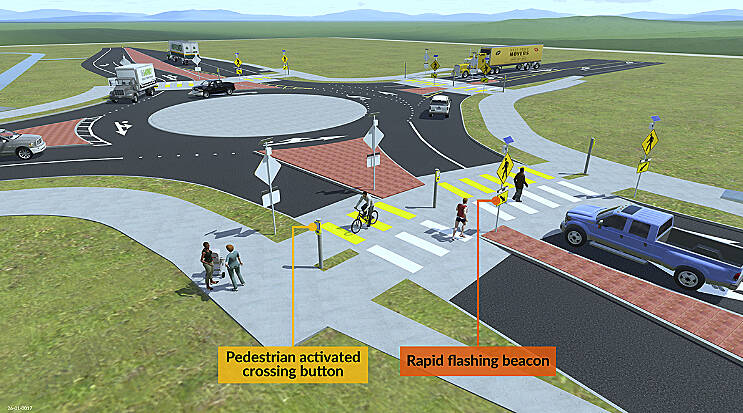
The Bainbridge Island City Council received an update March 31 about the predesign work for the proposed High School Road and Highway 305 roundabout.
Following an in-person open house held Feb. 11 at Woodward Middle School, the state Department of Transportation reported 150 attendees and 67 submitted surveys. WSDOT also hosted an online open house from Feb.2 to Feb. 20 and reported 4,863 page visits and 1,173 comments.
“We are making good progress on incorporating the public comments that we received. We’re not done yet. We’re still sorting through the comments, and our pre-design team is working to get us to a place where we have a final conceptual design,” WSDOT Olympic Region administrator Steve Roark said.
Several common concerns WSDOT officials have received through their public engagement efforts include: a perceived lack of need, ferry traffic, queue backups/ gridlock, and safety for pedestrians and cyclists.
Council voted in favor of directing interim city manager Ellen Schroer to draft a resolution opposing the roundabout. Mayor Clarence Moriwaki was the sole no vote.
“It would have been nice to allow my thoughts to come in before (Councilmember Mike Nelson’s) motion. I just chair the meeting, and I’m following what the council wants, and that’s all I can address right now. I feel like I missed an opportunity, and I just want to say that. So for that reason, I’m opposed to the motion,” Moriwaki said.
Schroer, in collaboration with city staff, will bring back a resolution to council for discussion and possible adoption. The resolution aims to alert WSDOT about where the council stands on the project, city communications coordinator Shannon Hays said.
Nelson asked if WSDOT is required to go through with the project, sharing the negative community sentiment around the project.
“We’re obligated to address safety issues on the state highway system that are directed to us by RCW and by the legislature. So it’s not optional,” Roark said.
The state legislature determines the WSDOT budget, which the agency then executes. The budget is primarily broken down into two categories: capital improvement projects and preservation projects. The I2 safety program is part of the improvement program and the funds are dedicated to safety improvements, Roark said.
“We do have corridors that we look at, but most of our safety money is usually focused on intersections because that’s where the most crashes are. And there’s a couple things we look at; the frequency of crashes and the severity of crashes,” he said.
“I2 funding is dedicated to safety improvement projects. It is separate from the money set aside for other roundabouts on (Hwy) 305,” per WSDOT presentation materials.
WSDOT determined a roundabout was recommended as it aims to reduce accidents.“A roundabout was recommended as it will reduce the frequency and severity of all targeted crash types. It will also improve connections for active transportation users,” per WSDOT.
Transportation officials assert roundabouts can reduce overall collisions by 37%, a 75% reduction in injury crashes, a 90% reduction in fatal crashes, and a 40% reduction in pedestrian collisions, based on data from the Federal Highway Administration, Roark said. “It aligns very well with the anecdotal data and the data that we collect. We are the central repository for crash data in the state of Washington, and I can say with certainty that we see phenomenal results in terms of the reduction of crashes and the severity of those crashes for all modes of transportation at roundabouts.”
Councilmember Lara Lant asked if WSDOT is able to evaluate if a project serves its intended purpose after construction is completed.
Roark said the agency will draw upon previous projects and apply the learnings to future projects. However, WSDOT doesn’t typically have extra funding after the completion of a project, adding, “Once we’re done with the construction project, we don’t generally have funds to come back in and modify it…to make repairs, yes, but not to modify the scope,” he said.
Councilmember Brenda Fantroy-Johnson said she felt the information WSDOT officials presented to council acknowledged community concerns but didn’t address them or provide other options.
WSDOT intends to conduct a preliminary engineering and environmental review likely in 2027, with construction likely in 2028.
Council also received updates on a planned bike box at the corner of Winslow Way and Hwy 305.
The city and WSDOT are also working on a project to take the former right-turn-only lane on Winslow Way and add a bike box. WSDOT Olympic Region traffic engineer Sarah Ott said they are hoping to complete the project later this year, most likely after the FIFA World Cup this summer. As part of the project, WSDOT intends to relocate the ferry traffic signals further north, allowing for separated and spaced signal indicators.
WSDOT has previously received community concerns, including: about ferry traffic blocking the intersection, drivers line cutting, and confusion for drivers when making a right turn. In 2024, WSDOT implemented the right lane dedicated to a ferry-only lane, which included adding signs and pavement markings. WSDOT also worked with mapping apps such as Google and Waze to update navigation instructions. The work aims to provide clarity of movement, Ott said.
Hadley Rodero, a member of the Washington State Ferries external relations team, provided an update on preparations ahead of the FIFA World Cup this summer.
WSF has budgeted for 24/7 contract security at the Bainbridge terminal both during and in between games in Seattle. Washington State Patrol plans to increase staffing to ensure troopers are at terminals and aboard vessels on game days. WSF also hired additional Puget Sound Executive Services off-duty officers providing traffic control.
“We’ll have an additional three officers for the entire 22 day duration of the World Cup there to help provide traffic control, both at the Winslow Way intersection, but also further down by the terminal, anticipating a lot of unfamiliar ferry riders and vehicles coming through the intersection, and just to help keep things moving as quickly as possible as we anticipate heavier loads,” Rodero said. We’re going to have our Emergency Operations Center activated on all game days with a direct tie-in to other regional (EOCs), and we’ll also have a direct link to Bainbridge’s emergency services through that, so we can react really quickly on game days, as well as provide support to our frontline employees.”
WSF also anticipates having 20 of 21 vessels available, allowing two spare vessels to be staged at Eagle Harbor in the event a ferry breaks down. Rodero said WSF also will have additional crew members at Eagle Harbor and throughout the system ready to replace crew members in an effort to maintain service, something Rodero said isn’t something they normally do.