Less trash, more strawberries
Published 12:00 pm Friday, April 20, 2007
Voyager Montessori School earns an Earth Day award for its
sustainable practices.
One by one, the two dozen students of Voyager Montessori Elementary School upturned trash bags into Renee Kok’s waiting hands.
Twenty-four hours worth of paper towels, food wrappers, bread crusts, crumpled aluminum, tooth floss and milk cartons tumbled into piles as Kok, the school’s director, sifted through the debris and tallied up the weight.
“In September we had 6.6 ounces per person,” she said. “Today, we have 1.3 ounces per person. What do you think of that?”
The kids let out a raucous cheer.
“I had no garbage!” boasted one.
“It was a much lighter load,” said another.
“And I feel a lot better,” added a girl with a beaming smile.
The Friday morning show-and-tell is just one earth-friendly lesson that helped Voyager win Kitsap County’s 2007 Earth Day award for outstanding achievement in environmental education.
“Voyager doesn’t teach one day’s lesson about the environment,” said Colleen Minion-Pierce, who administers the awards program for the county’s public works department. “They do it every day.”
The school will receive special recognition and an award at the county commission’s meeting on Monday.
“For me, this recognizes the work we’ve accomplished this year,” said Kok. “We designed a lot of hands-on opportunities to learn and make the world a better place.”
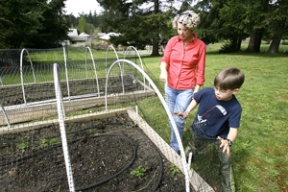
Voyager, a private school on High School Road, recently enlisted students into an ambitious recycling, composting and gardening program.
Students in September and April gathered all their personal trash in zippable plastic bags over 24-hour periods. This project and other efforts to reduce landfill-bound waste cut trash levels by almost 80 percent.
After every lunch break, kids collect food scraps for a fermentation-based composting process that breaks down everything from vegetable bits and banana peels to meat, dairy and bone. They add yeast, lactic acid and algae to aid in the composting process.
After two weeks, the mixture is added to the school’s pesticide and herbicide-free blueberry bushes, fruit trees and garden beds.
On Fridays, students weed and maintain the plants, producing lavender sachets as fundraiser gifts and herb mixes for Thanksgiving turkeys.
The school recently added rows of Marshall strawberries, a variety with a long history on Bainbridge and the 3.5 acre property on which Voyager sits.
“You can still see how the land is choppy from the rows of strawberries that grew here in the ‘30s,” Kok said. “We wanted to honor the Oyama family that farmed here so we planted strawberries in the exact same location.”
Daniel Nathan, a Voyager third-grader, often pokes around the strawberries at recess. This week, he found a cluster of strange-looking mushrooms that had popped up near the young plants.
“I have fun in the dirt,” he said. “I like it because you find things that are cool and weird and gross. I like gross things.”
While well versed in the history of the Marshall strawberry, Daniel prefers to talk about their culinary prospects.
“I bet they’ll taste pretty good,” he said. “But I don’t want to just pick them and eat them, because I think they’ll be very good in a pie.”
Daniel rushed off to the school’s wooded area where he and his classmates were erecting a fort replete with a fir bough roof and walled courtyard decorated with transplanted shrubs.
Allowing kids to frolic in what amounts to a small forest instills a greater sense of appreciation for the environment, said Kok.
“A lot of kids today have ‘nature deficit disorder,’” she said. “They’re rushing off to soccer practice or working in front of a computer screen. We want to give kids a first-hand experience so they know what they’re protecting.”
Established in 1996, Voyager’s four teachers serve 24 students in grades 1-5. As a Montessori-affiliated school, instruction is experience-oriented and often individually tailored for students.
In addition to gardening and composting, students learn to use public transportation to reduce vehicle emissions, collect and send seeds to Ethiopian farmers and participate in role playing games that teach lessons on how ecosystems work.
The signs of spring hint that many classroom lessons will soon spill out-of-doors, said fifth-grader Charlotte Rosen.
“It’s Earth Day tomorrow and that means we get to plant more stuff,” she said. “That’s fun because we come out of class and it lets us stretch our legs and go in the yummy garden.”
Her friend Mallory Shea is quick to point out that these lessons also have a deeper purpose.
“And we get to learn to make the earth clean and beautiful,” she said.